
PriorLabs' TabPFN-3 Beats Every Tuned Model on Tabular Data 20x Faster
PriorLabs releases TabPFN-3, a tabular foundation model that beats 8-hour AutoGluon runs in a single forward pass and scales to 1 million rows
Takeaways
- TabPFN-3 released: PriorLabs published a technical report for TabPFN-3, now the default model in the TabPFN library.
- Benchmark-topping performance: A single forward pass beats all tuned and ensembled baselines on TabArena, including 8-hour AutoGluon runs.
- 1M row scale: Scales to 1 million training rows on a single H100 via reduced KV cache and row-chunking, up to 20x faster than TabPFN-2.5.
- Thinking mode: TabPFN-3-Plus (Thinking) uses test-time compute scaling to beat non-TabPFN models by 420 Elo on the largest data subset, 10x faster than AutoGluon extreme.
- Broader data support: New gains on time-series, relational, and tabular-text data; SHAP computation is up to 120x faster with KV caching.
- SAP acquisition context: SAP announced plans to acquire Prior Labs with over €1B investment, with Prior Labs continuing to operate independently.
TabPFN, the foundation model for tabular data from PriorLabs, just got its most significant upgrade yet. The team published a technical report for TabPFN-3, which is now the default model in the library. The headline numbers are hard to ignore: a single forward pass beats every other model on the TabArena benchmark, including tuned and ensembled baselines, and the model is up to 20x faster than its predecessor.
The problem TabPFN solves
Most tabular ML workflows are a grind. You pick a gradient-boosted tree, tune hyperparameters, engineer features, and run cross-validation. Most machine learning inside companies is not about writing poems or generating images. It is about deciding whether a borrower is risky, whether a machine is likely to fail, whether a patient needs follow-up, or whether demand will move in a certain direction next week. Those problems live in tables. TabPFN attacks this by being a pre-trained model that already knows how to handle tabular data , you just hand it your dataset.
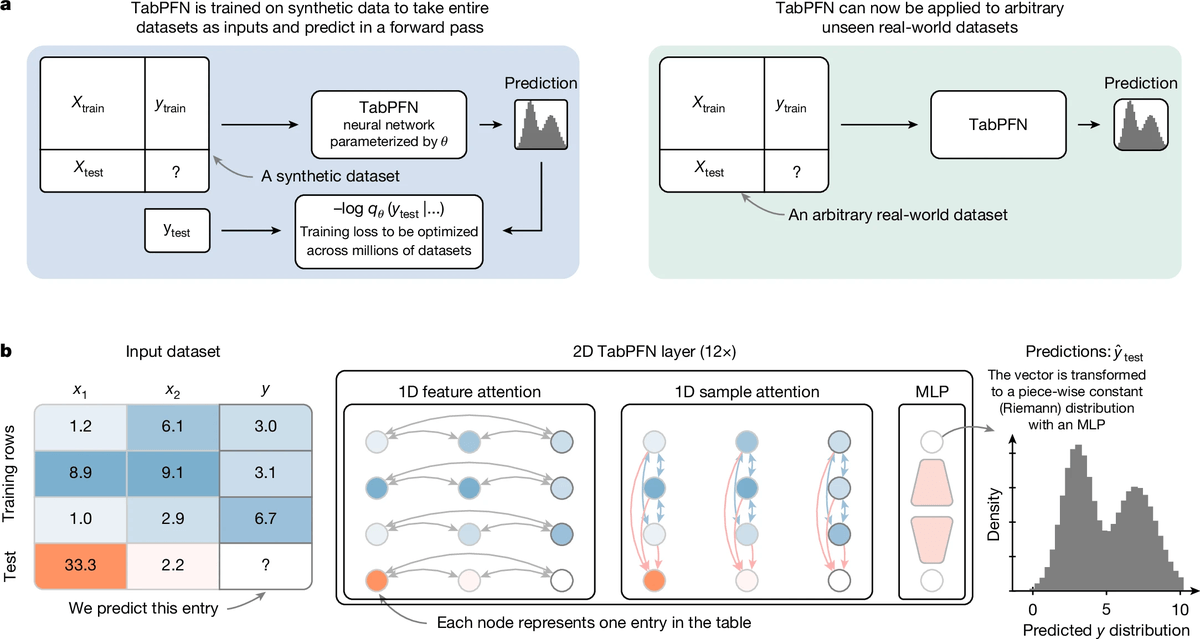
As a Prior-Fitted Network, TabPFN is not trained on the user's data. Instead, it is pre-trained on a vast number of synthetic datasets generated from a broad prior over structural causal models, thereby learning to mimic Bayesian posterior-predictive inference. In plain terms: the model learned a general theory of how tabular data behaves, so it can make good predictions on your specific dataset without ever seeing it during training.
How it actually works
Its architecture assigns a unique representation to each table cell, then employs a two-way attention mechanism: each cell attends to other features within the same sample (row-wise attention) while simultaneously attending to other samples within the same feature (column-wise attention). This design makes the model invariant to permutations of both rows and columns , a critical property for general-purpose tabular data analysis.