
Rice Student's XLeRobot Builds a $660 Dual-Arm Robot in 4 Hours
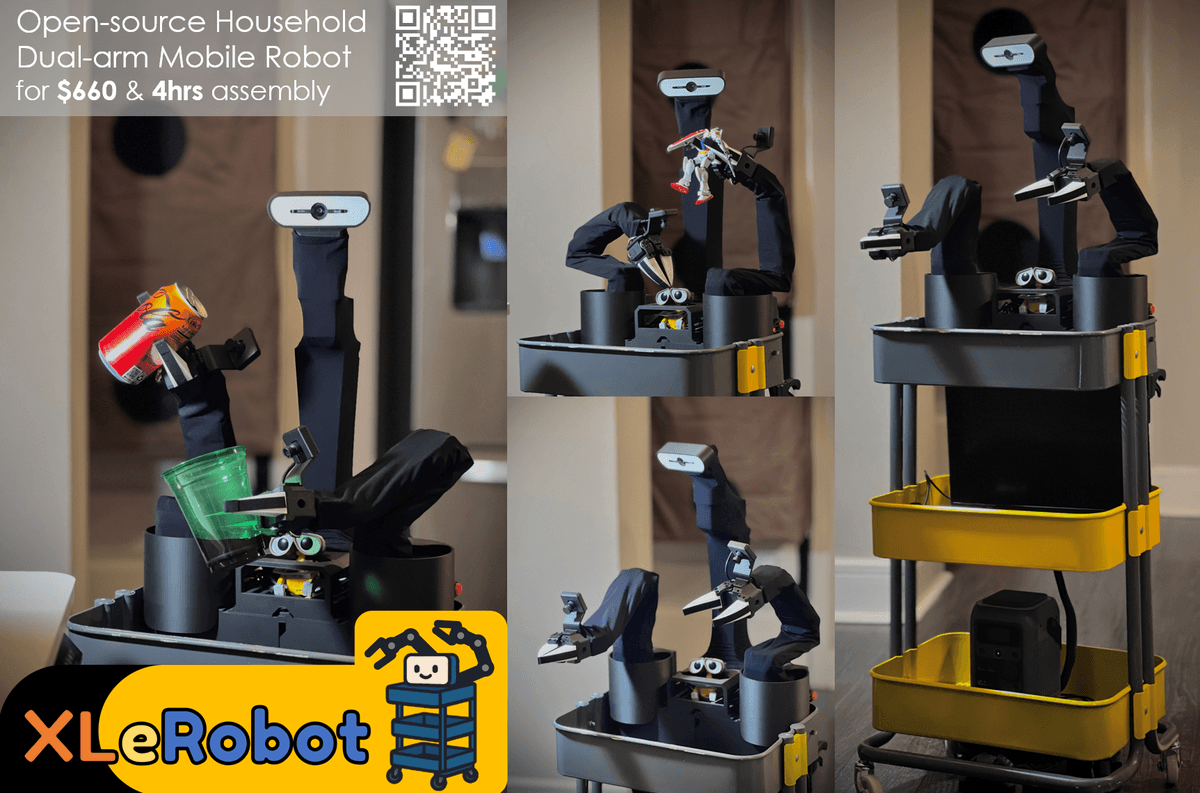
XLeRobot is a fully open-source, dual-arm mobile robot you can build at home for $660 and under 4 hours, with full Hugging Face LeRobot AI integration.
Takeaways
- $660 dual-arm mobile robot: XLeRobot is a fully open-source, buildable-at-home robot with two 5-DOF arms on a wheeled IKEA cart base.
- Under 4 hours to assemble: 90% 3D-printed parts plus off-the-shelf components; assembly kit also available from Wowrobo for $579.
- Full LeRobot/Hugging Face integration: Plug-and-play access to VLA models, datasets, and a 10,000+ member community with no code changes needed.
- Multiple control modes: Keyboard, Xbox controller, Switch Joy-Con, Quest3 VR, or autonomous VLA policies -- all Bluetooth, no Wi-Fi required.
- Known limitations: ~40 cm arm reach, 600-1000g payload per arm, fixed height, not suited for dexterous or dynamic tasks.
- Upgrade path: Existing SO-101 + Lekiwi owners can upgrade for ~$250 with no motor ID changes; full repo on GitHub.
XLeRobot is a fully open-source dual-arm mobile robot that costs $660 to build and takes under four hours to assemble. It was created by Gaotian (Vector) Wang, a CS graduate student at Rice University, as a personal project to make embodied AI research accessible to anyone. The repo has already crossed 5,000 GitHub stars and 550 forks, and it has become one of the most-watched open robotics projects in the community.
A robot made of IKEA parts and 3D prints
XLeRobot is essentially: Lekiwi base + SO-101 arms + IKEA RÅSKOG cart + Anker power supply. That's not a simplification -- that's the actual bill of materials. The design combines 3D-printable parts with readily available off-the-shelf items, including an IKEA trolley for its mobile base, a simple yet ingenious solution that provides far more stability and durability than a fully 3D-printed chassis.
About 90% of components are 3D printed, with affordable motors and electronics. The two SO-101 arms take roughly 67 minutes to assemble and configure. Getting the robot running requires only a simple pip install and a few lines of code.
The hardware spec, in plain numbers
- Dual 5-DOF SO-101 arms with 17 STS3215 servos (12V, 30 kg·cm) -- roughly 40 cm reach, 600-1000g payload per arm
- Omni-wheel holonomic base (Lekiwi-style with 3 VEX 4" omni wheels)
- Powers both 12V arms, base, and Raspberry Pi through three USB-C charging cables, with 12+ hours of normal use and 8 hours of intensive operation on a single charge
- Raspberry Pi is optional (+$79); your laptop works as the primary compute
- Optional stereo RGB head cam (+$30) or Intel RealSense RGBD (+$220)