
Robin Gives Security Researchers Free AI-Powered Dark Web Intelligence
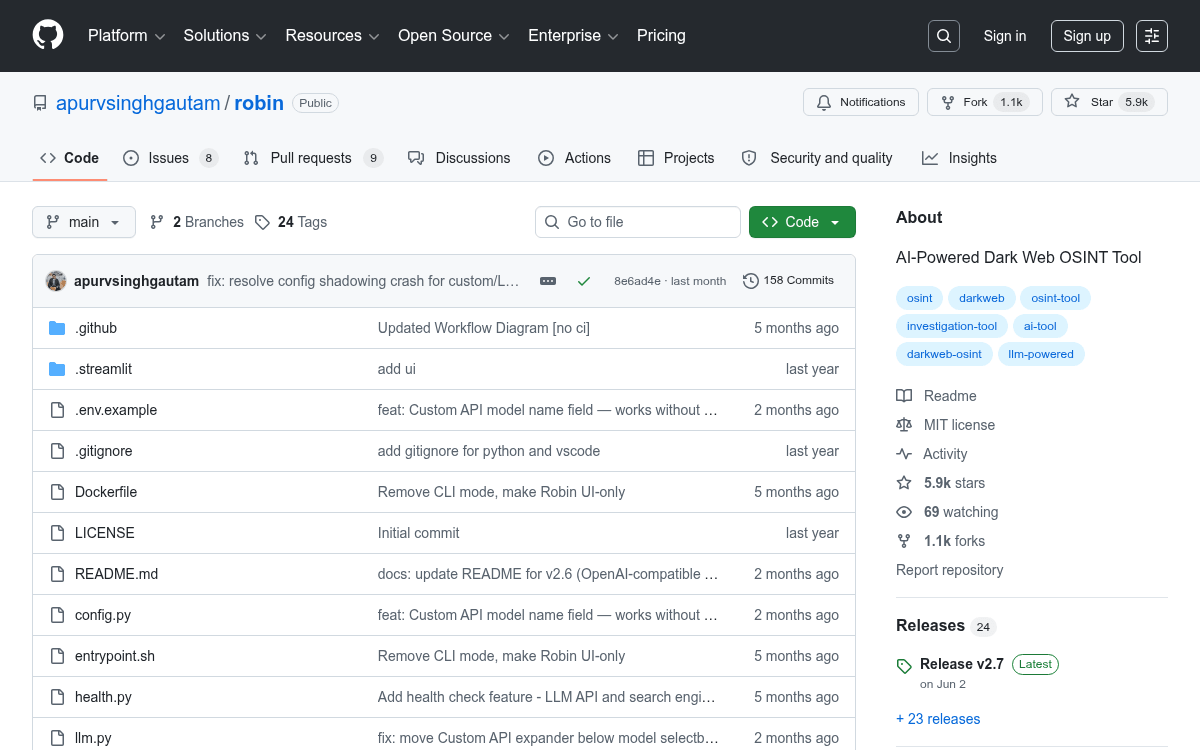
Robin is an open-source, LLM-powered dark web OSINT tool that automates query refinement, multi-engine search, and investigation summarization over Tor
Takeaways
- What it is: Robin is a free, open-source Python tool that automates dark web OSINT investigations using LLMs over Tor.
- How it works: A three-stage pipeline: LLM query refinement → parallel multi-engine dark web search via Tor → LLM filtering and investigation summary.
- Model support: Works with OpenAI GPT-4.1, Anthropic Claude 3.5 Sonnet, Google Gemini 2.5 Flash, and local Ollama models (fully air-gapped option).
- Deployment: Docker-recommended; also runs via Python 3.10+ with Tor installed; Streamlit web UI at localhost:8501 or CLI mode.
- Use cases: Ransomware leak monitoring, credential exposure checks, threat actor research, and CTI pipeline integration via JSON output.
- Limitations: Query-driven only (no continuous monitoring), Tor instability affects results, and LLM API calls may expose sensitive queries.
Robin is an open-source Python tool that brings LLM-powered automation to dark web OSINT (Open Source Intelligence) investigations. Built by security researcher Apurv Singh Gautam, it has crossed 5,600 GitHub stars and nearly 1,000 forks, and was featured at DEFCON 33's Recon Village. The pitch is simple: instead of manually navigating unstable onion sites and sifting through noise, you type a natural-language query and Robin handles the rest.
It combines automated dark web search capabilities with large language models to analyze and summarize information discovered across hidden services and Tor-based search engines, helping refine investigative queries, collect results from multiple dark web sources, and filter relevant intelligence using AI-driven processing. The whole pipeline runs over Tor, so your IP never touches the dark web directly.
The problem it solves
Dark web investigations have always been painful for security researchers. Manual searches through obscure onion sites, endless false positives, and the constant risk of exposure to illegal content make traditional OSINT methods painfully inefficient. The dark web is also fragmented: there is no single Google for .onion sites, so analysts have historically needed to juggle multiple search engines, manually copy links, and then read through raw scraped content themselves.
The dark web is a critical source of intelligence for cybersecurity professionals, threat analysts, law enforcement, and OSINT practitioners. Within its layers lies valuable information: leaked credentials, criminal operations, emerging threats, and conversations that rarely surface on the open web. The scale of the problem is growing fast. As of 2026, researchers had logged more than 9,000 victim postings on ransomware leak sites, and more than 2.7 million individuals visited the dark web daily.