
Roboflow Ships Open-Source Trackers to Keep AI Locked on Moving Targets
Roboflow's open-source library ships benchmarked, clean-room implementations of five leading multi-object trackers that plug into any detector.
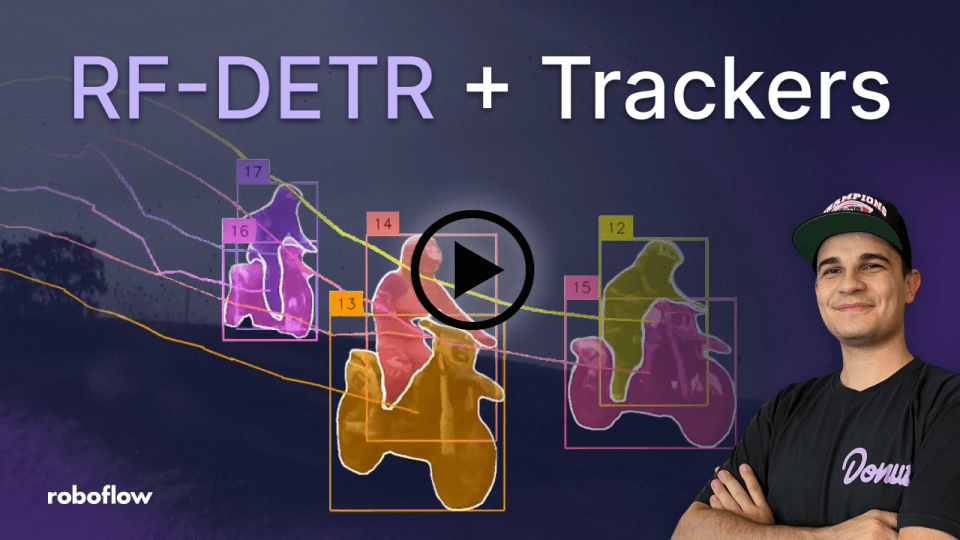
Takeaways
- Roboflow released trackers, Apache 2.0 re-implementations of SORT, ByteTrack, OC-SORT, BoT-SORT, and C-BIoU.
- Works with any detector producing bounding boxes through the
supervision.Detectionsinterface. - Benchmarked across MOT17, SportsMOT, SoccerNet, and DanceTrack, with BoT-SORT leading on HOTA scores.
- Ships
trackers track,trackers eval, andtrackers downloadCLIs for end-to-end workflows. - Includes Optuna hyperparameter tuning and a mask-conditioned McByte variant using SAM and Cutie.
- Install via
pip install trackers, requires Python 3.10 or later, browser demo on Hugging Face.
Keeping a bounding box glued to the same person across a video feed is one of those problems that looks trivial in a demo and turns nasty in production. Occlusions, similar-looking targets, fast motion, and a moving camera all break naive ID assignment. Roboflow's trackers library ships clean, benchmarked implementations of the classic multi-object tracking algorithms under a permissive license, wired to whatever detector you already run.
Inside are re-implementations of SORT, ByteTrack, OC-SORT, BoT-SORT, and C-BIoU, all rewritten from the original papers rather than repackaged from existing repos. That matters because most tracking codebases in the wild carry restrictive licenses inherited from academic reference implementations. Everything here is Apache 2.0, so you can ship it in a commercial product without lawyering up.
One interface, any detector
The design choice that makes this useful is standardizing on the supervision.Detections format. It works with YOLO, DETR, RT-DETR, or any model that produces bounding boxes, with no inference library required or assumed. Every tracker exposes the same update(detections, frame=None) call, so swapping ByteTrack for BoT-SORT is a one-line change.
Adding tracking to an existing detection loop looks like this: