
RoboParty's ROBOTO_ORIGIN Lets Anyone Build a Running Humanoid for $7,000
RoboParty open-sources a full-stack bipedal humanoid — hardware, firmware, RL training, and deployment — for under $7,000 in parts
Takeaways
- Full-stack open-source humanoid: RoboParty released ROBOTO_ORIGIN, covering hardware CAD, firmware, RL training, and ROS2 deployment under GPLv3.
- Built in 120 days for ~$7,000: 1.25m tall, 34kg, 23 DOF, capable of running at 3 m/s using an AMP-based gait algorithm.
- Five modular sub-repos: Hardware, training (IsaacLab + MuJoCo Sim2Sim), deployment (ROS2), URDF/MJCF descriptions, and embedded firmware are all published separately.
- Backed by Xiaomi and Matrix Partners: $10M seed round; founded by 21-year-old Yi Huang, who previously built a $2,300 dorm-room bipedal robot.
- AMP + SMPL-X locomotion: Uses Adversarial Motion Priors and human motion capture data to produce natural gaits without manual reward engineering.
- Research prototype, not a product: Parts are China-sourced; no manipulation capability yet; positioned as a community baseline for embodied AI research.
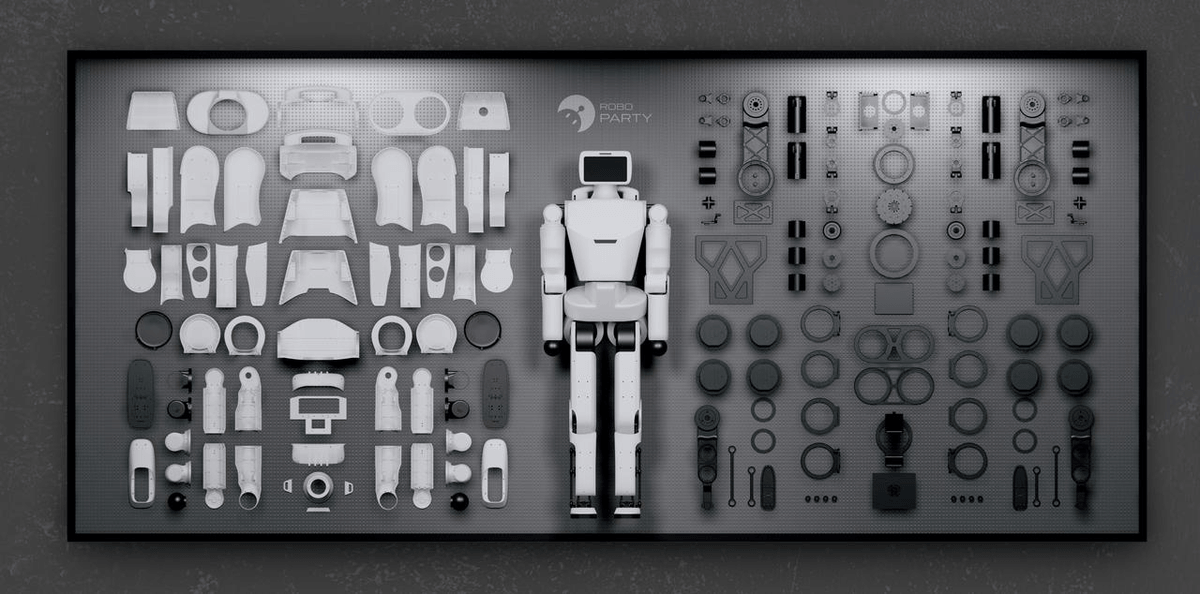
ROBOTO_ORIGIN is a fully open-source, DIY-buildable bipedal humanoid robot from Shanghai startup RoboParty. The project was completed in just 120 days and is positioned as a prototype verifying end-to-end capabilities from "zero to running" , not an industrial product , and has already earned over 1,000 GitHub stars and nearly 100 development kit pre-orders. What makes it stand out is not just the hardware: every layer of the stack, from CNC drawings to reinforcement learning training code, is published under GPLv3.
Built in 120 days by a 21-year-old
The project traces back to founder Yi Huang's time at Harbin Institute of Technology, where he won a national tech competition with an amphibious drone and later built an open-source bipedal robot in his dorm for just $2,300, catching the attention of Boston Dynamics founder Marc Raibert. Frustrated by the industry's "closed-loop inefficiency" and repeated wasted trial-and-error costs, Huang founded RoboParty after graduating early in 2025.
The company is backed by a $10 million seed round from MPCi (Matrix Partners China), Xiaomi Strategic Investment, and Galbot. RoboParty's stated goal is to turn "repeated parts of humanoid building into reusable infrastructure." That philosophy is baked directly into how the repo is structured.
What you actually get
ROBOTO_ORIGIN stands 1.25 meters tall, weighs 34 kg, has 23 degrees of freedom, and reaches a top speed of 3 m/s. The full open-source release is split across five sub-repositories, each covering a distinct layer of the stack:
- Atom01_hardware , CNC mechanical drawings, PCB schematics, full BOM with supplier links
- atom01_train , IsaacLab-based reinforcement learning environment with Sim2Sim transfer to MuJoCo
- atom01_deploy , ROS2 deployment framework covering IMU, motor drivers, and inference
- atom01_description , URDF and MJCF model files for simulation and visualization
- atom01_firmware , Embedded firmware including USB2CAN, OrangePi build tooling, and system daemon management