
RoboVerse Unifies 9 Robot Simulators and 10M Transitions in One Open-Source Framework
A unified framework wraps nine robot simulators behind one API, pools 30+ datasets, and standardizes benchmarks for both imitation and reinforcement learning.
Takeaways
- RoboVerse unifies 9 robot simulators behind one API via the MetaSim abstraction layer.
- Ingests and normalizes 17+ existing datasets (RLBench, ManiSkill, LIBERO, Meta-World, CALVIN, HumanoidBench).
- Synthetic dataset spans 10M+ transitions with photoreal rendering and high-fidelity physics.
- Four-level generalization benchmark covers embodiment, visual, and physics transfer.
- Accepted to RSS 2025; Apache 2.0 licensed; installs via pip.
- Best fit for generalist manipulation, sim-to-real, and cross-embodiment research pipelines.
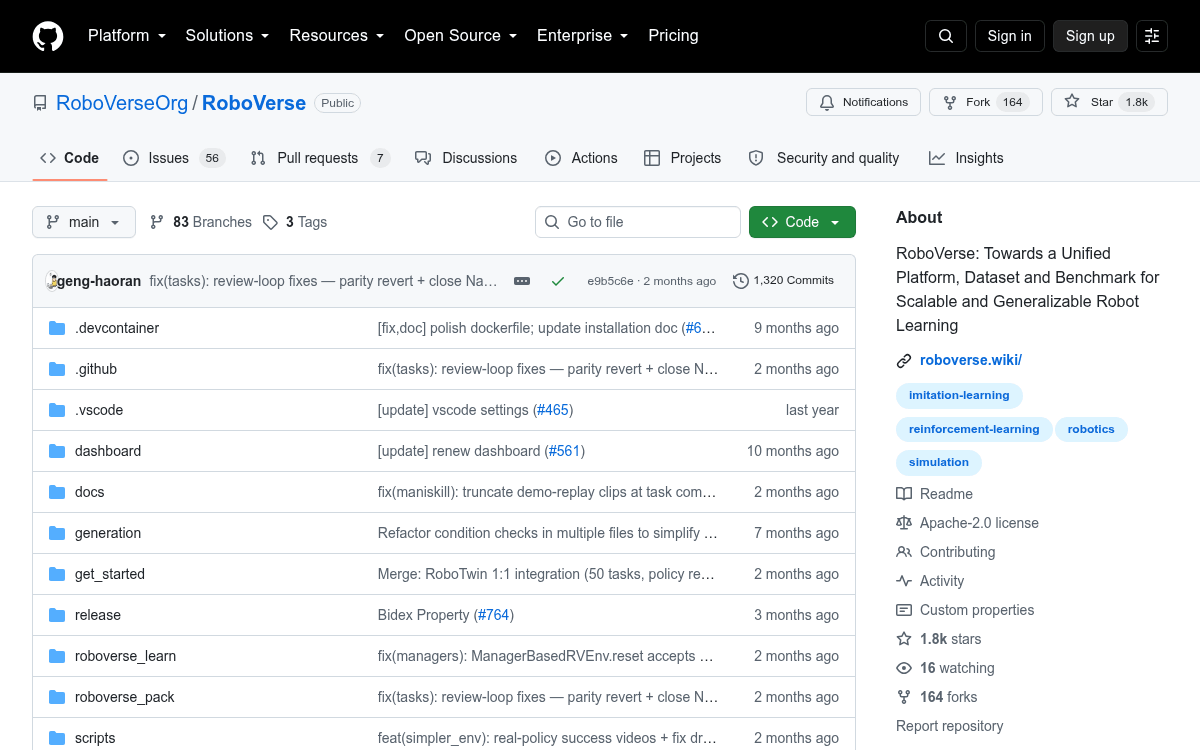
Robot learning has a fragmentation problem. Every serious simulator (Isaac Lab, MuJoCo, SAPIEN, PyBullet, Genesis) speaks its own dialect of scene files, coordinate frames, and control APIs. Every popular benchmark (RLBench, ManiSkill, LIBERO, Meta-World) ships its own asset formats and evaluation protocols. Porting a policy from one stack to another is often a multi-week rewrite. RoboVerse is an open-source attempt to collapse that mess into a single interface, and it just crossed 1.7k stars on GitHub after being accepted to RSS 2025.
The project bundles three things: a simulation abstraction layer called MetaSim, a large synthetic dataset, and unified benchmarks. MetaSim provides a universal configuration system and simulator-agnostic interface that enables cross-simulator integration, hybrid simulation, and cross-embodiment transfer. The code is Apache 2.0 and installs as a standard Python package.
One config, many physics engines
MetaSim's config system sits above whatever engine you happen to have installed, abstracting diverse environments behind a universal interface and an API that aligns the functionality of different backends. Launching an environment, loading assets with initial states, and stepping physics all go through the same calls regardless of what is running underneath.

The list of supported backends is unusually broad. RoboVerse integrates Isaac Lab and Isaac Sim, Isaac Gym, MuJoCo, SAPIEN, PyBullet, Genesis, cuRobo for motion planning, and PyRep on top of CoppeliaSim. Blender is wired in for photoreal rendering. Because the config is decoupled from the runtime, the same task definition can run on a GPU-parallel simulator for RL rollouts and a high-fidelity one for evaluation.