
Snyk's Agent Scan Hunts Hidden Threats Across Claude, Cursor, and Gemini CLI
Snyk's open-source agent-scan CLI audits your local MCP servers and AI agent skills for prompt injection, tool poisoning, and hardcoded secrets before they can be exploited.
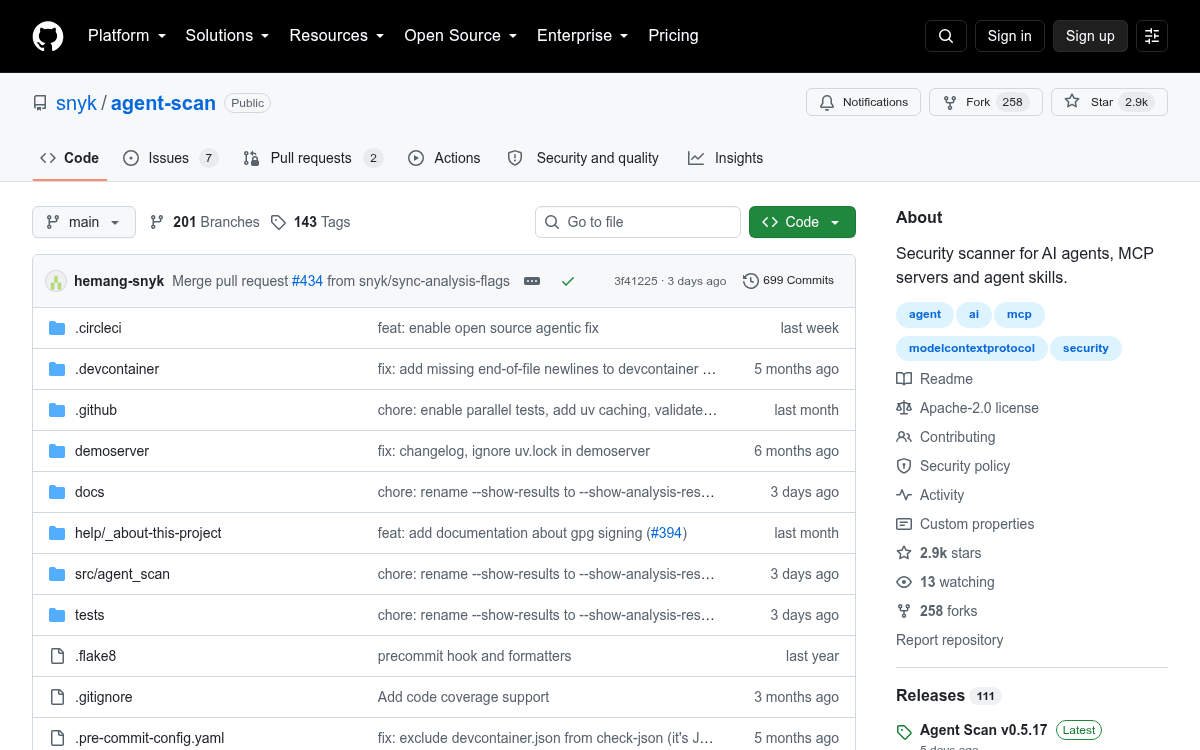
Takeaways
- What it is: Snyk Agent Scan is a free, open-source CLI that audits MCP servers and AI agent skills for 15+ security risks.
- Threats detected: Prompt injection, tool poisoning, tool shadowing, malware payloads, hardcoded secrets, and toxic data flows.
- Coverage: Auto-discovers components from Claude, Cursor, VS Code, Gemini CLI, Windsurf, Amazon Q, and 6+ other agents across macOS, Linux, and Windows.
- Known limitation: Scanning MCP servers requires executing them; always run in a sandbox when evaluating untrusted configs.
- Privacy note: Tool descriptions and metadata are sent to Snyk's cloud API for analysis -- review before use in sensitive environments.
- How to run:
export SNYK_TOKEN=... && uvx snyk-agent-scan@latest-- free Snyk account required; Apache 2.0 licensed.
Snyk Agent Scan is a free, open-source CLI that scans the AI agent infrastructure sitting on your machine right now. MCP servers, agent skills, and tool configurations installed by Claude, Cursor, VS Code, Gemini CLI, and a growing list of other coding assistants are all in scope. The tool auto-discovers these components, audits them for a battery of AI-specific threats, and produces a risk report you can read or pipe into CI.
The problem no one was solving
The Model Context Protocol has become the backbone infrastructure for connecting AI models with external tools, data sources, and automated business workflows. As enterprises and developers embrace MCP servers for advanced AI integration, these systems hold ever more sensitive data and runtime privileges. That surface area is now being actively exploited.
MCP servers face urgent threats: prompt injection, where attackers trick AI models into running hidden commands, and tool poisoning, which manipulates the description or behavior of external tools to lure agents into unsafe actions. Both attack vectors can lead to data loss, privilege abuse, or full system compromise.
The MCPTox benchmark tested 45 live MCP servers and 353 authentic tools against poisoned descriptions across a wide range of modern LLMs. The headline findings were striking: many popular agents exhibited attack success rates above 60%, with the highest at 72%, and the most-capable models often performed worse than smaller ones because their superior instruction-following made them more compliant with malicious metadata. The problem is structural, not incidental.
Tool poisoning works by embedding hidden instructions directly in tool definitions, the metadata that tells AI agents what each tool does and how to use it. Because this metadata is consumed silently, users never see the attack happening.
What it detects
Agent Scan auto-discovers local agent configurations, connects to MCP servers to fetch tool descriptions, and scans for 15+ risks such as prompt injection, tool poisoning/shadowing, toxic flows, malware payloads, untrusted content, credential handling, and hardcoded secrets.