
Taste-Skill Teaches Cursor and Claude Code to Stop Generating Generic AI Slop
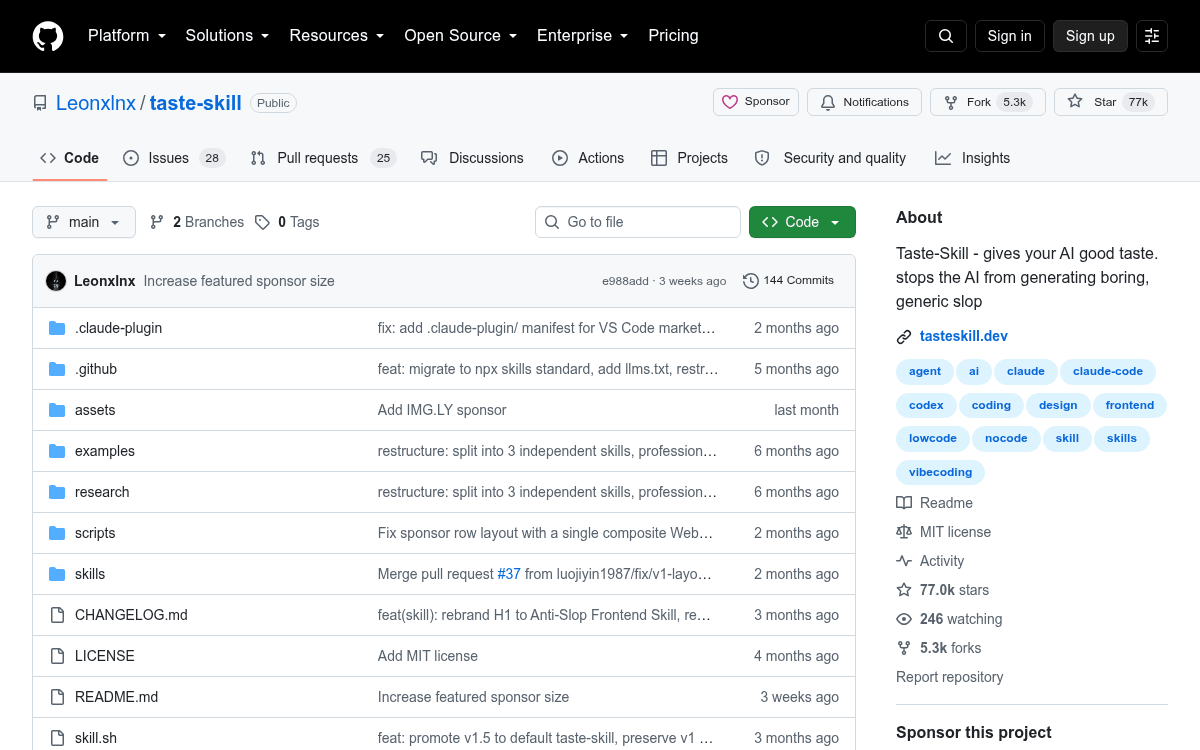
Taste-Skill is an open-source collection of agent skills that forces AI coding tools to stop generating generic, template-looking frontends
Takeaways
- What: Taste-Skill is an open-source collection of agent skill files that inject opinionated design rules into AI coding agents to prevent generic UI output.
- The problem: AI tools like Cursor and Claude Code default to the same purple-gradient, centered-hero layouts, a pattern the community calls "AI slop."
- v2 is live: The default skill now reads your project brief first, infers design direction from keywords like "minimalist" or "SaaS", and tunes layout/motion/density before writing any code.
- 10+ specialized skills: Includes variants for brutalist UI, minimalist/editorial, soft premium, image-to-code pipelines, and a GPT/Codex-specific stricter mode.
- One-command install: Works via
npx skills add https://github.com/Leonxlnx/taste-skilland is compatible with Cursor, Claude Code, Codex, Windsurf, Copilot, and more. - Free and MIT-licensed: No cost, framework-agnostic (React, Vue, Svelte), and skills can also be pasted directly into ChatGPT or Codex conversations.
Taste-Skill is an open-source repository by developer Leonxlnx that packages opinionated design rules into portable agent skill files, giving AI coding tools like Cursor, Claude Code, and Codex a sense of aesthetic judgment they otherwise lack. The pitch is simple: stop the AI from generating the same purple-gradient, centered-hero, three-feature-card landing page every single time.
The AI slop problem
We are living in the golden age of vibe coding, where rapid prototyping with AI assistants lets single developers ship entire web applications in an afternoon. But as developers lean heavily on tools like Cursor, Claude Code, and GitHub Copilot, a distinct and frustrating visual pattern has emerged.
The industry has dubbed this "generic AI slop." It is characterized by the statistically safest, most average web design choices possible: a dark theme with an AI-purple-to-blue linear gradient, a perfectly centered hero text block with a generic headline. To build standout interfaces, developers need a way to snap the AI out of its probabilistic comfort zone. This is exactly where Taste Skill steps in.
What it actually is
The underlying format, pioneered by Vercel Labs, treats a skill as a monorepo of packaged instructions that extend what an agent can do. After installation, skills live in agent-specific directories such as ~/.claude/skills or .cursor/skills. The agent discovers these skills, reads SKILL.md, and is then able to route relevant user requests to the correct skill.