
Tencent's AI-Infra-Guard Scans Your Entire AI Stack for Hidden Vulnerabilities
Tencent's open-source A.I.G platform scans AI infra, MCP servers, and agent workflows for CVEs, prompt injection, and jailbreak risks — all in one place.
Takeaways
- Full-stack AI red teaming: A.I.G from Tencent Zhuque Lab scans AI infra, MCP servers, agent workflows, and LLMs for security risks in one platform.
- 1,600+ CVEs covered: The infra scanner fingerprints 68+ AI frameworks (Ollama, vLLM, ComfyUI, Triton) and matches against a continuously updated vulnerability database.
- MCP security pioneer: Used to scan 50,000+ agent skills on ClawHub and thousands of MCP projects, uncovering 4,000+ novel AI security risks.
- Free and open-source: Apache 2.0 license, deployable via Docker in minutes, with a full REST API for programmatic integration.
- Real-world threat context: GreyNoise captured 91,403 attack sessions targeting exposed LLM endpoints in a single 3-month window, validating the urgency.
- Black Hat-backed research: Presented at Black Hat Europe 2025 Arsenal; cited in 19 academic papers; no-auth warning means it's for internal use only.
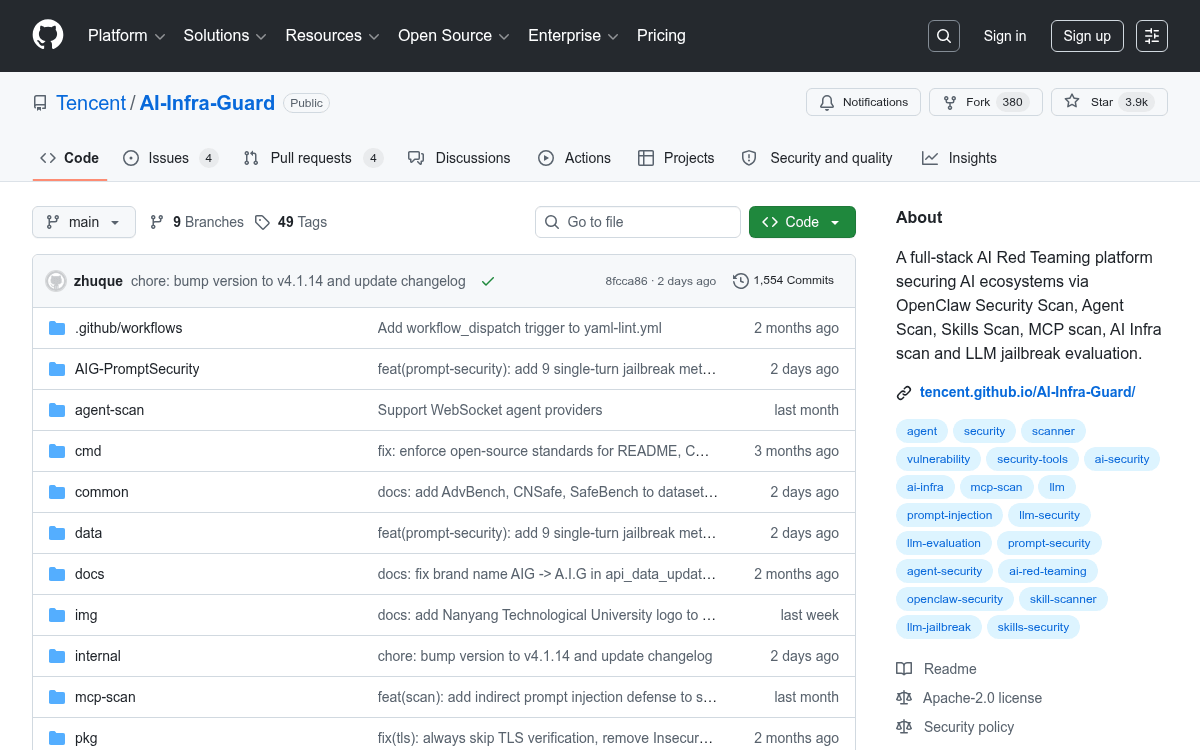
AI-Infra-Guard (A.I.G) is a full-stack AI red teaming platform from Tencent's Zhuque Lab that brings together five distinct security scanning capabilities under one roof: infrastructure CVE scanning, MCP server analysis, agent workflow auditing, skills scanning, and LLM jailbreak evaluation. It's free, open-source under Apache 2.0, and deployable with a single Docker command. With nearly 4,000 GitHub stars and adoption across organizations like DeepSeek, Ant Group, ICBC, and Bilibili, it has quickly become one of the most comprehensive tools available for auditing AI deployments.
The problem it's solving is real and getting worse
AI infrastructure is being attacked at scale. Between October 2025 and January 2026, GreyNoise's honeypot infrastructure captured 91,403 attack sessions targeting exposed LLM endpoints. The root cause is rarely sophisticated , the most common and most exploited misconfiguration is a self-hosted LLM inference API exposed to the internet without authentication, and because tools like Ollama do not have authentication and access control functions by default, opening the service to the public network creates an immediate risk.
The threat surface has also expanded dramatically with the rise of AI agents. Prompt injection is the most frequently mentioned risk on major AI vulnerability lists , attackers design inputs that cause an LLM to ignore its original instructions, and since the model operates on system prompts and user input as a single undifferentiated text stream, it is usually impossible for the model to distinguish between them. MCP (Model Context Protocol) , the emerging standard that lets AI agents call external tools , has introduced an entirely new class of supply chain risks on top of that.
Five scanning modules, one platform
The system employs a distributed architecture, combining a Go-based orchestration layer with specialized Python-based scanning engines to detect vulnerabilities, insecure configurations, and prompt-based risks. Here's what each module does: