
Tencent's HunyuanVideo Beats Runway Gen-3 as a Fully Open 13B Model
Tencent's HunyuanVideo has grown from a single 13B text-to-video model into a full open-source ecosystem rivaling closed-source leaders like Runway and Sora
Takeaways
- 13B open-source model: HunyuanVideo is the largest open-source video generation model, outperforming Runway Gen-3 and Luma 1.6 in professional evaluations.
- Full ecosystem: The repo has expanded to include I2V, HunyuanCustom, and Avatar models, all sharing the same DiT backbone.
- HunyuanVideo-1.5: A lighter 8.3B successor runs on consumer GPUs, with a step-distilled variant generating videos in 8–12 steps (75% faster on RTX 4090).
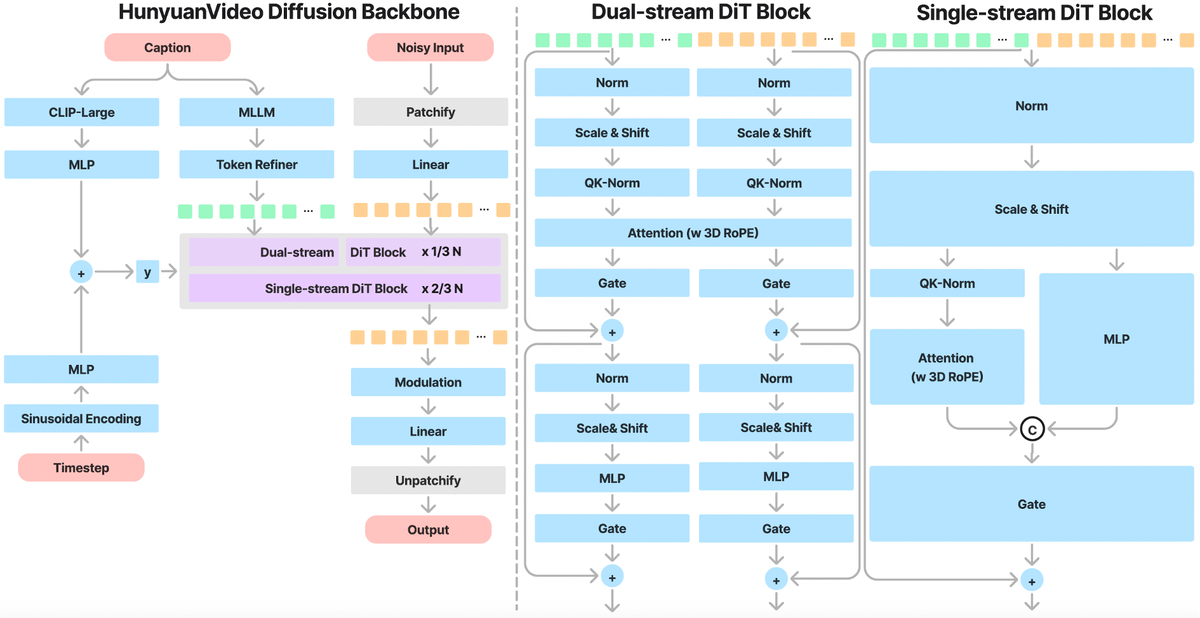
- Key architecture: Dual-stream transformer, MLLM text encoder, 3D Causal VAE, and built-in prompt rewriting distinguish it from earlier open-source models.
- Hardware requirements: Base model needs 60–80GB VRAM; community GGUF quantization brings it down to 8GB, and FP8 saves ~10GB vs full precision.
- Diffusers integration: Available via HuggingFace and ComfyUI, with multi-GPU parallel inference via xDiT achieving 5.64x speedup on 8 GPUs.
HunyuanVideo started as a bold claim: an open-source video generation model that could match or beat closed-source giants like Runway Gen-3 and Luma 1.6. That claim has held up. What began as a single text-to-video checkpoint has since grown into a layered ecosystem of foundation models, conditional variants, and audio-driven animation tools , all sharing the same underlying architecture and all fully open-source.
The foundation: 13B parameters, fully open
With 13 billion parameters, HunyuanVideo achieves leading performance across video quality and motion stability, and is fully open-source on GitHub and Hugging Face. According to professional human evaluation results, HunyuanVideo outperforms previous state-of-the-art models, including Runway Gen-3, Luma 1.6, and three top-performing Chinese video generative models. The evaluation used 1,533 text prompts and was scored by more than 60 professional evaluators across three criteria: text alignment, motion quality, and visual quality.
Tencent's 13B-parameter DiT generates 5–15 second clips at 720p / 24fps with cinematic motion coherence that rivals closed-source Sora and Runway Gen-3. The base model supports multiple aspect ratios at both 540p and 720p, with 129 frames per clip (~5.4 seconds at native frame rate).
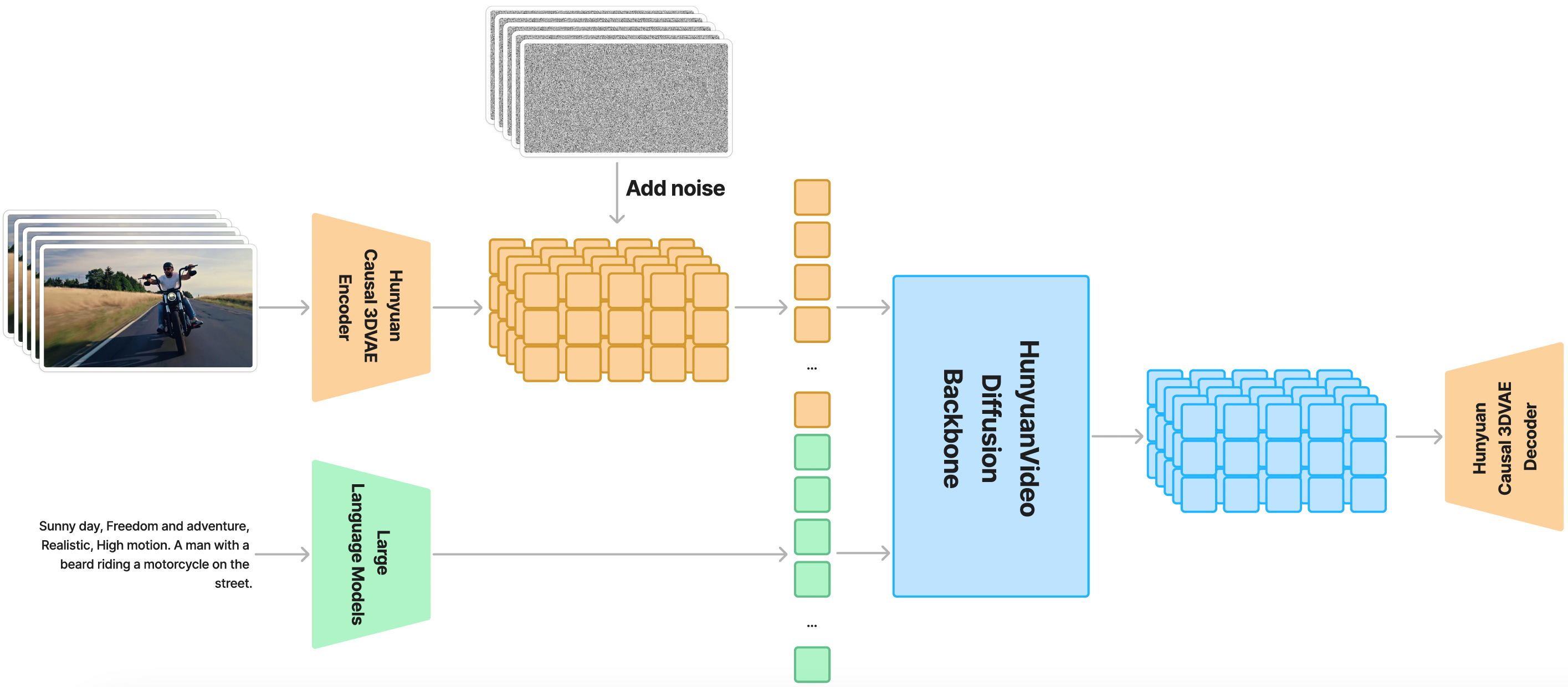
Four architectural bets that paid off
The model's design is built around four interlocking innovations that separate it from earlier open-source video models:
- Dual-stream to single-stream transformer: HunyuanVideo employs a "dual-stream to single-stream" hybrid model design. Video and text tokens are processed independently through multiple Transformer blocks, then concatenated and fused in a single-stream phase. This lets each modality develop its own representations before they interact , a cleaner design than forcing joint attention from the start.
- MLLM text encoder: Instead of the standard T5 or CLIP encoders used by most video models, HunyuanVideo uses a Multimodal Large Language Model (MLLM) with a decoder-only architecture as its text encoder. This gives it superior ability in image detail description and complex reasoning, and lets it act as a zero-shot learner by following system instructions prepended to user prompts. An extra bidirectional token refiner is added on top to compensate for the causal attention limitation of decoder-only models.