
Tencent's HY-World 2.0 Turns Text Into Walkable 3D Worlds for Game Engines
Tencent fully open-sources HY-World 2.0, a four-stage pipeline that turns a text prompt or image into a navigable, game-engine-ready 3D world — not just a video.
Takeaways
- Full open-source release: Tencent releases all weights and inference code for HY-World 2.0, a 3D world model that outputs meshes and Gaussian Splats instead of videos.
- Four-stage pipeline: HY-Pano 2.0 → WorldNav → WorldStereo 2.0 → WorldMirror 2.0 turns a text prompt or single image into a navigable, game-engine-ready 3D scene.
- Two modes: World Generation (text/image → 3D) and World Reconstruction (video/multi-view → 3D digital twin) via a single forward pass.
- Game-engine compatible: Outputs drop directly into Unity, Unreal Engine, Blender, and Isaac Sim with physics-based collision and real-time rendering.
- WorldMirror 2.0 (~1.2B params) runs on 12–24 GB VRAM; the full pipeline includes an 80B panorama model, making end-to-end generation GPU-intensive.
- Free to use: All weights on Hugging Face under the tencent-hy-world-2.0-community license; try the product at 3d.hunyuan.tencent.com.
Most AI world models today produce video: a convincing clip that plays once and disappears. HY-World 2.0, Tencent's fully open-sourced multi-modal world model, takes a fundamentally different bet. Give it a text prompt or a single image, and it outputs a real, persistent 3D scene , meshes, point clouds, and Gaussian Splats , that you can load directly into Unity, Unreal Engine, Blender, or NVIDIA Isaac Sim.
A different kind of world model
Existing world models, such as Genie 3 and Cosmos, generate pixel-level videos , essentially "watching a movie" that vanishes once playback ends. HY-World 2.0 is built around a different output format entirely. This multimodal world model marks a critical step forward for AI, advancing from generating 2D images and videos to creating 3D virtual worlds that can be directly interacted with and edited , and unlike previous world models that could only output video files, HY-World 2.0 is capable of directly generating 3D assets usable in game engines and digital twin applications.
The practical difference is significant. Video world models accumulate inference cost with every interaction and can't be imported into any engine. HY-World 2.0 outputs Mesh, 3D Gaussian Splatting (3DGS), point clouds, depth maps, and camera parameters that drop directly into Blender, Unity, Unreal Engine, and Isaac Sim. Once generated, the world renders in real time on consumer GPUs at essentially zero marginal cost.
The four-stage pipeline
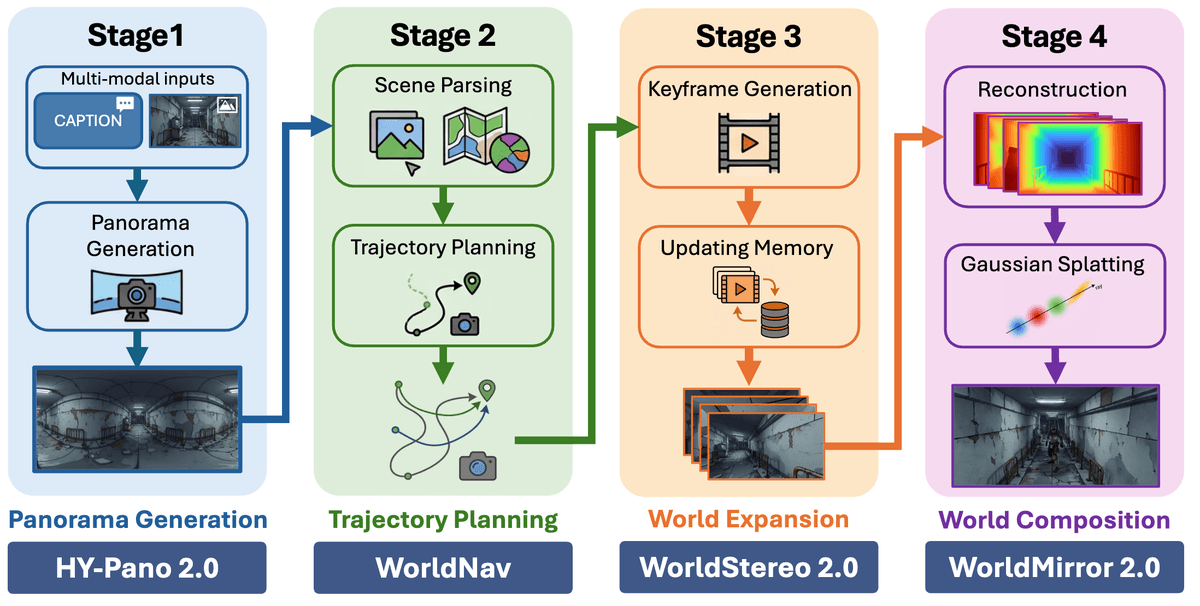
A systematic pipeline , Panorama Generation (HY-Pano 2.0) → Trajectory Planning (WorldNav) → World Expansion (WorldStereo 2.0) → World Composition (WorldMirror 2.0 + Splatting Learning) , automatically transforms text or a single image into a high-fidelity, navigable 3D world. Each stage is a distinct model with its own architecture:
- HY-Pano 2.0 , A panorama generation model that converts a single perspective image or text prompt into a 360° equirectangular panorama. Its full backend uses HunyuanImage-3 with a chain-of-thought recaptioning step, internally rewriting the user prompt via a think → recaption → diffuse workflow before running diffusion. There's also a lighter Qwen-based LoRA backend for faster iteration. The full model is ~80B parameters; the Qwen variant is ~425M.