
Ultralytics Ships YOLO26 43% Faster on CPU With NMS-Free Edge Inference
Ultralytics launches YOLO26 with native NMS-free inference, a lighter detection head, and up to 43% faster CPU performance than YOLO11
Takeaways
- Ultralytics launches YOLO26, its most advanced YOLO release, with a fully end-to-end, NMS-free architecture built for edge and low-power devices.
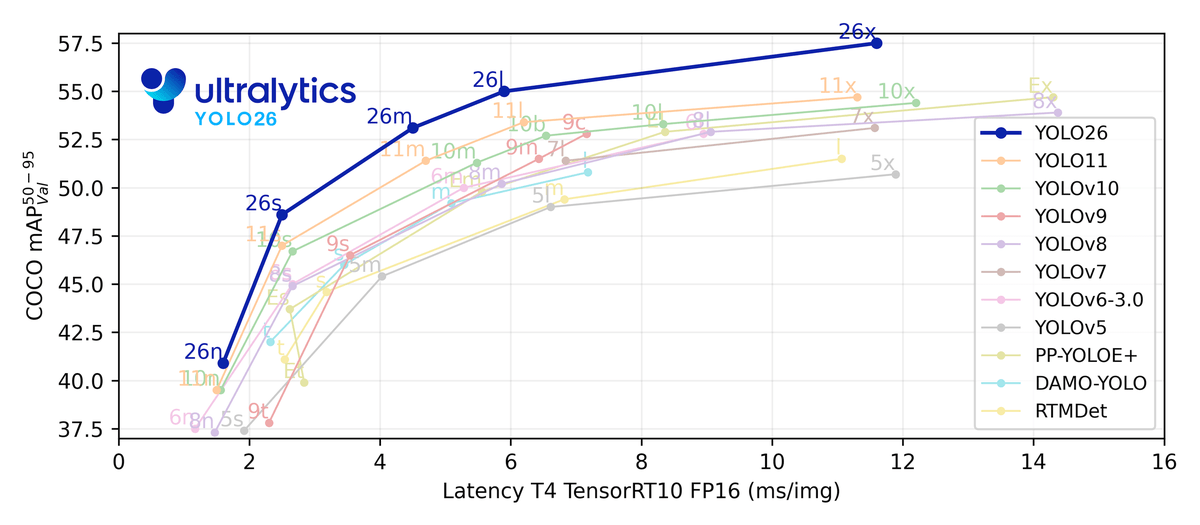
- Up to 43% faster CPU inference than YOLO11n on Intel Xeon; COCO mAP ranges from 40.9 (nano) to 57.5 (extra-large) at 1.7–11.8 ms on T4 TensorRT.
- DFL removed: Distribution Focal Loss is dropped from the detection head, simplifying export to TensorRT, ONNX, CoreML, TFLite, and OpenVINO.
- New training recipe: MuSGD optimizer, Progressive Loss, and STAL label assignment improve accuracy, especially on small objects.
- YOLOE-26 ships alongside as an open-vocabulary segmentation family supporting text prompts, visual prompts, and prompt-free detection on any category. Docs
- Available now under AGPL-3.0 on GitHub; enterprise licenses available for commercial deployment.
Ultralytics has officially launched YOLO26, the newest generation of its YOLO model family and the most significant architectural overhaul the series has seen in years. Engineered from the ground up for edge and low-power devices, YOLO26 introduces a fully end-to-end, NMS-free architecture that fundamentally redefines how object detection is trained, deployed, and scaled in production. The release also ships a companion model family, YOLOE-26, that brings open-vocabulary segmentation into the same framework.
The NMS Problem, Finally Solved by Default
If you've shipped a YOLO model to production before, you know the pain of non-maximum suppression (NMS). NMS is the post-processing step that filters overlapping bounding boxes after inference, and it has historically been a headache: it's slow, it's hard to export cleanly to edge runtimes, and it's a separate component you have to wire up yourself. YOLO26 removes it from the default inference path entirely.
The YOLO26 model family is built around native end-to-end inference: the default one-to-one detection head produces predictions without non-maximum suppression, simplifying deployment and reducing post-processing. This is not a minor tweak. It means you can export to TensorRT, ONNX, CoreML, TFLite, or OpenVINO and get a self-contained model with no extra glue code needed.
For teams that still want the traditional NMS path (which can squeeze out slightly higher accuracy), YOLO26 keeps a one-to-many head available as an opt-in. You switch between them with a single flag:
from ultralytics import YOLO
model = YOLO("yolo26n.pt")
# Default: end-to-end, no NMS
results = model.predict("image.jpg")
# Opt-in: traditional NMS path for max accuracy
results = model.predict("image.jpg", end2end=False)