
VectifyAI's OpenKB Turns Karpathy's Viral Idea Into an Open-Source RAG Killer
OpenKB turns raw documents into a self-maintaining wiki using LLMs, skipping chunking and vector databases entirely
Takeaways
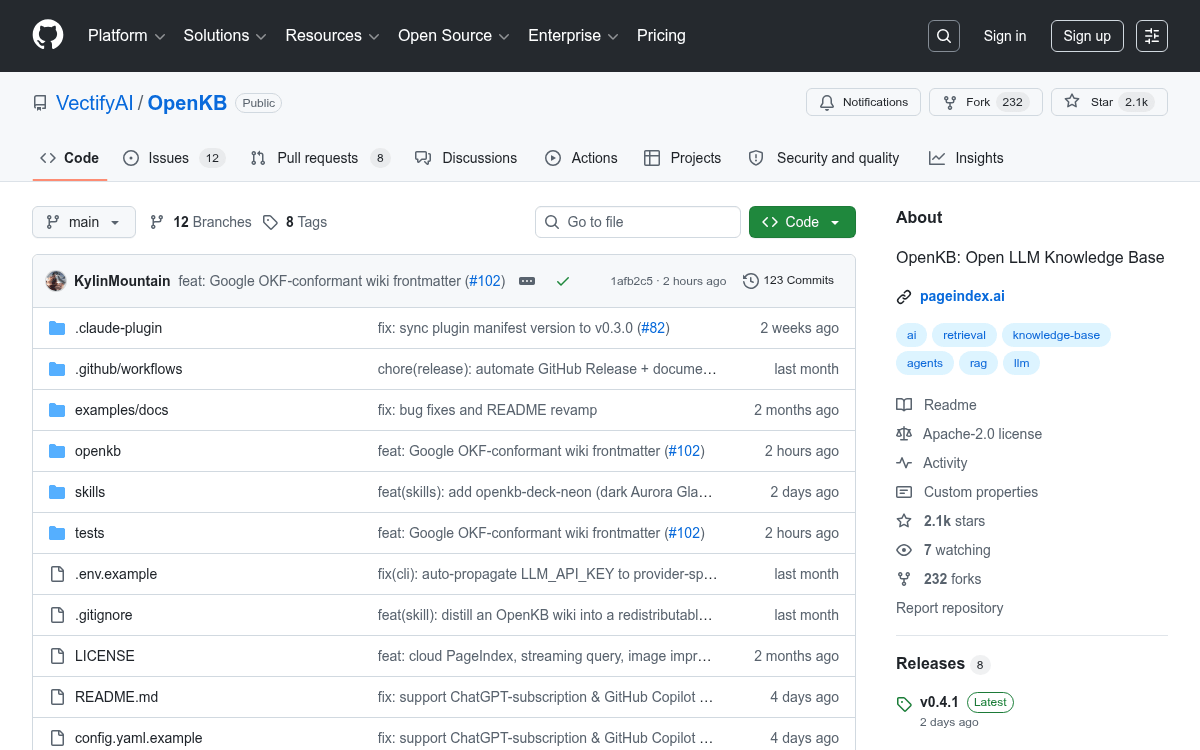
- OpenKB is a free, open-source CLI that compiles raw documents into a persistent, interlinked wiki using LLMs, with no vector database or chunking required. GitHub
- Inspired by Andrej Karpathy's viral April 2026 thread on LLM knowledge bases, which amassed over 16 million views and sparked a wave of community implementations.
- Uses PageIndex, a vectorless tree-indexing engine, to handle long PDFs; the underlying system scored 98.7% on FinanceBench vs ~50% for traditional vector RAG.
- Each new document can update up to 15 wiki pages automatically, with cross-references, contradiction detection, and gap analysis built in.
- Outputs plain Markdown with
[[wikilinks]], fully compatible with Obsidian for graph-view browsing; supports OpenAI, Anthropic, Gemini, and any LiteLLM provider. - Available now via
pip install openkbunder Apache 2.0; cost is LLM API usage only, with an optional PageIndex Cloud tier for OCR and faster indexing.
Andrej Karpathy posted a thread in early April 2026 describing how he now uses LLMs not to write code, but to compile knowledge. He described using LLMs to build personal knowledge bases for various topics of research interest, and the post racked up 59,000 likes and 106,000 bookmarks. Within days the post had spawned a GitHub Gist, a wave of community implementations, and serious debate about whether this approach makes RAG pipelines obsolete for personal use. VectifyAI moved fast. Their answer is OpenKB, an open-source CLI that turns that idea into a production-ready system.
The problem with how RAG actually works
To understand why OpenKB matters, you need to understand the specific failure mode it targets. A typical RAG pipeline chunks documents, generates embeddings, stores them in a vector database, retrieves relevant chunks at query time, and feeds those chunks to the LLM to generate an answer. That workflow is mature and widely used, but it has a structural flaw. The knowledge itself does not really accumulate. Every question repeats the work of finding chunks, assembling context, and generating an answer.
Traditional RAG re-synthesizes from scratch every time, even for the same question on the same document. Token costs keep accumulating, and answer quality varies with prompt and context length. Karpathy's framing of this is essentially a compiler analogy: instead of having the LLM re-read your raw documents every time you ask a question, build a persistent, structured wiki once and keep it updated forever.
What OpenKB actually builds
OpenKB is an open-source CLI that compiles raw documents into a structured, interlinked wiki-style knowledge base using LLMs, powered by PageIndex for vectorless long document retrieval. The idea is based on a concept described by Andrej Karpathy: LLMs generate summaries, concept pages, and cross-references, all maintained automatically. Knowledge compounds over time instead of being re-derived on every query.
The output is not a database or an index. It outputs the knowledge base as ordinary Markdown files instead of locking it inside a dedicated database. OpenKB outputs pure Markdown with [[wikilinks]]. It opens instantly in Obsidian Graph View. Compile hundreds of company documents and see at a glance how concepts connect, a visualization of knowledge structure that no RAG system can provide.