
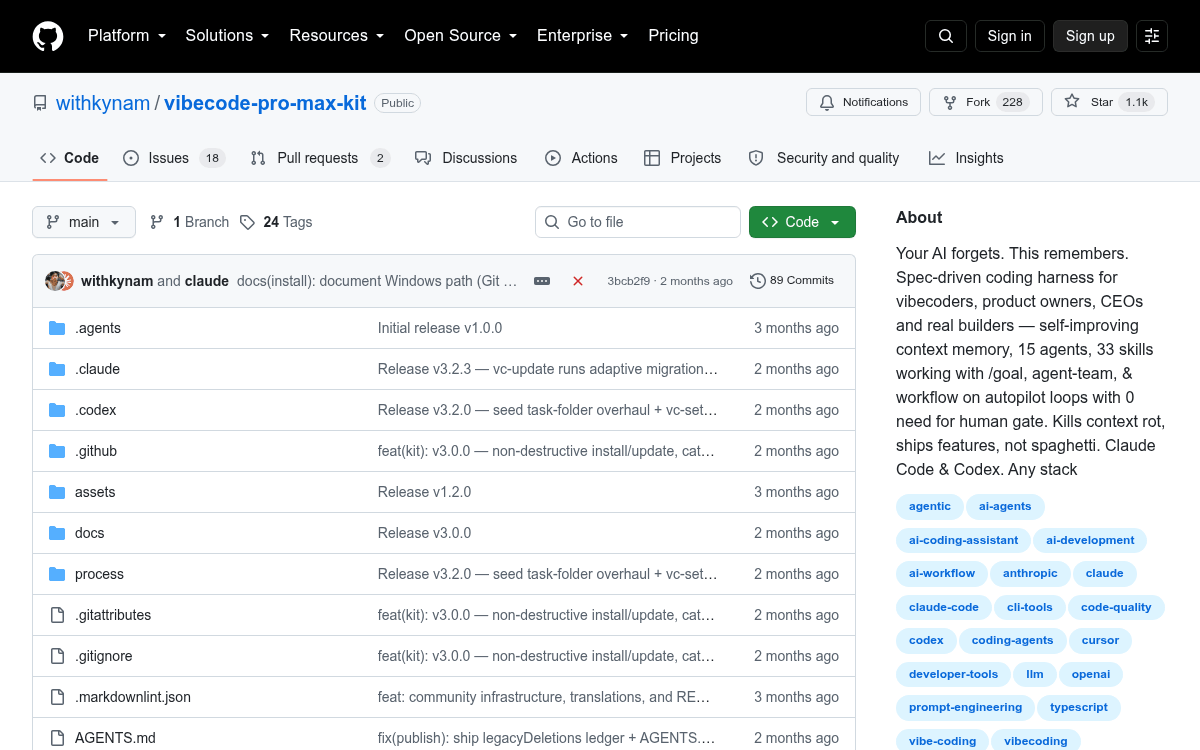
vibecode-pro-max-kit Fixes Claude Code's Worst Habit of Coding Before Thinking
A spec-driven harness bolts twelve agents, thirty-one skills, and phase-locked tool restrictions onto Claude Code and Codex to kill context rot.
Takeaways
- Vibecode-pro-max-kit is a spec-driven agent harness for Claude Code and Codex, MIT licensed.
- Ships 12 agents, 31 skills, and 7 hooks that install into any project via a curl one-liner.
- Enforces a RIPER-5 workflow (Research, Innovate, Plan, Execute, Update Process) with explicit approval gates.
- Phase-locked tool restrictions physically remove capabilities like Bash or file writes during research and planning.
- Plans live on disk with blast-radius and verification sections, so progress survives context window compaction.
- Includes specialist skills for STRIDE plus OWASP security audits, 12-dimension edge case generation, and autonomous metric optimization.
A new open-source project called vibecode-pro-max-kit is picking up traction on GitHub as an attempt to fix one of the most frustrating failure modes of AI coding assistants: they start writing code without understanding your project, forget everything between sessions, and let their context docs go stale. The repo bills itself as a RIPER-5, spec-driven, self-improving agent harness for Claude Code and Codex, with 12 specialist agents, 31 skills, and phase-locked safety that works with any codebase.
The core idea is to stop treating your agent as a code generator and start treating it as a junior engineer that has to research, plan, and get explicit approval before touching files. Everything ships under an MIT license and installs into an existing project in about thirty seconds.
Why coding agents keep face-planting
Anyone who has used a coding agent on a real codebase knows the pattern: you ask for webhook support, and 400 lines land in your repo that ignore your existing conventions. The maintainers argue the deeper issues are worse than that surface annoyance. Agent context dies every session, docs written last week are already stale, long tasks collapse when the context window fills, and architecture decisions get hallucinated instead of researched.
An outside writeup frames the project as a direct response to context rot inside AI coding assistants and a way to streamline the feature delivery pipeline. That is the promise the whole system is organized around.