
VibeProxy Turns Your Claude and ChatGPT Subscriptions Into a Free API
A macOS menu bar app that reroutes Factory Droids, Amp, and other coding CLIs through your existing Claude Code and ChatGPT subscriptions, skipping API bills.
Takeaways
- VibeProxy is a native macOS menu bar app routing coding tools through your existing AI subscriptions instead of API keys.
- Built on CLIProxyAPIPlus, it handles OAuth, token management, and request routing automatically.
- Supports Claude Code, ChatGPT/Codex, Gemini, Kimi, Qwen, Antigravity, and Z.AI GLM as upstream providers.
- Multi-account round-robin plus failover keeps sessions alive across rate limits and account switches.
- Optional Vercel AI Gateway integration reduces the account-ban risk when proxying Claude Max OAuth tokens.
- MIT-licensed, signed and notarized, requires macOS 13+; repo here.
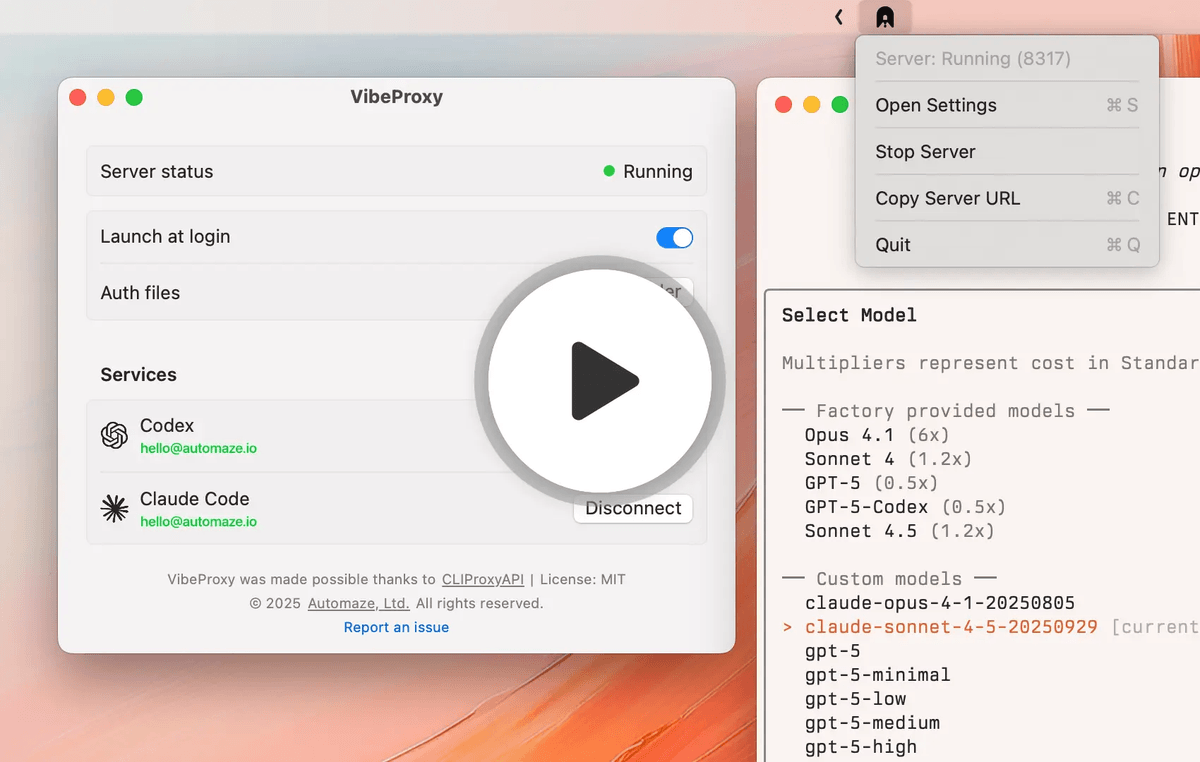
If you already pay for Claude Code, ChatGPT, or Gemini, paying a second time in API credits to run a tool like Factory Droids or Amp against those same models stings. VibeProxy is a native macOS menu bar app that closes that gap by turning your existing subscriptions into a local proxy any coding tool can hit as if it were a normal API.
The repo has quietly crossed 3.3k stars under an MIT license, and the pitch is blunt: stop paying twice for AI.
How the proxy works
VibeProxy wraps CLIProxyAPIPlus, a Go-based unified proxy server, in a thin SwiftUI shell. It handles OAuth authentication, token management, and API routing for Claude Code, ChatGPT, Gemini, Kimi, Qwen, Antigravity, and Z.AI GLM subscriptions, then exposes them to third-party tools like Factory Droids.
The workflow is roughly:
- Install the signed
.app, launch it, and a menu bar icon appears. - Click Connect for each provider you already subscribe to. Your browser opens, you complete OAuth, and credentials land in
~/.cli-proxy-api/. - Point any tool that expects an OpenAI or Anthropic-compatible endpoint at the local proxy. Requests get signed with your subscription's OAuth token instead of an API key.