
vxcontrol's PentAGI Hands Full Hacking Workflows to 13 Autonomous AI Agents
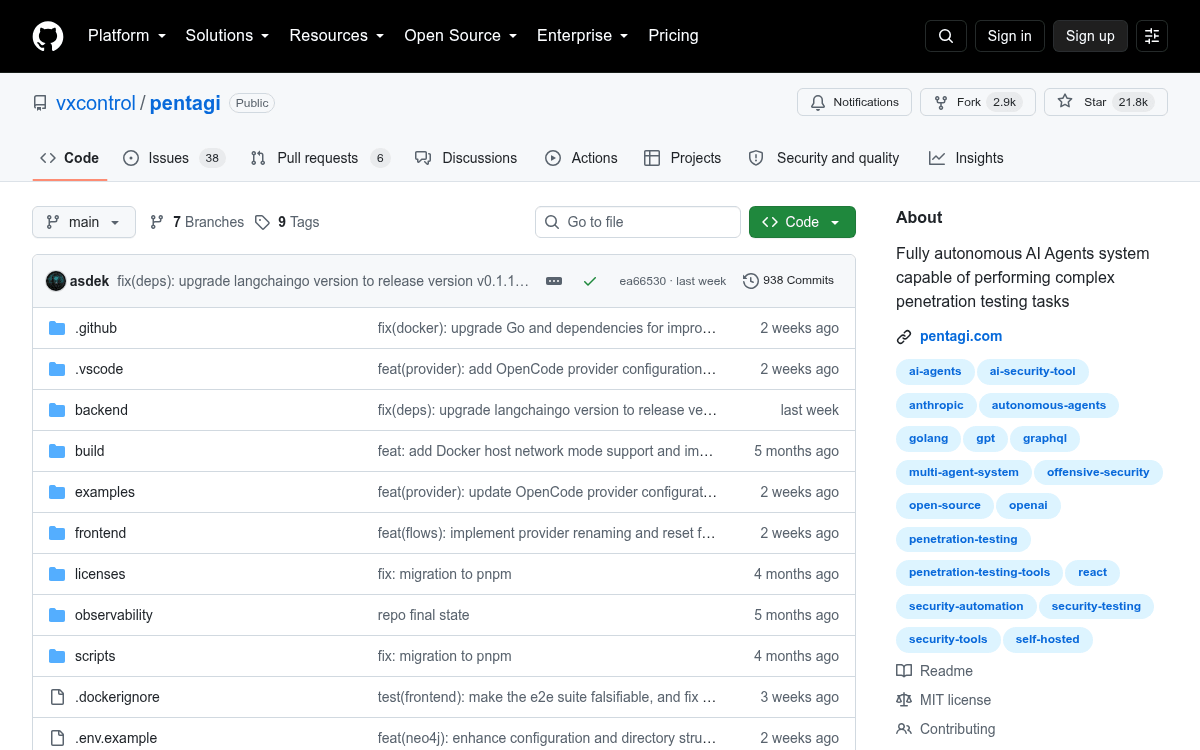
PentAGI is an open-source, self-hosted multi-agent system that autonomously plans and executes penetration tests using 20+ security tools inside sandboxed Docker containers.
Takeaways
- What it is: PentAGI is an open-source, self-hosted multi-agent system that autonomously runs penetration tests end-to-end inside sandboxed Docker containers.
- Agent architecture: 13 specialized agent types (orchestrator, researcher, coder, pentester, adviser, etc.) each assignable to a different LLM model via YAML config.
- Supervision system: Optional execution monitoring and task planning layers deliver a reported 2x quality improvement for models under 32B parameters, at 2–3x token cost.
- Provider support: Works with 10+ LLM providers including OpenAI, Anthropic, Gemini, AWS Bedrock, Ollama, DeepSeek, Qwen, and others; fully local deployment supported via vLLM.
- Memory: Three-layer memory system (long-term vector store, working memory, episodic memory) plus optional Graphiti/Neo4j knowledge graph for semantic relationship tracking.
- Access: MIT-licensed, deployable via Docker Compose with an interactive installer; full REST and GraphQL APIs available for programmatic flow control.
Penetration testing has always been a human-intensive craft. You map the target, pick your tools, chain your exploits, and write the report. PentAGI, an open-source project from vxcontrol, attempts to hand that entire workflow to a team of specialized AI agents , autonomously, end-to-end, with no human in the loop unless you want one.
One prompt, many agents
The core idea is a "flow": you describe a target and an objective in plain English, pick an LLM provider, and PentAGI decomposes the work into tasks and subtasks, each handled by a different specialist agent. The roster includes a primary orchestrator, a researcher, a coder, a pentester, an installer, a searcher, an enricher, a reflector, and an adviser , 13 distinct agent types in total. Each agent gets its own model assignment, so you can run a cheap flash model for reconnaissance and a frontier reasoning model for exploit development.
All tool execution happens inside sandboxed Docker containers. The system automatically selects between a generic Debian image and a Kali Linux image based on the task at hand, and it ships with more than 20 professional security tools pre-installed , nmap, Metasploit, sqlmap, and others. Nothing touches the host directly.
The supervision layer that makes smaller models viable
One of the more interesting engineering choices is the agent supervision system. Two optional beta features address a real problem with autonomous agents: they loop, get stuck, and repeat themselves.
- Execution Monitoring (
EXECUTION_MONITOR_ENABLED): a mentor agent watches for repeated identical tool calls (threshold: 5) or excessive total calls (threshold: 10) and intervenes with alternative strategies. The project reports a 2x improvement in result quality when tested with Qwen3.5-27B-FP8, at the cost of 2–3x more tokens and time.