PyTorch is an open-source deep learning framework, originally developed by Meta, that enables researchers and developers to build and train neural networks in Python with GPU-accelerated tensor computation and dynamic computation graphs. Now stewarded by the PyTorch Foundation under the Linux Foundation, it has become one of the most widely adopted frameworks in both academic research and production AI development.
Helion now picks fast GPU kernel configs by analyzing IR at compile time, skipping hours of autotuning while beating handwritten Triton and CUDA baselines.
Google and Meta ship a native PyTorch backend for TPUs with true eager execution, torch.compile, vLLM and SGLang support, and near-linear scaling to full pods.
Zephon plugs into TorchTitan to deliver identical global batches across GPU counts, so a job resumed on different hardware trains on the exact same data.
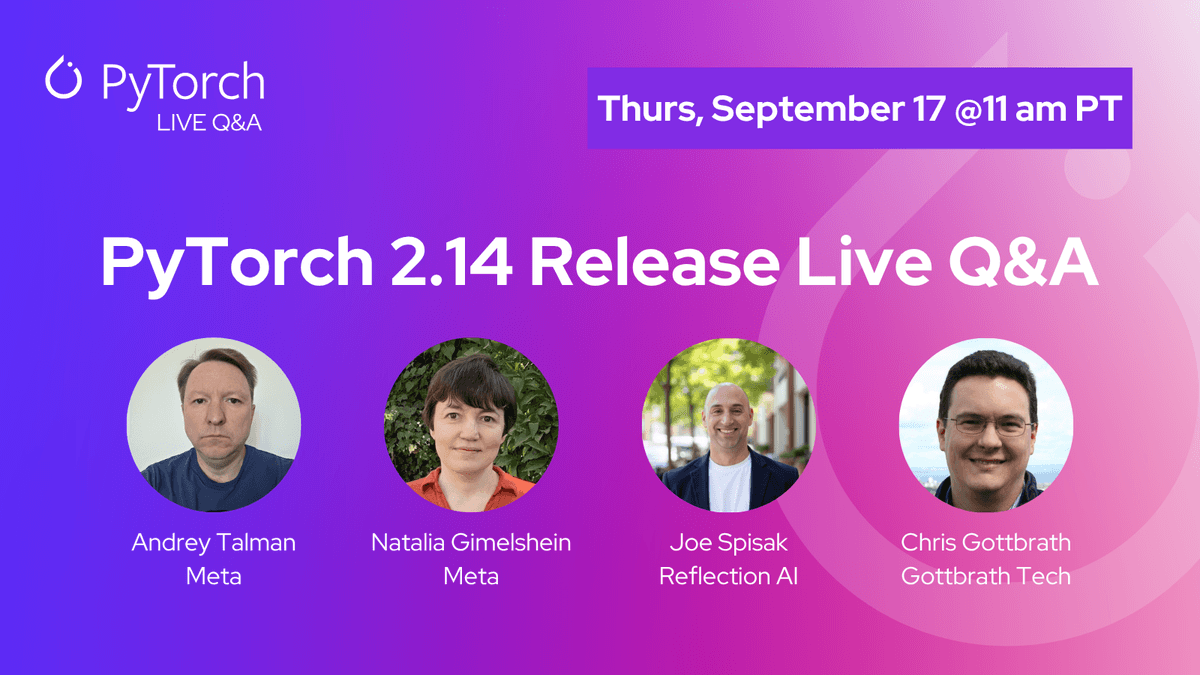
PyTorch 2.14 lands with a new CUTLASS-based GEMM backend, in-place fault tolerance for distributed training, and native linear algebra on Apple Silicon.
The latest PyTorch release ships NVGEMM CUTLASS kernels for Inductor, a rebuilt nccl2 backend, native Apple Silicon linear algebra, and first-class fault tolerance.
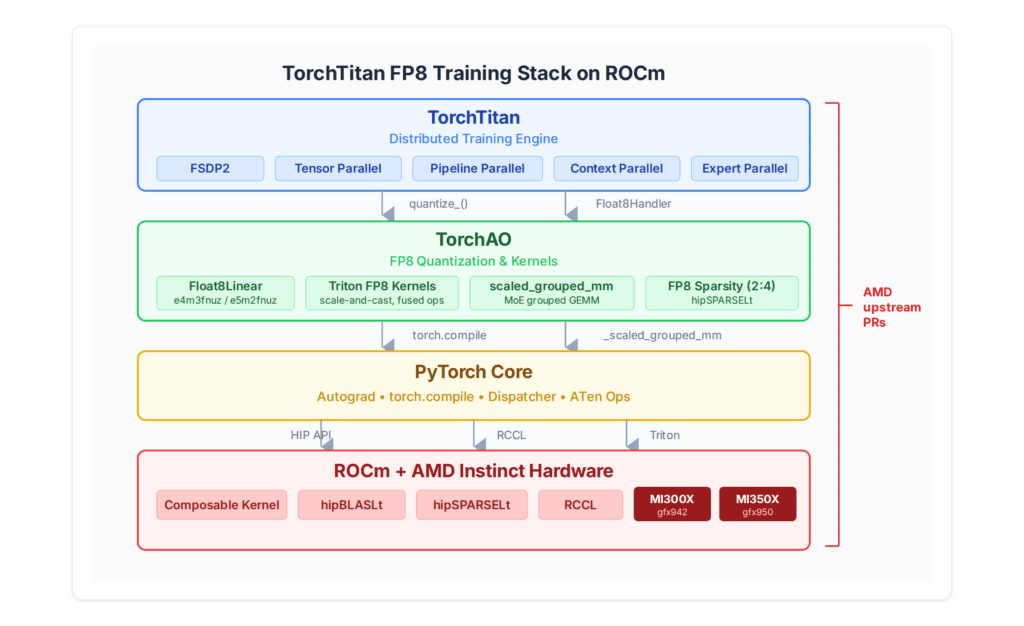
AMD upstreams FP8 training optimizations into TorchTitan and TorchAO, delivering 13.4% throughput gains on dense models and recovering 89% of MoE quantization overhead
PyTorch-Triton 3.7 ships a plugin system that loads custom compiler passes at runtime, ending the era of maintaining Triton forks for hardware-specific optimizations
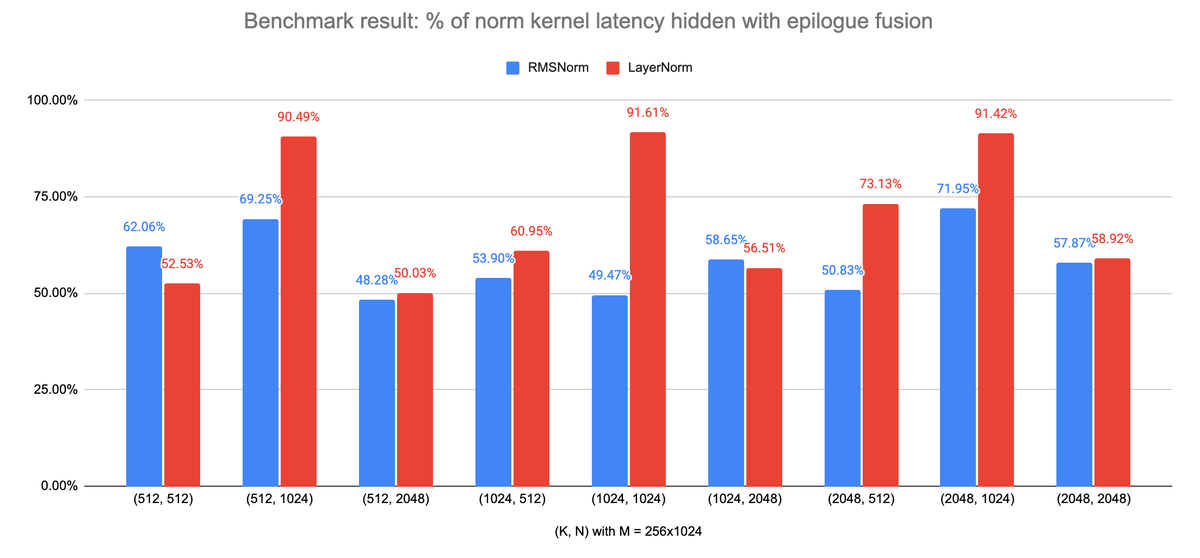
Meta's new kernel fusion techniques hide up to 90% of LayerNorm/RMSNorm latency inside GEMM and Attention kernels, cutting full Attention block latency by 35%
OpenEnv gains a multi-org governance committee spanning Meta, NVIDIA, Hugging Face, and more — becoming the shared infrastructure layer for open-source agentic RL training.