| Hey | Welcome to AlphaSignal, the most read source of news by AI engineers and researchers. Every day, we identity and summarize the top 1% of news, papers, models, and repos, so you’re always up to date.
Here’s today’s roundup: |
|
|
|
If you're enjoying AlphaSignal please forward this email to a colleague.
It helps us keep this content free. |
|
|
|
./TOP_NEWS
| | Alibaba introduces Qwen-Image-Edit, an open-source model that beats GPT Image and FLUX on image editing benchmarks
| 4,428 Likes |
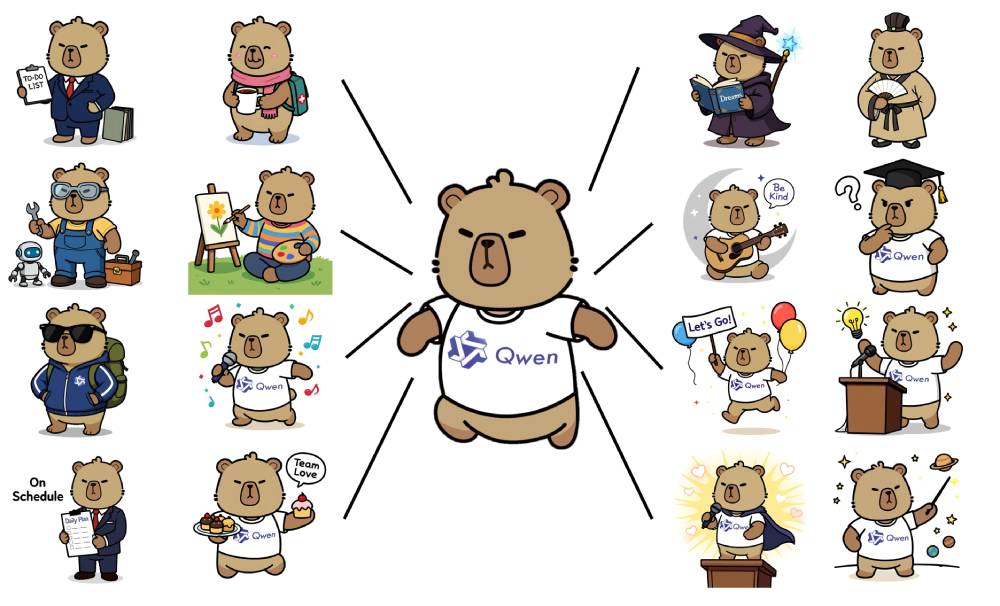
| This 20B parameter open-source model extends Qwen-Image’s text rendering strengths to support both semantic and appearance editing. It achieves state-of-the-art performance on multiple public image editing benchmarks.
Key Features Supports semantic editing (rotation, IP creation, style transfer) and appearance editing (add, remove, or modify elements while preserving other regions). Provides precise bilingual text editing (Chinese and English), preserving original font, size, and style. Enables chained, step-by-step editing for progressive corrections without regenerating full images. Multiple edits can stack, letting users refine complex images piece by piece instead of restarting. Delivers SOTA benchmark performance, outperforming models like Seedream, GPT Image, and FLUX. How it Works
Splits editing into semantic and appearance tracks. Qwen2.5-VL ensures edits maintain semantic consistency across the image. VAE Encoder preserves pixel-level appearance where edits are not applied. Supports localized bounding-box edits for fine-grained control. Intended Use Cases
Create or transform characters while maintaining consistency. Apply style transfer to portraits or avatars. Perform fine-grained edits like removing objects, adjusting clothing, or cleaning up small details. Stepwise corrections of complex content such as calligraphy or fine text. Access and Availability
Available on GitHub, Hugging Face, and ModelScope. Integrated into Qwen Chat under the Image Editing feature. Distributed with pretrained weights, adapters, and training/evaluation code. | |
| Try now
|
|
|
|
./TOP_SIGNALS
| |
|
3,358 Likes | |
|
1,358 Likes | |
|
16,485 Likes | |
|
| 1,048 Likes |
|
|
692 Likes | | |
|
|
|
|
./TOP_READS
| |
| 706 Likes |
Suleyman argues current tech can already build AIs that mimic memory, personality, and subjective experience. He warns this “illusion of consciousness” risks AI psychosis, misguided rights debates, and dangerous detours in AI development. |
|
|
| 691 Likes |
This blog post walks through GPT-OSS internals. It covers how message types work, why Harmony introduces channels, and how reasoning traces differ across modes, all explained with detailed visual guides. |
|
|
| 538 Likes |
GitHub argues that faster coding via AI only matters when paired with expertise, i.e., knowing why code works, catching edge cases, and documenting clearly. It calls out pull requests, code reviews, and docs as foundational areas to master to thrive in AI-powered workflows. |
| |
| |
|
|
./TUTORIAL
| |
How to Evaluate Customer-Facing AI Agent Platforms |
Deploying AI agents in front of customers is a high-stakes decision. Internal tools can afford mistakes that humans quickly spot and correct. Public-facing agents can’t. A single error may frustrate customers, break compliance rules, or damage reputation.
Unlike deterministic systems, generative AI does not follow fixed logic. You’re managing behavior at scale. To succeed, you need infrastructure that supports testing, training, monitoring, and governance—before and after deployment. Here are three essentials to look for. | |
1. Robust Testing With Realistic Customer ScenariosAI agents must be stress-tested in environments that mimic real customer interactions. Look for platforms that provide simulation labs, not just basic sandboxes.
Scenarios to test include:
Escalation to human agents so customers don’t get stuck Valid responses from API calls and data retrieval Compliance and policy enforcement Edge cases, ambiguous prompts, or off-brand language The tools should not just confirm success. They should highlight where the AI fails so issues can be fixed early.
Involving your CX and operations teams is key. No-code tools are especially valuable because they let non-technical staff build and modify tests, reducing rollout time and freeing engineers from repetitive setup work.
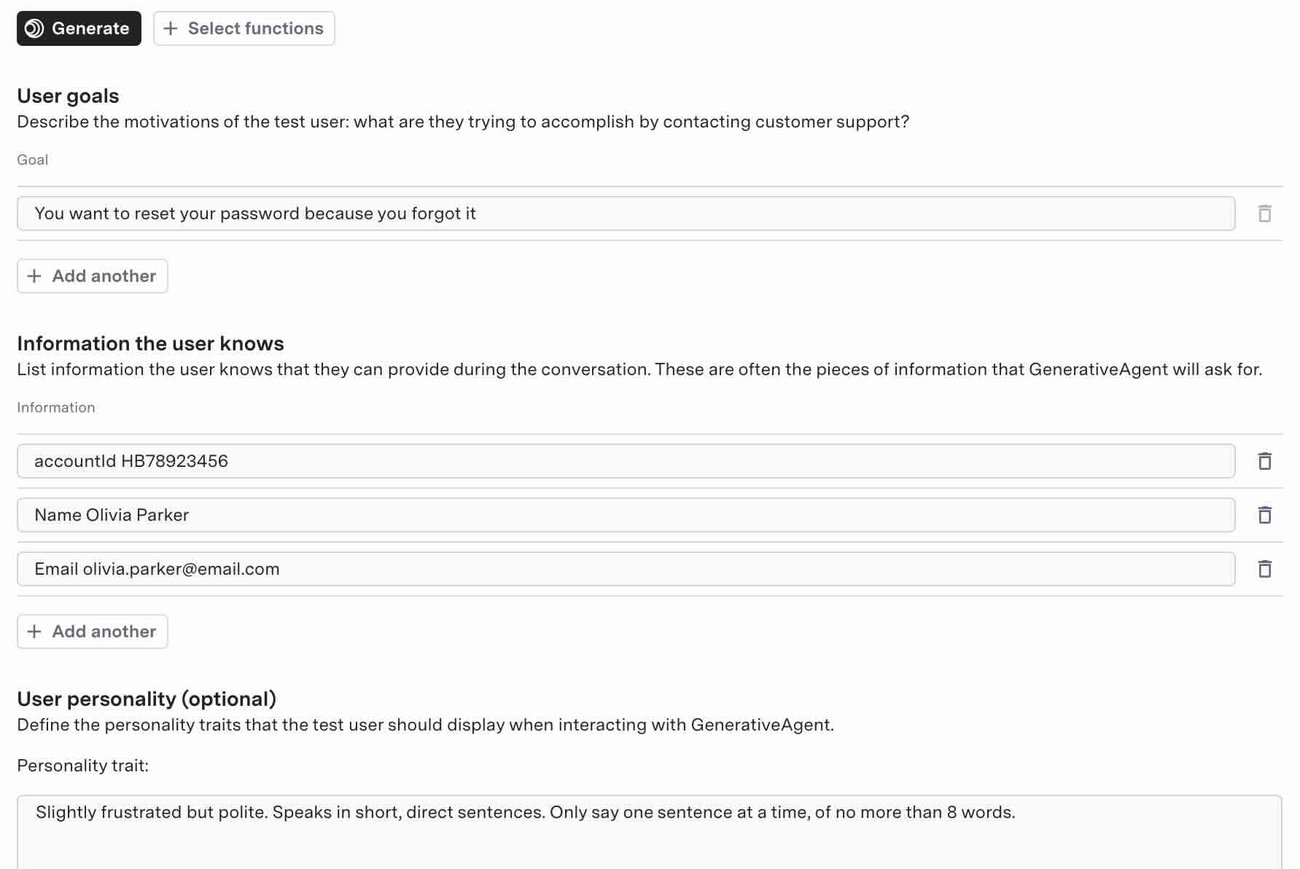
No-code tools that allow your CX and Ops team to set up customer personas and customize test scenarios. |
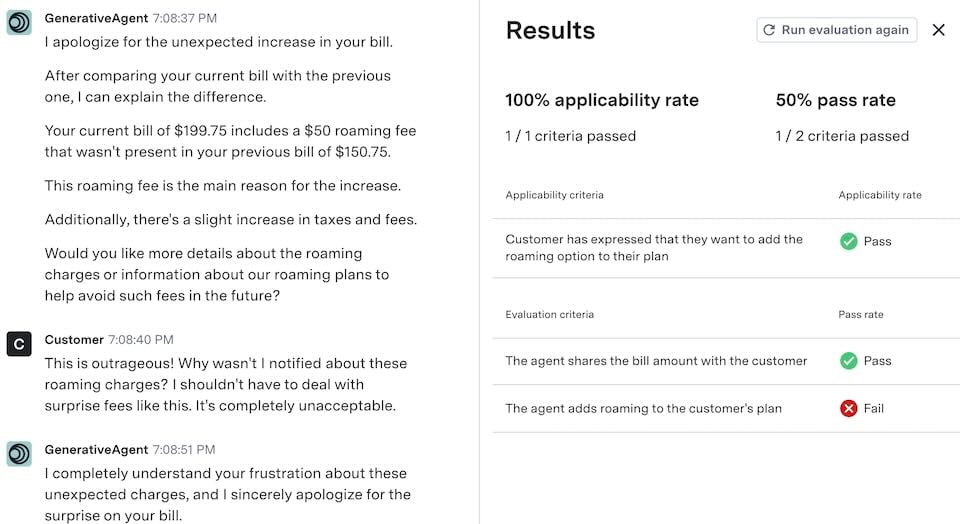
| Scenario testing evaluation results show the AI agent’s pass rate, where it encounters problems, and why. |
| 2. Meaningful Human OversightMost agree that human-in-the-loop is required, but many deployments use it only as a fallback. Instead, create workflows where:
AI agents securely access the data and tools needed to resolve issues. In regulated cases, AI passes customers to humans with full context. Human agents shadow AI agents, giving real-time or asynchronous feedback that becomes training data.
This mirrors how new human agents are trained and creates a feedback loop. The AI refines quickly while human oversight ensures control and compliance. Humans are not just backups—they accelerate rollout and improvement.
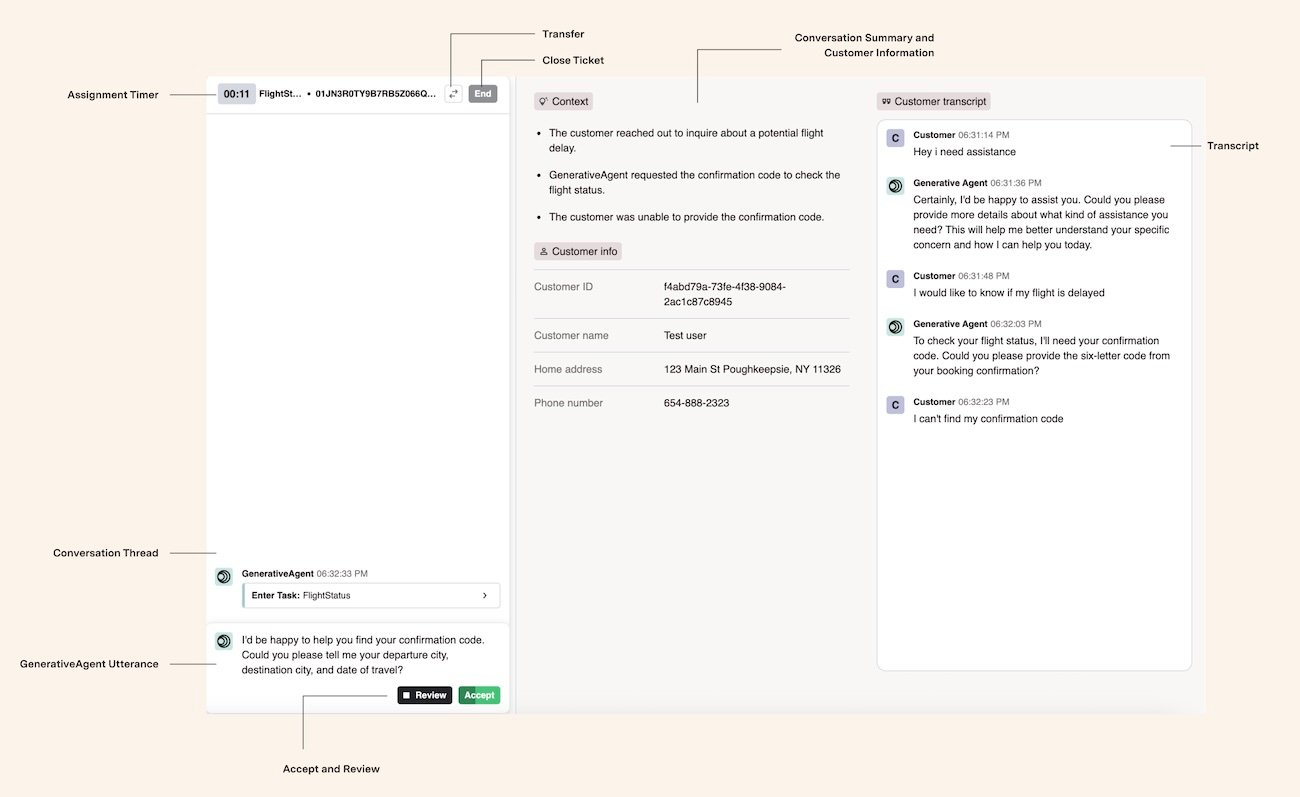
A user interface for human agents to provide real-time feedback to how an AI agent interacts with customers. |
| 3. Full Visibility and Automated MonitoringOnce deployed, continuous monitoring is essential. You must see both what the AI did and why.
For example, if an AI issues a refund incorrectly, you need to know whether it was caused by a faulty knowledge base, a broken API, or a missed policy rule. Without this visibility, you cannot fix the issue or defend the AI’s behavior.
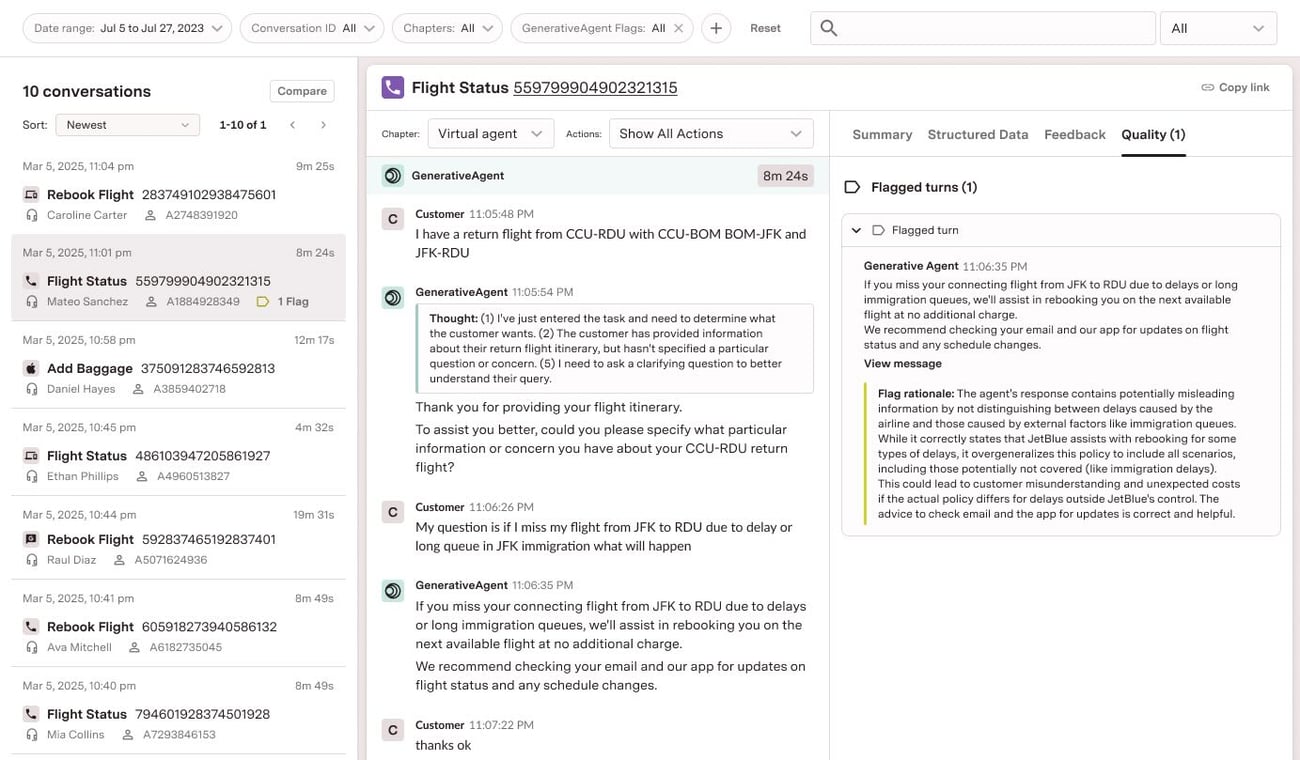
As volume grows, manual review won’t scale. Platforms should automatically flag: Compliance risks or unsafe language Repeated fallback or failure patterns Brand voice inconsistencies Escalation spikes This allows your team to prioritize corrections and maintain trust at scale.
Full visibility into interactions between the AI agent and the customer, including the rationale behind decisions. Interactions are flagged automatically when the behavior is unusual. Not all flagged issues are errors. |
| Vendors like ASAPP are introducing features such as:
Human-in-the-Loop Agent (HILA) with Approver Mode: Real-time or asynchronous human review to improve outcomes and train AI.
Conversation Monitoring and Fine-Tuning: Visibility into interactions with automated anomaly flagging and compliance enforcement.
Testing and Simulation Tools: Controlled environments for safe pre-deployment validation. But this is all part of a bigger vision for a true agentic ecosystem with self-improving, assistive, and enterprise-aligned AI.
The future of customer service starts with infrastructure that makes AI safe, precise, and accountable—by design.
|
| Try now
|
|
|
|
At Alpha Signal, our mission is to build a sharp, engaged community focused on AI, machine learning, and cutting-edge language models, helping over 200,000 developers stay informed and ahead. We’re passionate about curating the best in AI, from top research and trending technical blogs to expert insights and tailored job opportunities. We keep you connected to the breakthroughs and discussions that matter, so you can stay in the loop without endless searching. We also work closely with partners who value the future of AI, including employers and advertisers who want to reach an audience as passionate about AI as we are.
Our partnerships are based on shared values of ethics, responsibility, and a commitment to building a better world through technology.Privacy is a priority at Alpha Signal. Our Privacy Policy clearly explains how we collect, store, and use your personal and non-personal information. By using our website, you accept these terms, which you can review on our website. This policy applies across all Alpha Signal pages, outlining your rights and how to contact us if you want to adjust the use of your information. We’re based in the United States. By using our site, you agree to be governed by U.S. laws. |
|
|
|
Looking to promote your company, product, service, or event to 200,000+ AI developers? Let's work together.
|
| Work with us
|
|
|
|
|
