|
Hey,
Your daily briefing is ready. You can finally take a break from the AI firehose.
Our algos spent the night splitting signal from noise and pulled the top news, models, papers, and repos.
Here’s the must-read:
|
|
Together with:
|

|
|

|
Today's Author
Lior Alexander. Founder of AlphaSignal and former ML Engineer.
Previously built ML systems at Iguazio, Guesty, Enphase, Mila.
|
|
Top News
|
|
|
|
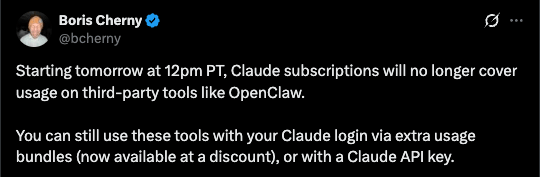
Anthropic ends third-party agent like OpenClaw access under Claude plans, requires credits or API keys
|
|
16,539 Likes
|
|
Anthropic updates Claude subscriptions to exclude third-party tools like OpenClaw. Starting April 4, these tools no longer use Pro or Max plan quotas.
Policy change
Claude plans stop covering third-party agent workloads.
- Third-party tools now consume paid usage credits instead of subscription limits
- Applies to integrations using Claude login inside external agent platforms
- System prompt checks identify and restrict non-first-party usage attempts
- Requests return errors when attempting to use plan-based quota through agents
Reason for change
Anthropic adjusts for demand from continuous agent execution.
- Agent tools send persistent, high-frequency requests beyond plan assumptions
- Flat-rate pricing fails under sustained autonomous task execution patterns
- Capacity management prioritizes direct product usage and API customers
- Company states change supports long-term service stability and allocation control
Pricing updates
Anthropic introduces credits and revised access paths.
- One-time credit equals the user’s current monthly subscription payment
- Discounted usage bundles replace subscription coverage for external tools
- Refund option provided through email link for users choosing cancellation
- API key access continues with standard pay-as-you-go billing structure
|
|
|
|
Presented by Augment Code
|
|
Spec Driven Development. With Agents. Done Right.
|
|
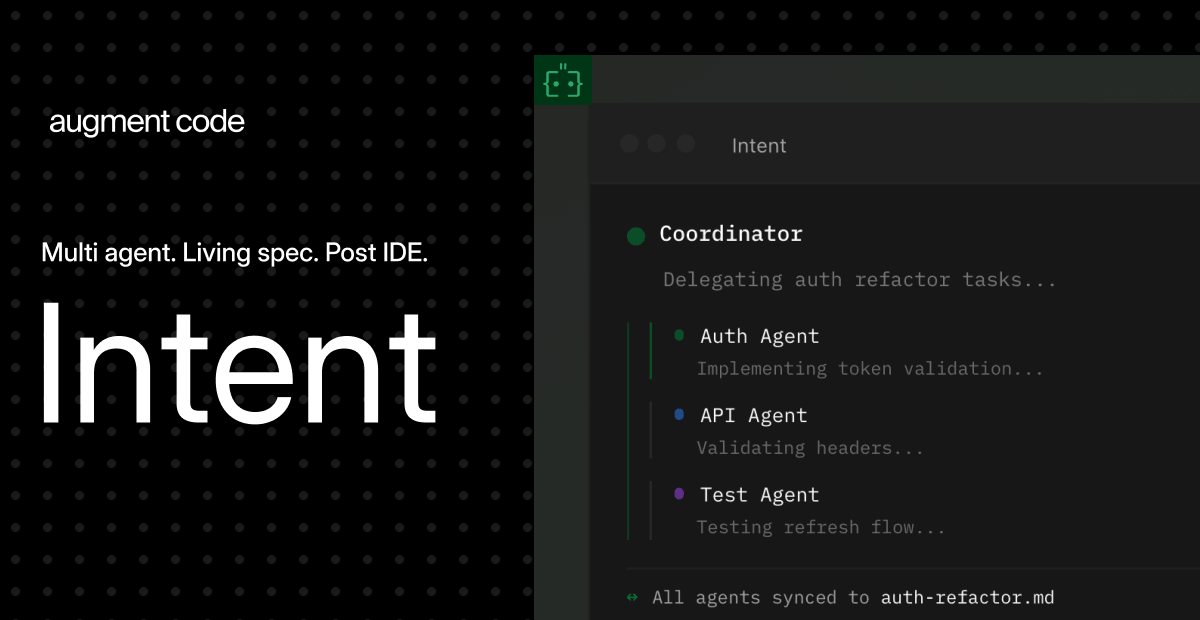
You wrote a spec. Now you're prompting one agent at a time? This isn’t 2025.
Intent is a developer workspace for orchestrating multiple agents from a living spec. Go from idea to PR without juggling terminals, repo copies, or stale prompts.
Works with Augment, Claude Code, Codex, and Open Code.
|
|
|
|
partner with us
|
|
Top Paper
|
|
|
|
Netflix presents VOID, an open-source framework enabling video object removal with updated motion
|
|
4,528 Stars
|
|
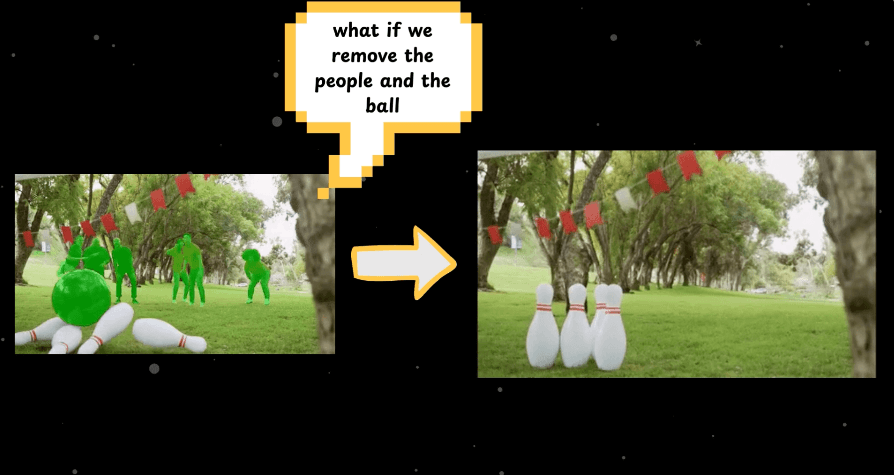
Netflix introduces VOID, an open-source framework that removes objects from videos and updates the physical interactions they cause.
Most tools only fill in pixels behind removed objects, which breaks motion and collisions in the scene. VOID instead generates a new version of the video where objects move and react as if the removed object never existed.
What it does
VOID edits videos by simulating cause-and-effect, not just appearance.
- Removes selected objects while updating motion, collisions, and trajectories across frames
- Uses a vision-language model (image + text reasoning system) to find affected regions
- Builds a quadmask that separates removed, affected, and preserved areas
- Runs a video diffusion model to regenerate consistent frames over time
How it works
VOID trains on examples where object removal changes interactions.
- Uses Kubric for physics-based synthetic scenes and HUMOTO for human motion data
- Learns from paired inputs: original video, mask, and correct counterfactual outcome
- Runs a second pass with flow-guided noise to stabilize object shapes if needed
Results
VOID improves consistency compared to standard inpainting methods.
- Handles gravity, collisions, and chain reactions after object removal
- Avoids artifacts like floating objects or broken motion paths
- Evaluators prefer VOID outputs in ~66% of comparisons vs baseline models
|
|
|
|
Top News
|
|
|
|
Nous Research announces modular memory in Hermes Agent update with support for custom backend providers
|
|
2,592 Likes
|
|
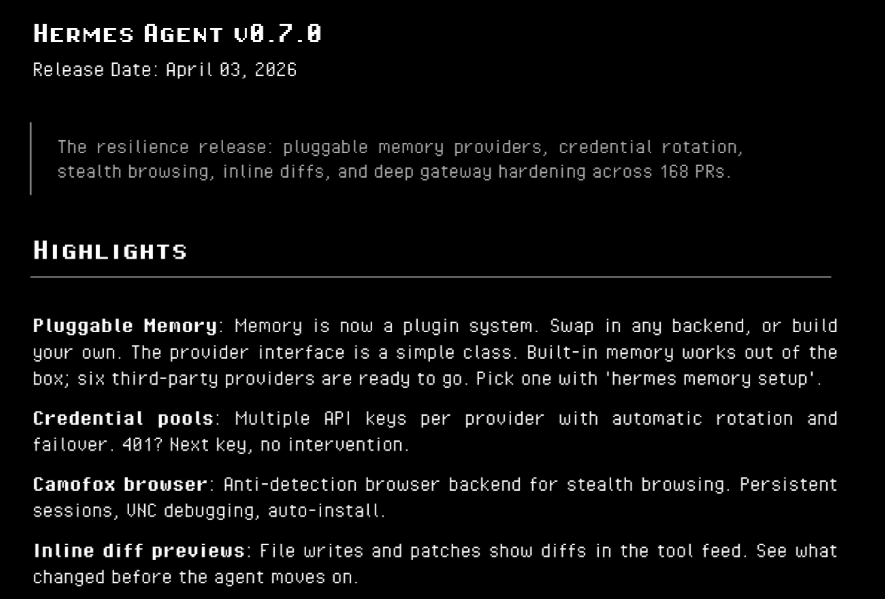
Nous Research releases Hermes Agent v0.7.0 with a shift toward modular memory and more stable agent execution.
The update replaces fixed memory with a plugin system, so the agent no longer depends on a single storage design. The key change lets you choose or build memory backends, which changes how agents store and retrieve context across tasks.
What it does
Hermes Agent runs autonomous tasks using tools, APIs, and stored context.
- Executes multi-step workflows using models, tools, and external services
- Stores context (“memory”) so agents reuse past information across tasks
- Integrates with editors, APIs, and browsers through tool plugins
- Supports long-running sessions with persistent state and tool access
Key features
This release adds modular systems and execution visibility.
- Pluggable memory system supports custom backends like vector stores or databases
- Credential pools rotate API keys automatically to handle failures and limits
- Camofox browser enables local browsing with session persistence and debugging access
- Inline diff previews show file changes before the agent continues execution
- Security checks block secret leaks from prompts, URLs, and tool outputs
|
|
|
At Alpha Signal, our mission is to build a sharp, engaged community focused on AI, machine learning, and cutting-edge language models, helping over 200,000 developers stay informed and ahead. We’re passionate about curating the best in AI, from top research and trending technical blogs to expert insights and tailored job opportunities. We keep you connected to the breakthroughs and discussions that matter, so you can stay in the loop without endless searching. We also work closely with partners who value the future of AI, including employers and advertisers who want to reach an audience as passionate about AI as we are.
Our partnerships are based on shared values of ethics, responsibility, and a commitment to building a better world through technology.Privacy is a priority at Alpha Signal. Our Privacy Policy clearly explains how we collect, store, and use your personal and non-personal information. By using our website, you accept these terms, which you can review on our website. This policy applies across all Alpha Signal pages, outlining your rights and how to contact us if you want to adjust the use of your information. We’re based in the United States. By using our site, you agree to be governed by U.S. laws.
|
|
|
Looking to promote your company, product, service, or event to 250,000+ AI developers?
|
|
|
|
|
