AI agents are handling tasks with increasingly long contexts. They analyze massive code repositories, process hours of conversation history spanning across days or weeks, and execute complex workflows across multiple files and applications.
As these contexts grow, the compute and memory costs of running prompts explode. Response times crawl to a halt, making continuous agentic interactions expensive and impractical.
One way the AI community is tackling this bottleneck is by optimizing the “attention mechanism,” or how large language models store and recall information in their context window.
The core challenge
To understand the bottleneck, you have to look at how LLMs process information. The standard attention mechanism requires every new token to compute its relation to all previous tokens in the sequence.
This design creates a quadratic compute cost. If you double the length of the prompt, the math required to process it quadruples.
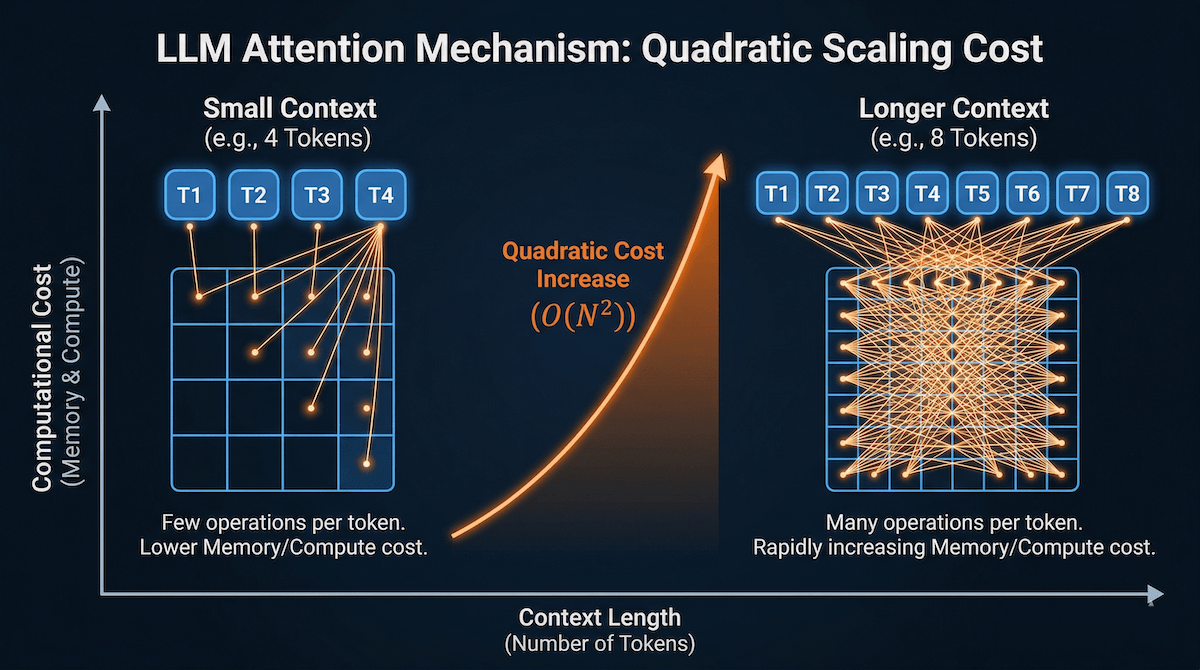
To avoid recalculating the entire sequence for every new token, LLMs use a Key-Value (KV) cache. The KV cache stores the mathematical representations of past tokens in a temporary memory bank.
While the KV cache solves the immediate compute problem, its size scales linearly with the context length. This creates massive memory overhead that impacts two distinct stages of LLM inference:
- Prefill: The initial stage where the model ingests the user's prompt. Processing a massive prompt requires an enormous, immediate block of compute and memory. This increases the “time to first token” (TTFT), or how long it takes for the model to start generating the response.
- Decode: The generation stage where the model produces new tokens sequentially. Here, the sheer size of the KV cache slows down the memory bandwidth, capping generation speed.
When an AI coding agent handles an entire repository, or when a framework like OpenClaw manages tasks over several hours, the KV cache eventually exhausts the available GPU memory. The system is forced to offload data or crash, entirely breaking the agentic workflow.
The simple fixes
Developers initially addressed this memory wall with straightforward heuristics. These methods reduce the memory footprint but introduce compromises in model accuracy and reasoning.
- Sliding window attention: The model maintains a fixed-size window of recent tokens. As the model generates new tokens, it drops the oldest tokens from the cache. This saves space but induces "amnesia," preventing the model from recalling early instructions or initial prompt guidelines.
- Context summarization: The system periodically condenses past interactions into a shorter text summary. While this limits the context length, it inherently loses pertinent, fine-grained information that the agent might need later in the workflow.
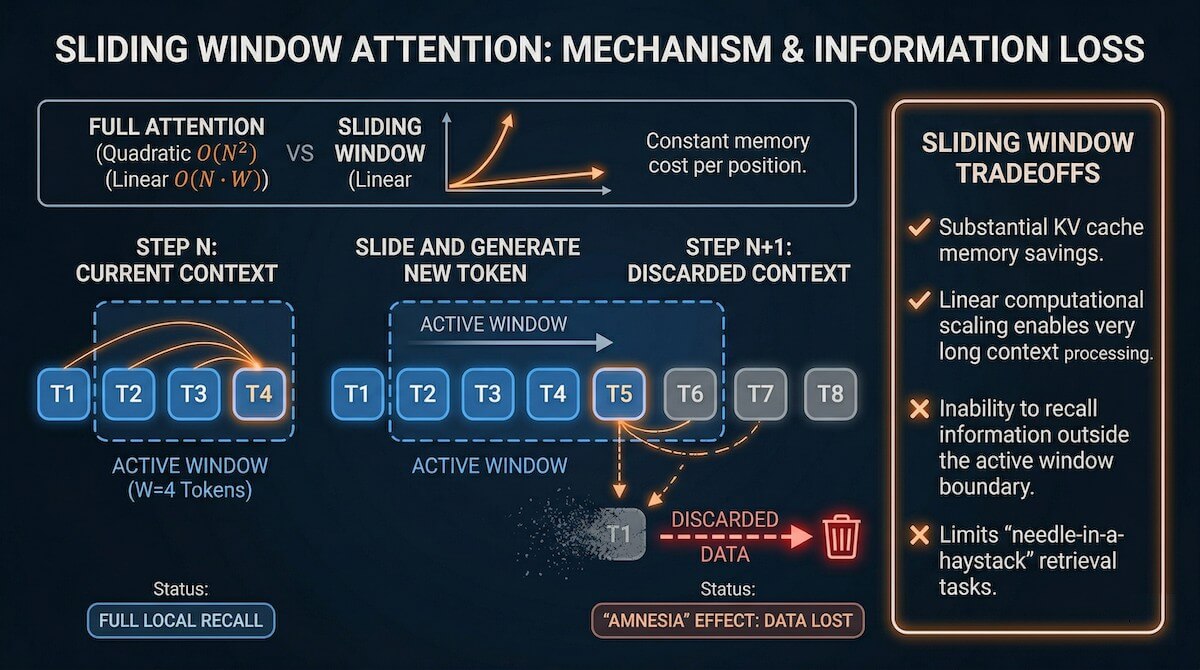
In one example, context summarization deleted important instructions in its initial prompt, which resulted in the agent carrying out tasks that it was explicitly told not to do.
Sparse attention
Sparse attention fixes the memory problem of full attention while avoiding the amnesia of sliding windows. Instead of attending to everything or dropping tokens chronologically, the model dynamically attends to the most critical parts of the context window.
DeepSeek models, starting with DeepSeek-V3.2, use DeepSeek Sparse Attention (DSA). DSA replaces brute-force quadratic interactions with a more efficient two-stage pipeline.
First, a lightweight “lightning indexer” quickly scans the context to determine which tokens are most relevant to the current generation step. Then, the model performs the heavy attention calculations only on that specific selection of tokens.
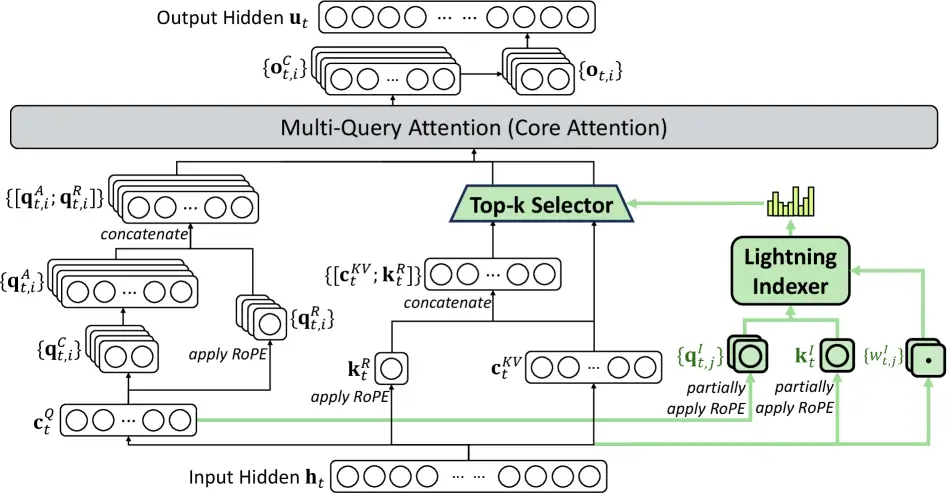
This results in the model’s attention memory and compute cost remaining relatively constant as the context continues to grow.
Researchers at Z.ai recently introduced IndexCache, an upgrade to DSA. IndexCache optimizes the indexing stage by reusing indexed tokens across adjacent layers.
This cross-layer reuse strips out redundant computations. Tests show it reduces indexer math by 75% and delivers 1.82x faster inference on long-context models with negligible quality loss.
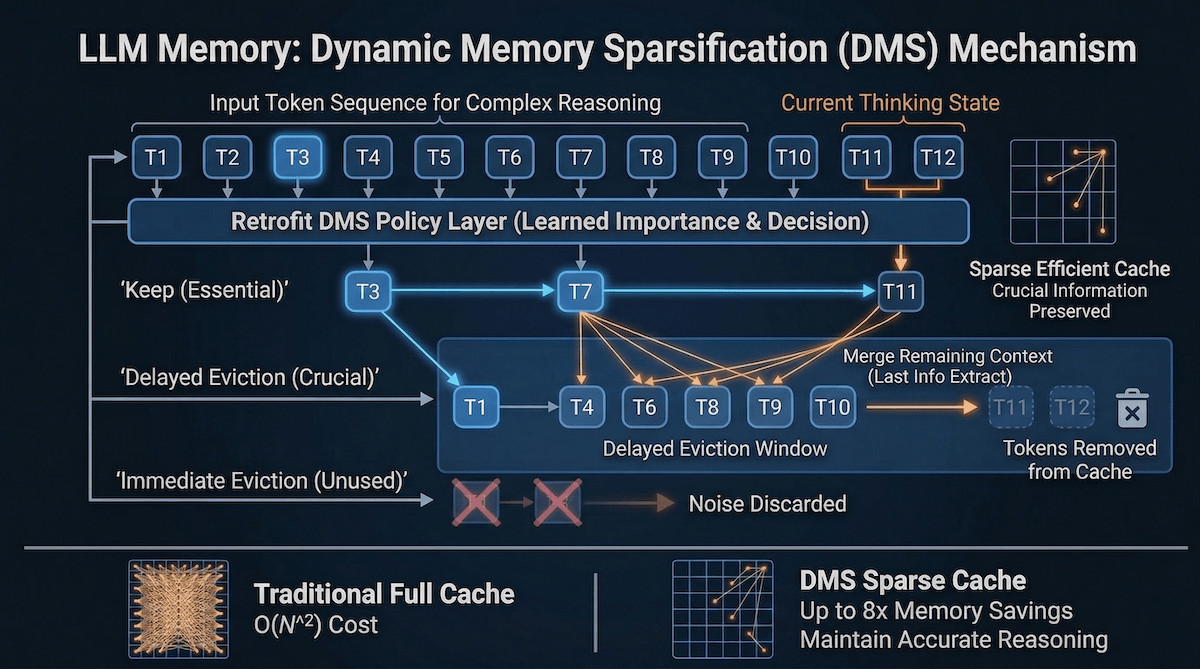
Nvidia tackles sparse attention differently with Dynamic Memory Sparsification (DMS). The advantage of DMS is that it can be applied to existing models by retrofitting them to learn to drop tokens that are not relevant to the current task.
However, instead of dropping tokens immediately, DMS uses a "delayed eviction" mechanism. This acts like periodic garbage collection. It allows tokens to age out gracefully so the model can extract any remaining value before purging them.
Nvidia’s research shows that on some models, DMS cuts reasoning costs by 8x without losing accuracy.
Sparse attention delivers superior overall performance on long-context tasks. Its primary challenge surfaces in tasks that require retrieving highly specific, isolated pieces of information from deep within the context, often referred to as needle-in-a-haystack retrieval.
KV cache compression
KV cache compression takes a different path. Instead of dropping tokens, it preserves the entire attention trace but mathematically compresses the KV cache data itself.
Nvidia’s KV Cache Transform Coding (KVTC) applies principles similar to media codecs, like JPEG compression, to LLM memory.
KVTC uses Principal Component Analysis (PCA) to compress the attention features. PCA is a technique commonly used in machine learning to reduce dimensionality in complex feature spaces.
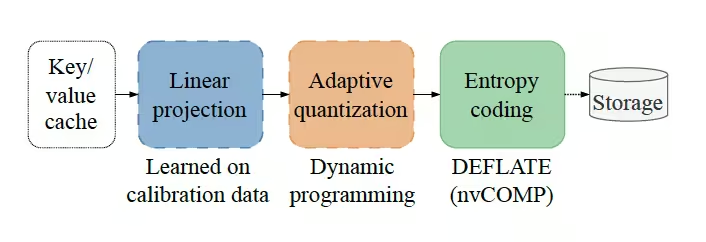
This mathematical compression shrinks the memory footprint up to 20x. It accomplishes this without requiring developers to change or retrain the underlying model weights.
The challenges of compression is the compute overhead it introduces and balancing the degree of compression against information loss.
Compressing the full prompt during the prefill stage requires significant computation, especially if it includes large documents. If the compression math is too heavy, it can cause a severe slowdown in the time-to-first-token.
Techniques like KVTC navigate these tradeoffs effectively. By offloading the compression math efficiently, KVTC slashes time-to-first-token by up to 8x for massive prompts while maintaining the full attention trace.
Why attention optimization matters for developers
These optimizations unlock a new class of always-on agentic applications. By allowing models to think longer within the same memory constraints, developers can build tools that maintain continuous context over days or weeks.
When choosing between optimization methods, you need to align the technique with the specific demands of your workload.
Consider the following decision matrix for your applications:
- For short-context tasks: Rely on models with full precision of standard attention to guarantee maximum accuracy.
- For general reasoning over long contexts: Use sparse attention models to balance speed, memory, and recall.
- For detailed retrieval from massive contexts: Use KV cache compression to preserve the complete attention trace and avoid dropping critical information.