Hey, | Welcome to this week's edition of AlphaSignal.
Whether you are a researcher, engineer, developer, or data scientist, our summaries ensure you're always up-to-date with the latest breakthroughs in AI.
Let's get into it!
Lior |
|
|
|
IN TODAY'S EMAIL | Read Time: 3 min 50 sec |
|
|
|
TOP NEWS | Inflection AI upgrades its chatbot Pi to near GPT-4 performance | 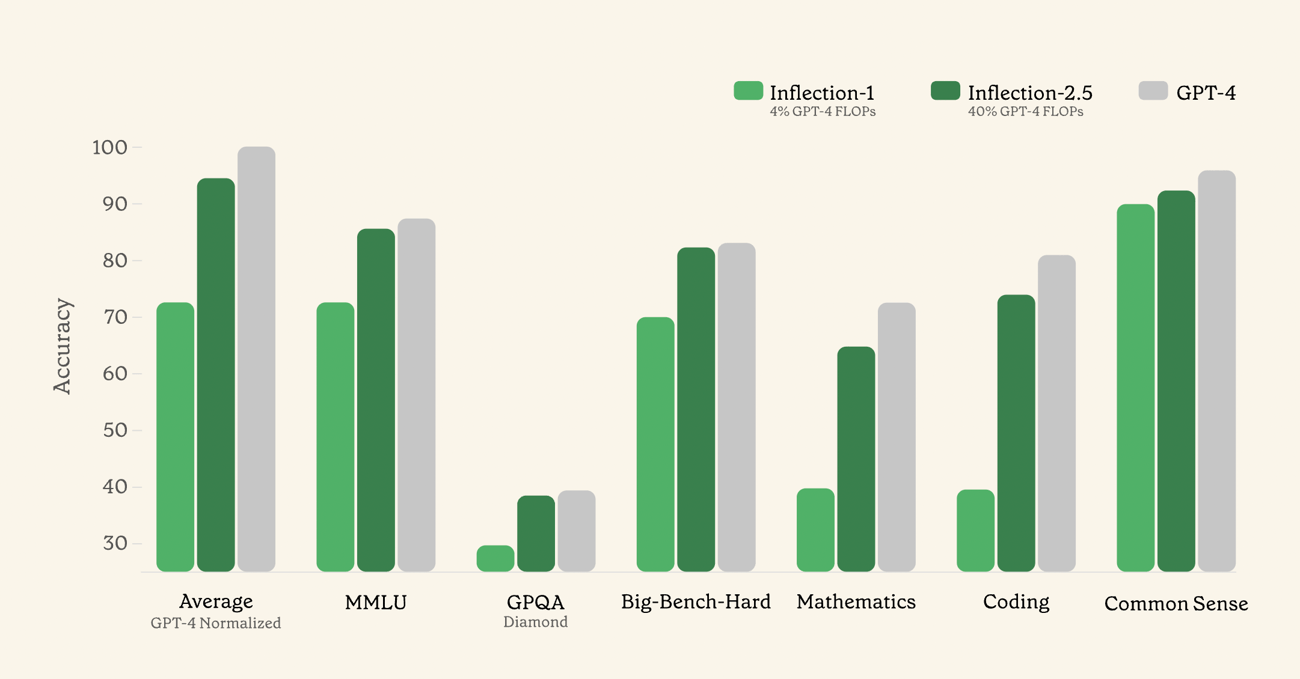 | What's New? | InflectionAI just announced the release of Inflection 2.5, its newest language model that powers Pi, the personal AI chatbot the company is developing.
After the focus on empathy, safety and personalization, InflectionAI is now adding strong intellectual performance to Pi. The unique empathetic fine-tuning performed on Pi is now complemented with strong reasoning capabilities.
Multiple IQ oriented tested are performed, and Pi 2 shows significant improvements compared to Pi 1, nears GPT-4 performance, but without surpassing it on any test. Math, reasoning, coding, are all assessed using datasets such as HumanEval, or MMLU.
Even if this latest model does not beat GPT-4, which is almost turning 1 year old, Inflection-2.5 wins in its training efficiency. It reportedly only used 40% of GPT-4's FLOPS (Floating Point Operations Per Second), although OpenAI has not released this number officially.
This low compute was likely achieved using techniques such as model pruning, knowledge distillation, low-rank approximations or layer factorizations.
The brand new version of Pi also boasts native real-time web retrieval capabilities, improving the user experience by allowing conversations about recent events. The tests on different benchmark are performed without web retrieval. However, the context window length is not as large as other models: Pi's context window is only 10% of Claude's 200,000 tokens.
Inflection-2.5 is available to all Pi's users, at pi.ai, on iOS, on Android, or the new desktop app. | | Try pi |
|
|
|
 | Secure your spot at TED2024 | April 15-19 | Did you know you could be a part of the TED Conference? Let new sources of insight inspire and transform your vision.
This year’s speaker lineup will feature the latest in technology, art, business, science and so much more. Seats are filling up fast – apply today. | | Register now | partner with us |
|
|
|
TOP REPO | Is Localhost History? Meet Daytona |  | What's New? | Daytona is an open-source development environment manager that automates the setup of coding environments.
It allows you to set up development environments across any infrastructure with a single command.
Key Features: - Supports multiple config file formats: dev containers, DevFiles, Nix, Flox
- Prebuild system accelerates environment setup
- Integrated web IDE along with VS Code and JetBrains IDE support locally
- Integrates with Git providers like GitHub, GitLab, Bitbucket for branch/PR management
- Multiple project repos can co-exist in the same workspace
- Reverse proxy enables collaboration by exposing preview ports and web IDE
How Daytona Changes Development: - Reduces Setup Time: By automating the environment setup, Daytona drastically cuts down the time developers spend configuring their workspaces.
- Facilitates Collaboration: The tool's reverse proxy integration and support for multiple project workspaces enhance collaboration among teams, especially in microservice architectures.
- Supports Customization: Daytona's extensible framework allows you to customize their development environments according to project requirements.
| | Check repo |
|
|
|
DEEP DIVE | Knowledge Distillation | Knowledge Distillation (KD) is a technique to transfer knowledge from a large, complex model (teacher) to a smaller, more efficient one (student). The essence of KD lies in its ability to capture the rich representations learned by the teacher model and impart them to the student, enabling the latter to perform tasks with comparable accuracy while being more resource-efficient.
Implementing KD begins with training the teacher model to its full capacity. Next, the student model is trained using a specific loss function.
This loss function is based not only the hard labels of the training data but also on the soft outputs (probabilities) generated by the teacher model. These soft outputs convey the teacher's confidence across various classes, offering a more nuanced understanding than hard labels alone.
The process typically utilizes a temperature parameter to soften the probabilities, making the distribution more informative and easier for the student to learn from. This parameter is key; it softens the output distributions, making them richer in information and easier for the student to assimilate.
Some popular teacher-student pairs include BERT (teacher) and DistilBERT (student) for NLP tasks, or ResNet50 and MobileNet for image classification. Below is an example of implementation of the KD process. |
import torch

import torch.nn.functional as F


def distillation_loss(student_logits, teacher_logits, targets, temperature):

    soft_loss = F.kl_div(F.log_softmax(student_logits / temperature, dim=1),

                         F.softmax(teacher_logits / temperature, dim=1),

                         reduction='batchmean') * (temperature ** 2)

    hard_loss = F.cross_entropy(student_logits, targets)

    return soft_loss + hard_loss


# Assuming teacher_model and student_model are defined and loaded

# Define temperature and alpha for balancing the loss components

temperature = 5.0

alpha = 0.5


# Compute teacher and student outputs

teacher_logits = teacher_model(input_data)

student_logits = student_model(input_data)


# Compute distillation loss

loss = distillation_loss(student_logits, teacher_logits,
                        targets, temperature)


# Backpropagate and update student model

loss.backward()

optimizer.step()
|
|
|
|
| | Ghita is an editor at AlphaSignal and AI Engineer at Clear Ventures. Experienced in Computer Vision and Language models, she holds 2 masters in Applied Mathematics. | | Thank You. |
| | Want to promote your company, product, job, or event to 175,000+ AI researchers and engineers? You can reach out here. | |
|
|
|
|
