Hey, | Welcome to this week's edition of AlphaSignal.
Whether you are a researcher, engineer, developer, or data scientist, our summaries ensure you're always up-to-date with the latest breakthroughs in AI.
Let's get into it!
Lior |
|
|
|
IN TODAY'S EMAIL | Read Time: 4 min 28 sec |
|
|
|
TOP NEWS | --------------------- This is happening days after he sued OpenAI for abandoning its original mission in favor of a for-profit model. xAI released Grok last year, its features includes access to “real-time” information and information that countered “politically correct” views. | | --------------------- OpenAI’s Superalignment team released their internal tool to analyze transformers for interpretability. The Transformer Debugger helps you analyze small language models by automating interpretability and incorporating sparse autoencoders. It supports neuron and attention head interventions, providing insights without coding. | | --------------------- Command-R is a language model for retrieval-augmented generation and using external tools at production scale. It integrates with Cohere's embedding and re-ranking models to leverage external data sources, supports 128k token context across 10 languages, outperforms GPT-3.5 Turbo and Mixtral on RAG tasks per Cohere's evaluations at lower pricing. Model weights publicly released. | |
| |
|
|
 | Join SW2con: The Developer Conference Focused on AI | SW2con is the conference for developers who are planning, building or implementing AI projects. If you’re digging in, diving deep, or just making the jump to AI, SW2con is the conference for you.
SW2con is bringing together: Speakers from GitHub, Google, DataStax, IBM, Cloudflare, Microsoft, Sourcegraph, Redmonk (the developer analyst firm), and many others.
Topics including RAG, DPO and Fine-tuning; Synthetic Data and Model Tracing; Vector Databases, Embeddings and Code Assists; Security and Data Privacy in Enterprise AI; Runtimes for AI Agents and so much more.
Use the code “Alpha10” to get 10% off of your Early Bird Registration! | | Register now | partner with us |
|
|
|
TOP REPO | Reconstruct 3D scenes from images using Dust3r | 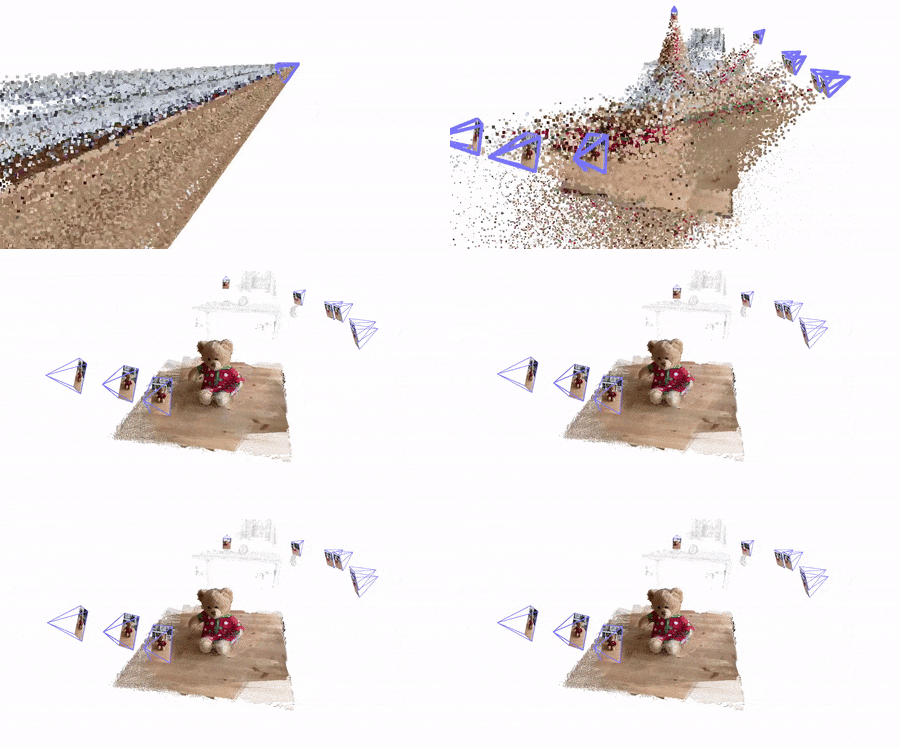 | What's New? | Duster is a repository introducing a novel approach called Dense and Unconstrained Stereo 3D Reconstruction (DUSt3R). It allows you to generate 3D models from 2D images without requiring camera calibration or viewpoint data.
Key Capabilities: - Operates on arbitrary image collections
- Integrates monocular and binocular reconstruction methods via pointmap regression
- Aligns multi-view pointmaps into a common reference frame
- Utilizes transformer encoders/decoders with pre-trained models
The approach simplifies previous multi-view stereo methods that necessitated intricate camera parameter estimation. Duster's unified formulation handles single, dual, and multi-image inputs seamlessly.
Includes: - Pre-trained models for various resolutions
- Interactive demos with Docker setup
- Data preparation and custom training guides
Duster achieves new state-of-the-art results for monocular/multi-view depth estimation and relative pose estimation tasks critical to 3D reconstruction.
| | Try dust3r |
|
|
|
Want to increase your TAM to over half the world’s population? | Transcription and translation for almost 4 billion people. With a target market that big, what would you do?
With Speechmatics powering your business’ speech technology, all you need to ask is… where next?
Find out more and put Speechmatics’ engine to the test. 👇
TRY FREE ↗️ |
|
|
|
TOP PAPERS | --------------------- This paper introduces a new approach to automating front-end web development through the Design2Code task, using multimodal large language models (LLMs) to transform visual website designs into functional code. The study demonstrates that models like GPT-4V can effectively generate webpages that match or even surpass the original designs in visual appeal and functionality. It highlights the potential of LLMs to democratize web development and streamline the design-to-code process. | | --------------------- The study introduces 3D Diffusion Policy (DP3), a cutting-edge visual imitation learning algorithm that integrates 3D visual representations with diffusion policies to teach robots dexterous skills efficiently and effectively. Leveraging a compact 3D visual representation from sparse point clouds, DP3 demonstrates remarkable success in both simulated and real-world tasks, achieving significant improvements over traditional methods with fewer demonstrations required and showcasing strong generalization capabilities across different conditions. | | --------------------- This paper explores the potential of enhancing the scalability and performance of deep reinforcement learning (RL) by adopting a classification approach for training value functions instead of the traditional regression method. Demonstrating across a diverse set of domains, this method achieves state-of-the-art results, effectively addressing common challenges in value-based RL such as noisy targets and non-stationarity, while improving scalability with minimal additional cost. | |
| |
|
|
TRENDING TWEET | Andrew Ng on Emergent capabilities of LLMs | "When we get to AGI, it will have come slowly, not overnight. A NeurIPS Outstanding Paper award recipient, Are Emergent Abilities of Large Language Models a Mirage? (by @RylanSchaeffer, @BrandoHablando, @sanmikoyejo) studies emergent properties of LLMs, and concludes:
"... emergent abilities appear due the researcher’s choice of metric rather than due to fundamental changes in model behavior with scale. Specifically, nonlinear or discontinuous metrics produce apparent emergent abilities, whereas linear or continuous metrics produce smooth, continuous, predictable changes in model performance."
Public perception goes through discontinuities when lots of people suddenly become aware of a technology -- maybe one that's been developing for a long time -- leading to a surprise. But growth in AI capabilities is more continuous than one might think.
That's why I expect the path to AGI to be one involving numerous steps forward, leading to step-by-step improvements in how intelligent our systems are."
- ANDREW NG
| | Read tweet |
|
|
|
| | Ghita is an editor at AlphaSignal and AI Engineer at Clear Ventures. Experienced in Computer Vision and Language models, she holds 2 masters in Applied Mathematics. | | Thank You. |
| | Want to promote your company, product, job, or event to 175,000+ AI researchers and engineers? You can reach out here. | |
|
|
|
|
