AI coding agents are exposing a critical flaw in traditional retrieval-augmented generation (RAG) pipelines. And the solution might be giving the agents the same tools that humans use.
Agentic search requires dynamic plan revision. If an agent is tasked with debugging a production incident, it does not know the full scope of information it needs.
It needs to examine partial evidence, formulate a hypothesis, and search again to verify its assumptions. Agents need to find exact strings, numerical values, version constraints, error codes, and specific file paths.
This is not what traditional RAG is designed for.
RAG systems break documents into chunks and store their embedding values in vector databases. When a user asks a question, the system retrieves text chunks based on the similarity of their embeddings with that of the prompt.
This dense retrieval method is excellent for broad semantic recall and answering general questions over static knowledge bases. But it breaks down in software engineering and IT operations.
Exact lexical constraints and multi-step hypothesis refinement are incredibly difficult to execute through semantic retrievers alone. Current retrieval pipelines often decide too early what the AI agent is allowed to see.
Once relevant evidence is filtered out by a vector index before the agent's reasoning loop begins, the data is lost. And no amount of reasoning can recover it.
Direct corpus interaction
Direct Corpus Interaction (DCI) is a new but simple paradigm that bypasses embedding models entirely. It allows AI agents to interact with raw data using general-purpose terminal tools like grep, find, cat, sed, and shell pipelines.
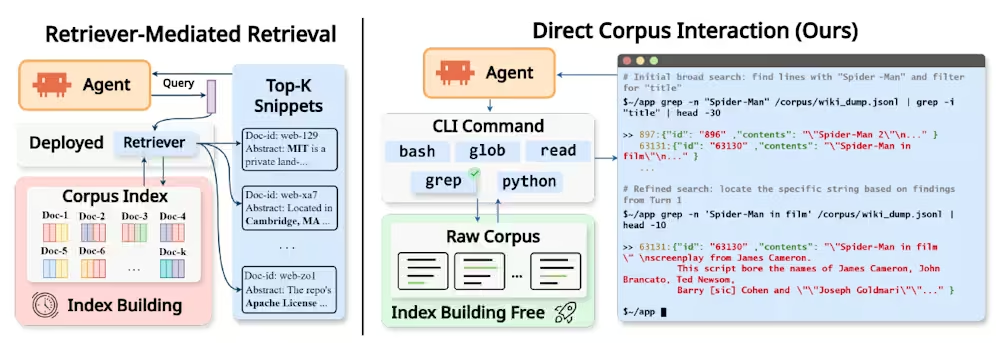
In enterprise environments, data is rarely a stable, static document collection. It consists of active incident logs, live IT tickets, recent code commits, daily financial reports, and constantly shifting configuration files.
Vector embeddings are always a snapshot of the past. Building, updating, and maintaining vector indexes takes compute power and batch processing time. DCI allows the agent to interact directly with the current state of the workspace as it exists right now.
With terminal tools, agents can enforce strict constraints that vector databases miss. An agent looking for a specific database failure can search for an exact error string, pipe the output to a secondary filter to remove legacy log files, and verify the local context immediately.
This creates an iterative feedback loop between the agent and the file system. The agent executes a command, reads the raw output, and adjusts its next query based on what it learns. This mirrors how a human developer navigates an unfamiliar codebase.
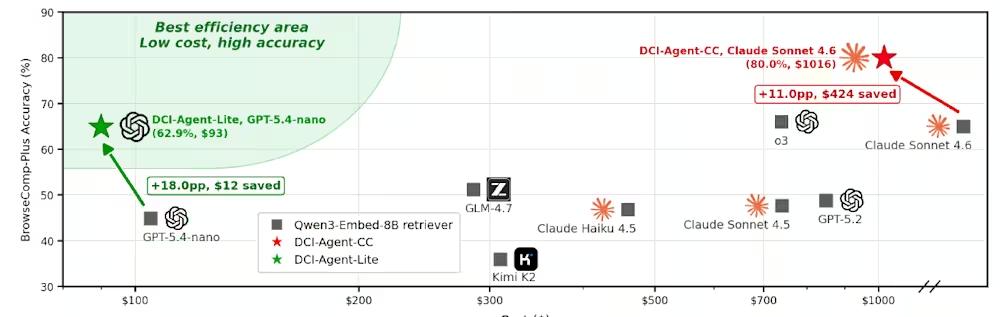
Experiments show that DCI outperforms semantic retrieval on multi-hop reasoning tasks and retrieval benchmark where clues are scattered across different files, while also reducing inference costs.
Scaling DCI with GrepSeek
Giving a language model raw terminal access introduces friction. Agents can get lost in complex, nested directory structures. They can execute broad search commands that overwhelm the terminal with thousands of lines of useless output, which quickly derails their reasoning process.
A new framework called GrepSeek upgrades DCI and addresses these friction points by training a model to treat the corpus as the search environment. GrepSeek reasons about the query and gathers evidence by issuing executable shell commands against the corpus.
To simplify the process of training GrepSeek, the researchers created a pipeline that generates training data from a very large unstructured body of text without human assistance.
This process generates causally grounded search paths. It trains the model on how to logically navigate a file system, form hypotheses, and use command-line tools efficiently.
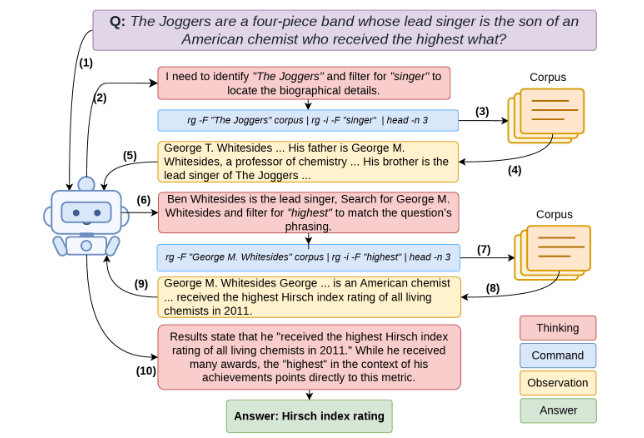
GrepSeek also uses reinforcement learning to improve the agent's task-oriented search behavior. It teaches the model to avoid dead ends, recognize when a command has failed, and refine its search queries accordingly.
Running raw shell commands sequentially over millions of documents introduces severe latency. Agents waiting for a massive grep search to complete across an entire enterprise repository slows down the orchestration loop to a crawl.
GrepSeek solves this bottleneck with a semantics-preserving sharded-parallel execution engine. This engine splits the underlying corpus into smaller data shards and runs shell commands simultaneously across them.
This approach speeds up shell-based retrieval by up to 7.6x compared to traditional execution while preserving the fidelity of the original data.
How to apply DCI in practice
Why not load an entire repository into a massive million-token context window? Because processing millions of tokens for every step an agent takes is unsustainable for most applications.
Massive context slows down the agent's time-to-first-token. Furthermore, cramming a model with raw code increases the likelihood that it will overlook specific, critical details buried deep within the prompt.
Raw terminal outputs from DCI can also bloat the context window if left unchecked. A single poorly constructed find command can return thousands of lines of text. And running grep on the entire corpus every time can be slow, especially if it is being accessed through a network.
For AI orchestration engineers and data architects, if you have a small corpus of information, DCI-style retrieval can work perfectly fine.
But for very large corpora, a balanced, hybrid approach will probably be better suited:
- Semantic retrieval handles broad, high-recall candidate discovery. It locates an initial anchor document when the user's intent is underspecified.
- DCI operates as a precision verification layer on top of the retrieved data.
- The agent uses terminal tools to expand laterally from the anchor document into neighboring files or dependencies.
- The agent checks exact constraints, verifies version numbers, and combines weak signals across multiple documents before generating a final answer.
This shift changes how we must think about enterprise data architecture. In the near future, data will not only need to be indexed for human search engines. It will need to be explicitly organized for agents that can inspect, trace, and verify raw files.
Retrieval quality for coding agents is not about generating better vector embeddings or using larger context windows. It relies on the resolution of the interface through which the agent is allowed to interact with the corpus.