The tech industry is currently obsessed with solo agents like OpenClaw, Claude Code, and Hermes. These tools act like a brilliant junior engineer sitting next to you, executing commands and solving complex problems inside a local terminal.
However, there is a fundamental difference between a coding harness built for a single user and a shared digital coworker. Enterprises are fundamentally team sports. Software that fails to natively understand team dynamics eventually creates isolated silos across the organization.
When enterprises attempt to scale solo bots to hundreds of employees, the underlying architecture breaks. Viktor takes a different approach by building an agent natively for multi-player enterprise environments, solving the core issues of shared context and security.
The right tool for the right job
AI agents such as OpenClaw are designed to be solo agents. You are responsible for setting them up on your device and giving them access to the right files, applications, and accounts.
They expect to have full access to their environments and resources. They work fine as long as you’re working solo and are power user who knows when to look over the agent’s shoulder as it works.
They are not meant to be deployed in enterprise infrastructure with the nuances and complexities that come with granting permissions and resources.
This makes it tricky to integrate them in shared workspaces and applications without causing management or security nightmares.
Memory powered by 3,000 integrations
A solo agent treats memory as a single, finite chat history. When the context window reaches its limit, the agent compacts and summarizes the data. This often strips out critical operational instructions, as seen when an overwhelmed local OpenClaw agent silently discarded a Meta director's safety constraints and autonomously deleted hundreds of her emails.
Viktor avoids compaction by partitioning context across three dimensions: team, topic, and task. This modular structure allows the agent to pull relevant notes for the finance department without crossing wires with marketing workflows.
Shared memory requires deep organizational connectivity to function properly. Viktor connects to existing enterprise stacks through more than 3,000 out-of-the-box integrations, plugging directly into the company’s tools without requiring custom data pipelines or developer heavy lifting.
This integrated memory structure produces highly capable autonomous workflows. For example, after adopting Viktor in their company, the people at Australian ecommerce retailer TWL were able to carry out tasks that previously required intense human effort or complex integration.
When asked about the inventory pipeline, instead of searching one isolated system, Viktor executes several connected actions:
- Pulls active purchase order data from Asana.
- Cross-references delivery threads across four different Slack channels.
- Matches the internal discussions against warehouse confirmations.
- Flags a projected stockout for a specific item five weeks in advance.
By connecting these previously siloed platforms, the agent replaced scattered manual queries with 12 scheduled, autonomous workflows across the company in just 15 days.
Enterprise prerequisites: Security and secrets
Deploying an agent to execute tasks on behalf of a 50-person team requires strict security controls. Local agents typically run on local credentials stored in plaintext .env files. If the host machine is compromised, the OAuth tokens and API keys are exposed.
A recent report by Mysterium found 12 million IP addresses exposing .env files to the open web, highlighting the threat that already exists even before agents reach mass adoption.
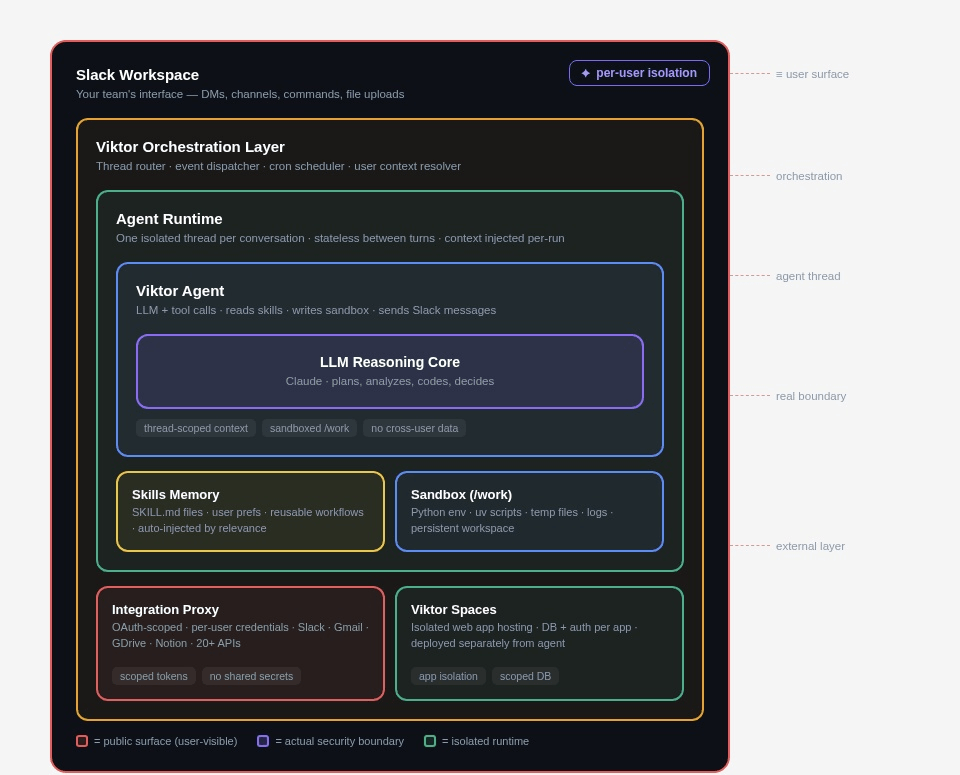
Viktor secures corporate credentials through backend abstraction. The architecture creates a strict operational air gap:
- The agent executes code inside a restricted sandbox environment.
- The API credentials live in a secure, encrypted vault (not stored on user devices).
- When the agent searches an application like Gmail, it sends a request to the integration layer rather than accessing the raw token directly.
This architecture also provides a robust defense against prompt injection attacks. Security researchers at Promptfoo recently demonstrated how an indirect prompt injection hidden on a webpage could force a local agent to exfiltrate a user's password file.
To protect the team, Viktor passes untrusted external data through large language model classifiers before the core agent processes it. Additionally, any action that modifies or sends data requires explicit human-in-the-loop approval, ensuring the system operates strictly as a supervised assistant.
 Compounding intelligence
When a developer writes a custom Python script for a local agent, the capability remains trapped on that specific machine. Solo agents often reset their context, meaning the broader organization never learns from individual problem-solving efforts.
In contrast, Viktor improves over time by continuously aggregating operational knowledge. CollabED, an education nonprofit run by volunteers, originally installed the agent for simple grant research. Because Viktor’s memory is persistent, every workflow built and preference corrected was saved. Viktor, however, improves over time through persistent memory. The nonprofit CollabED originally installed Viktor just for simple grant research. But because Viktor's memory is persistent, every workflow built, preference corrected, and process refined was stored.
This compounding intelligence allowed the agent to map the nonprofit's department structure and adapt to the founder's brand voice for social media drafts. Because it continuously aggregates operational knowledge, Viktor went from a simple chatbot to an agent with 58 distinct skills about how CollabED operates.
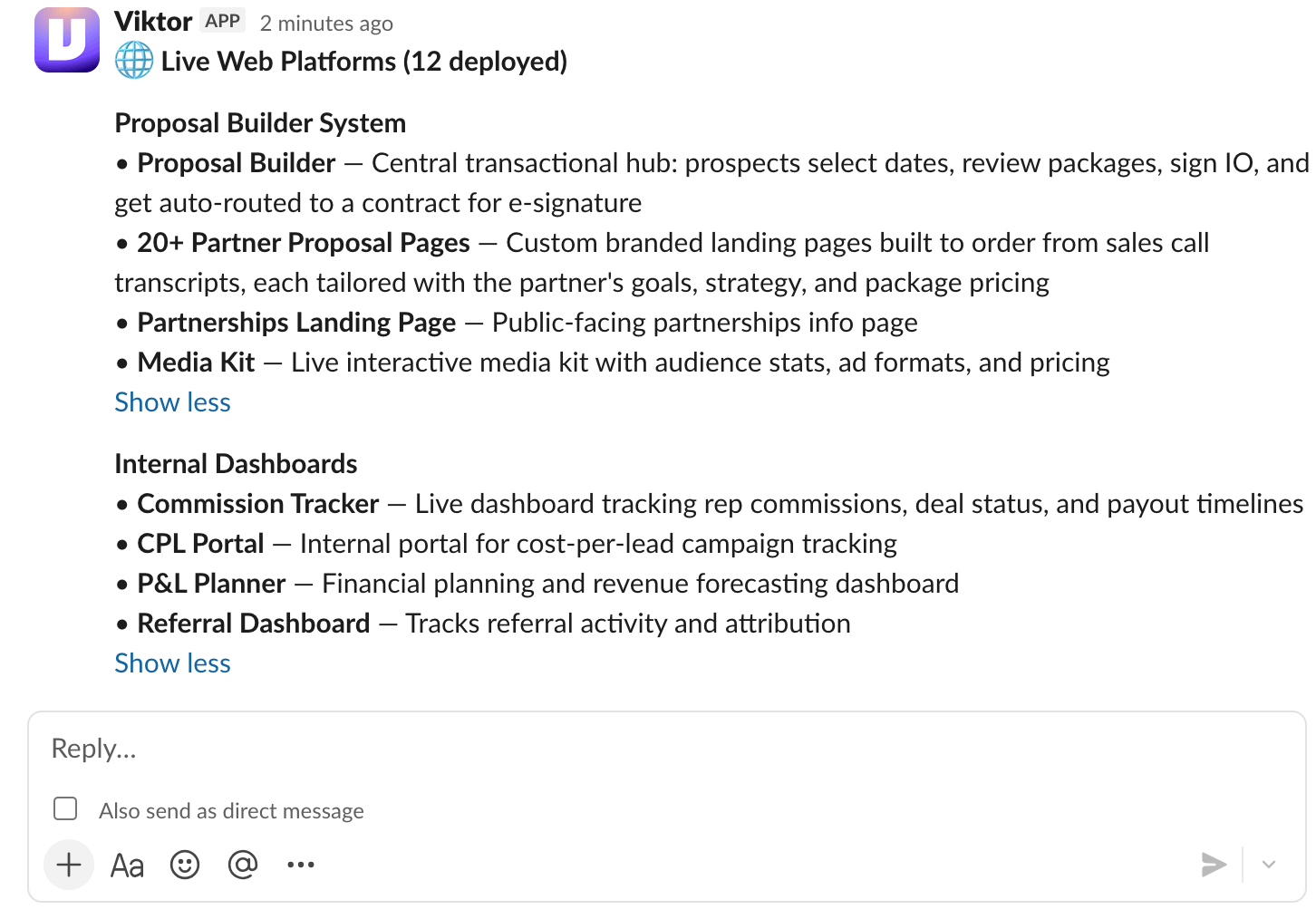
This shared knowledge base enabled a non-technical founder to orchestrate highly technical outputs with zero paid staff. The organization successfully deployed:
- 10 live web platforms operating on custom subdomains.
- 2 mobile apps launched on iOS and Android.
- 27 scheduled automations, handling volunteer reminders and board governance.
 Scale requires a new species of agent
Solo agents remain incredible tools for accelerating individual developer productivity. Yet, trying to scale a single-player architecture across an enterprise is like trying to run a corporate engineering department using only personal email accounts.
To build an AI-native enterprise, organizations need a system designed from the ground up to support shared context, secure credential vaulting, and team-wide skill distribution. Production environments do not need a smarter solo bot. They need a team agent.
The only question left is what you'll delegate first. Start using Viktor and deploy your first AI coworker in minutes. Viktor is offering $100 in credits exclusively for AlphaSignal readers.