Agentic AI workflows are currently hitting a massive financial wall. Frameworks like OpenClaw are racking up thousands of dollars in monthly API bills for developers simply by running routine automated tasks.
This astronomical cost happens because these agents rely on continuous background "heartbeats" and infinite storage of tool outputs and conversation histories, causing the context window to accumulate rapidly and burn through millions of tokens every week.
The financial strain is compounding with the latest frontier models. Anthropic's Claude Opus 4.6, which is the model of choice for many agentic tasks, costs $25 per million output tokens (and up to $150 if you want faster responses).
Developers and enterprises are quickly realizing that routing every automated action through closed APIs is economically unviable, forcing a hard shift toward smart routing architectures that rely on open-weight models that provide more flexibility on pricing and hosting environments.
However, the open-source landscape is simultaneously fracturing. Meta has notably slowed its release cadence for the Llama family. DeepSeek's highly anticipated R2 model is facing severe delays due to training instability on Huawei Ascend chips. The future of Alibaba's Qwen team is in question after several high-profile departures.
This void leaves an opening for a new leader. Nvidia might become the next champion of the open-source AI ecosystem while quietly solidifying its hardware dominance. And its recent open source releases reinforce this image.
Under the hood of Nemotron 3
Nvidia's direct answer to the agentic token tax is the newly released Nemotron 3 Super. It is a large 120-billion-parameter mixture-of-experts (MoE) model (12 billion active parameters), placing it in the class of OpenAI's gpt-oss-120b and Qwen3.5-122B. It also boasts a 1 million-token context window, making it suitable for long reasoning and coding tasks.
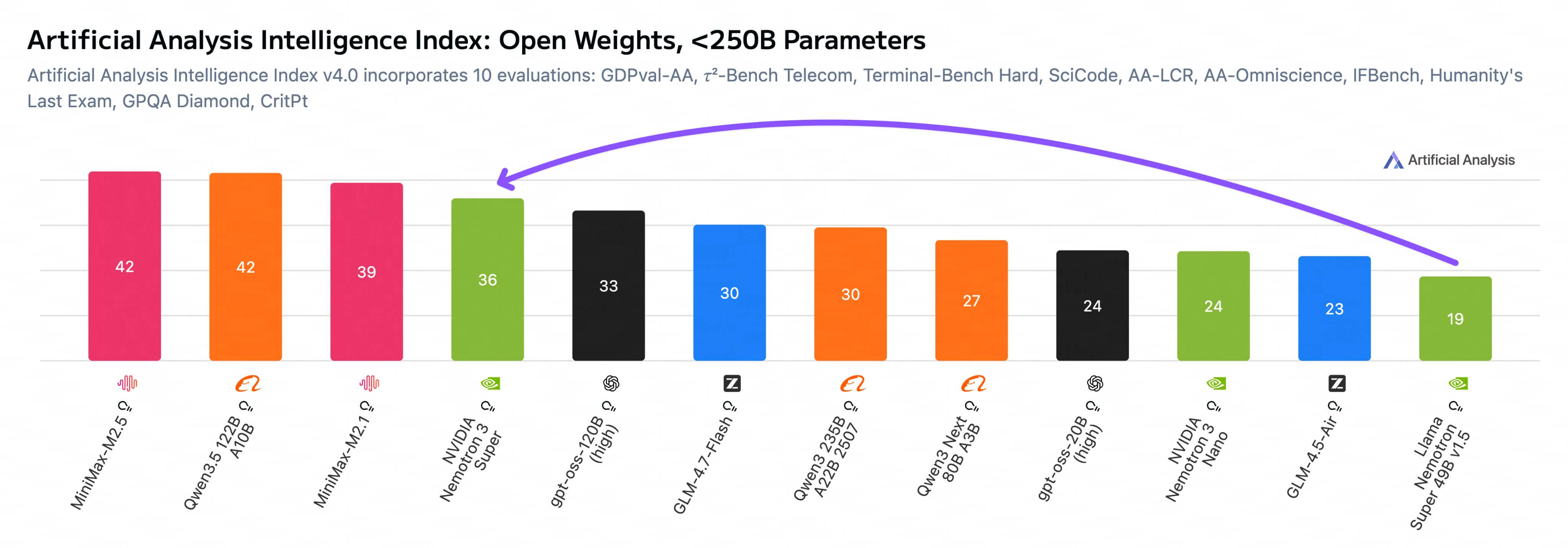
Independent benchmarks show this architecture works in practice. Nemotron 3 Super scored a 36 on the Artificial Analysis Intelligence Index (ahead of gpt-oss-120b, slightly behind Qwen3.5-122B). More importantly for developers, it delivers significantly higher throughput on B200 GPUs compared to similar open models.
This efficiency comes from specific architectural choices designed to solve real-world bottlenecks:
- Hybrid Mamba-Transformer: Standard Transformer models compare every token to every other token, meaning memory requirements scale exponentially as the context window grows. By integrating Mamba layers, Nemotron 3 bypasses this memory explosion on long context tasks.
- Latent MoE: Nemotron 3 performs the MoE routing stage in a compressed latent space, slashing communication overhead and allowing the model to use 4x more experts (and get higher accuracy) with the same compute budget.
- Multi-token prediction: The model predicts multiple future tokens simultaneously, speeding up the time-to-first-token and improving performance on reasoning tasks that require thinking several steps ahead.

The lightweight complement
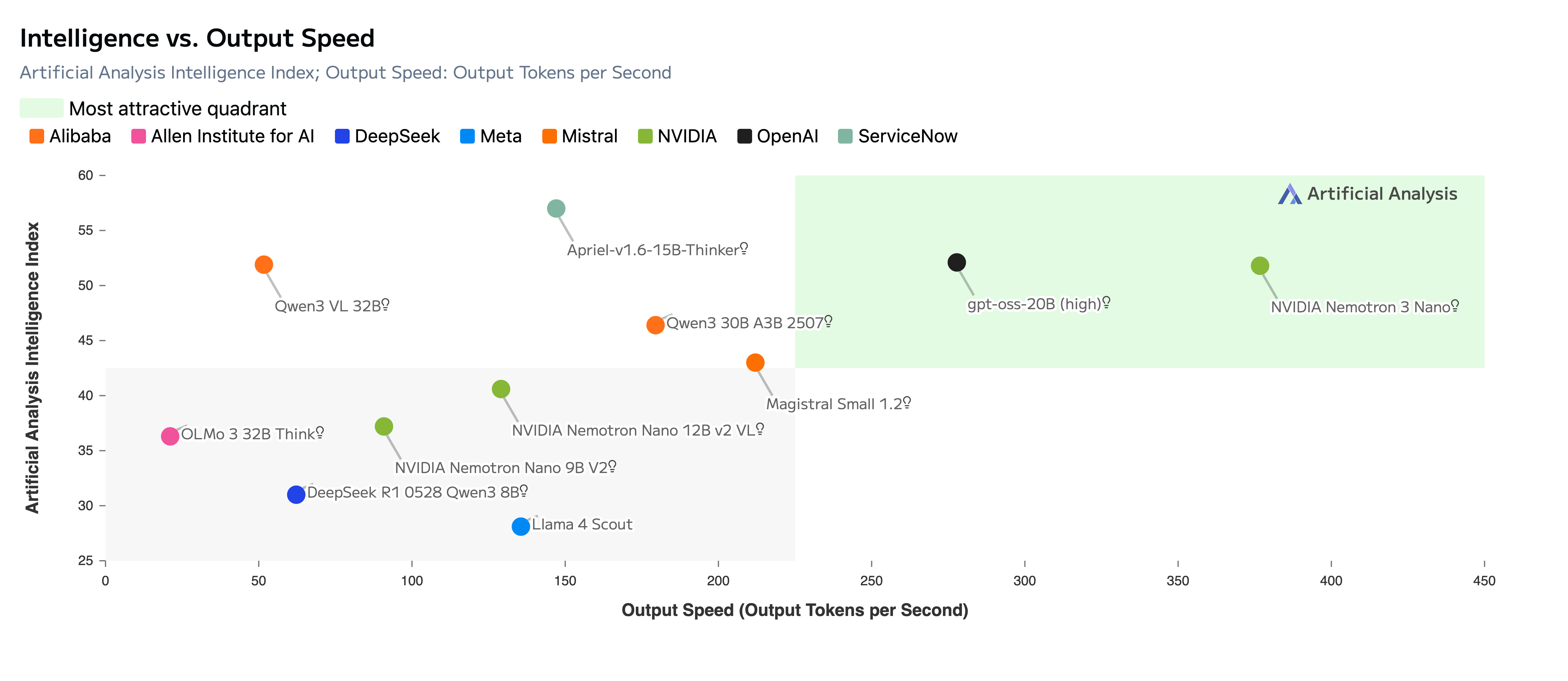
AI builders rarely need a 120-billion parameter model for every minor step in an agentic loop. To address the need for high-frequency, single-step tasks, Nvidia previously released Nemotron 3 Nano. Available in 30-billion and highly compact 4-billion parameter versions, Nano completes the developer ecosystem.
Developers can deploy Nano on smaller hardware partitions or edge devices for routine work like sorting files or parsing simple user inputs. Meanwhile Super can take care of deep reasoning, planning, and orchestration tasks. This keeps the entire workflow fast, cost-effective, and fully optimized within a single model family.
Nvidia's advantage
While many companies and labs release open models, Nvidia is particularly positioned to turn it into a profitable business.
Training LLMs is very costly, which is why AI companies are usually inclined to keep the models to themselves. They usually release the weights to raise brand awareness and drive customers to their higher end closed models (examples include OpenAI and Mistral).
For Nvidia, open models are a direct revenue driver built on hardware and software co-design.
Nvidia specifically designed its Blackwell B200 GPUs to train and run models using NVFP4, a 4-bit floating-point format that natively reduces precision requirements and doubles processing speed without losing accuracy.
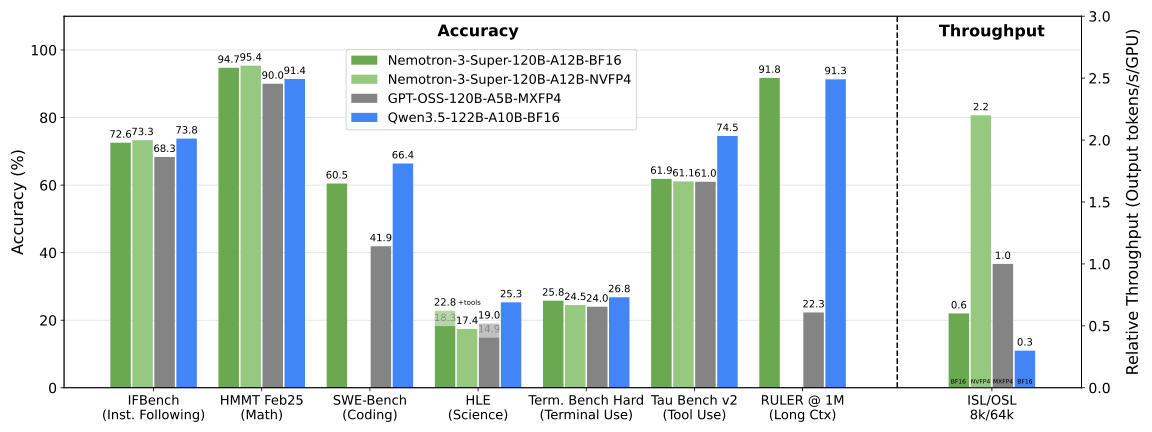
Nemotron 3 models are trained natively in this NVFP4 format from the ground up. This means the software is physically co-designed with the silicon. If developers want to run these highly efficient, standard-setting models at peak speed, the financial and performance incentives dictate they run them on Nvidia chips.
At the same time, Nvidia is releasing a bunch of other optimization techniques at different levels of the model architecture (e.g., KV cache optimization, quantization), all of which are designed to drive down costs and increase the speed of LLM inference on Nvidia hardware.
A $26 billion developer flywheel
Nvidia is reportedly investing $26 billion over the next five years on open-weight AI models. This massive investment serves a clear business purpose: building a robust new software moat alongside its existing CUDA platform to protect against hardware-agnostic compilers.
This might not sound much compared to the $100-billion+ rounds that AI labs are raising. But keep in mind that Nvidia has huge profit margins on its chips, which means it can do a lot more with less.
Broad developer adoption of Nvidia's open models directly translates to infrastructure sales. As developers build agents around Nvidia models, the demand for Nvidia hardware increases. This creates a developer flywheel where software adoption drives hardware dominance, drastically shortening the return on investment window for enterprise data centers.
Pushing state-of-the-art open models also keeps intense pressure on proprietary giants like OpenAI and Anthropic to innovate at a breakneck pace. Continued advances in open source AI prevents monopolies or duopolies and keeps innovation moving forward.
For the researcher community, this means higher incentives to share knowledge. For the AI developer community, this ensures lower inference costs and a massive win for the future of decentralized agentic applications.