There is a lot of excitement (and hype) surrounding the role of generative AI in software development. Many reports and empirical reports show developers generating unprecedented volumes of code, hinting at massive spikes in development output and promising a future where every developer becomes a 10x engineer.
But according to a thorough study by MIT and Wharton School, despite developers generating code at record speeds, the rate of shipping finished software remains relatively flat. The bottleneck has simply shifted from syntax creation to downstream validation.
AI massively accelerates the early, granular stages of production, such as writing individual functions or components. But this has created unaddressed work in other parts of the software development lifecycle.
Overall output remains bounded by tasks such as code review, testing, and deployment that still require human oversight, meaning the pipeline is only as fast as its slowest human reviewer.
Methodology: Unpacking the data
To measure the true impact of AI on software delivery, the researchers analyzed a massive dataset tracking over 100,000 active GitHub developers. They blended public repository data with internal Microsoft telemetry to build a comprehensive view of developer output.
To eliminate activity bias, the researchers matched users adopting new AI tools against a control group of similarly active developers from the same calendar week one year prior.
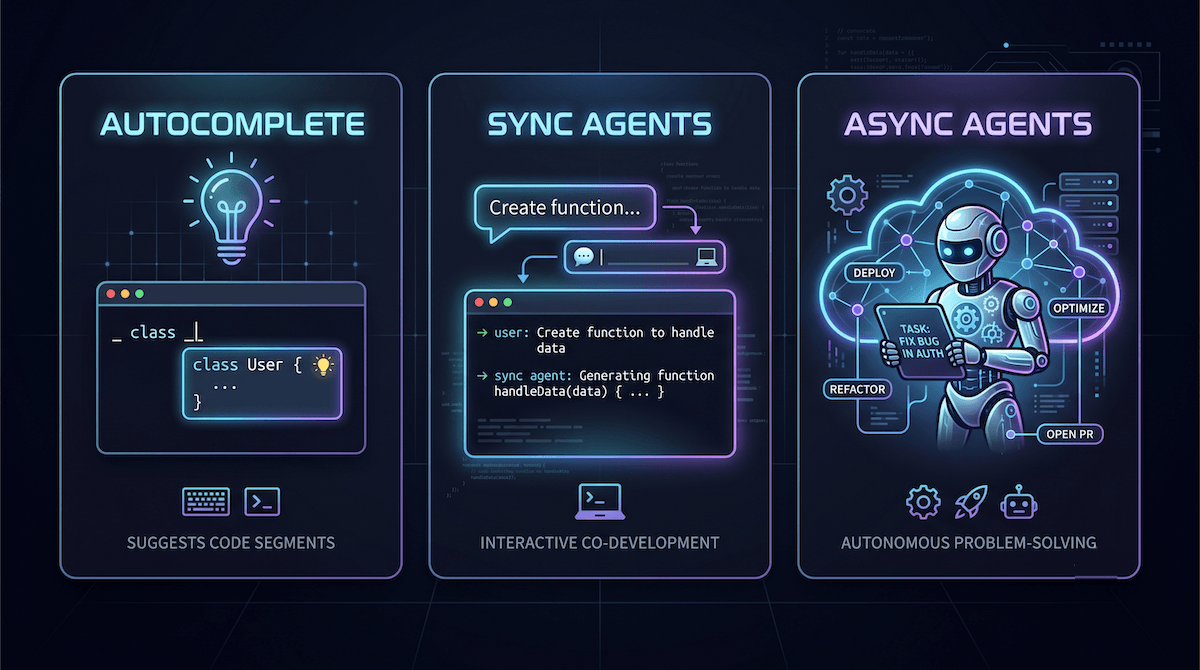
The researchers tracked productivity across multiple generations of AI tools:
- Autocomplete models that suggest blocks of code, such as the classic GitHub Copilot running in VS Code
- Sync agents that work interactively with developers, like Claude Code running on your local device
- Async agents that operate autonomously to solve larger issues, like GitHub Agents running in the cloud
They mapped these tools against the entire production lifecycle, tracing raw lines of code up through pull requests and final releases.
To validate the real-world consumer impact, the study also aggregated monthly panel data. They tracked app deployments and usage across the Apple App Store, Google Play Store, Chrome Web Store, and SourceForge.
The attenuation effect and marketplace paradox
At the top of the funnel, AI generates undeniable gains. As has been often mentioned in anecdotes shared on social media, we’re seeing huge boosts in the number of lines of code produced with the help of AI, with async agents producing up to 17x more code than human developers.
The same effect can be seen in other stages of the software development lifecycle. Autocomplete boosted coding commits by 40%. Interactive sync agents pushed that number to 140%, while autonomous async agents raised cumulative commit gains to an impressive 180%.
These study metrics confirm publicly reported spikes in overall GitHub activity, validating the observed industry-wide explosion in both new repositories and pull request volumes across the platform (to the point that some companies are stopping public pull requests because they can’t handle the volume of AI-generated code).
However, as code moves up the production hierarchy, an attenuation effect takes hold. These massive upstream gains severely diminish as they approach release.
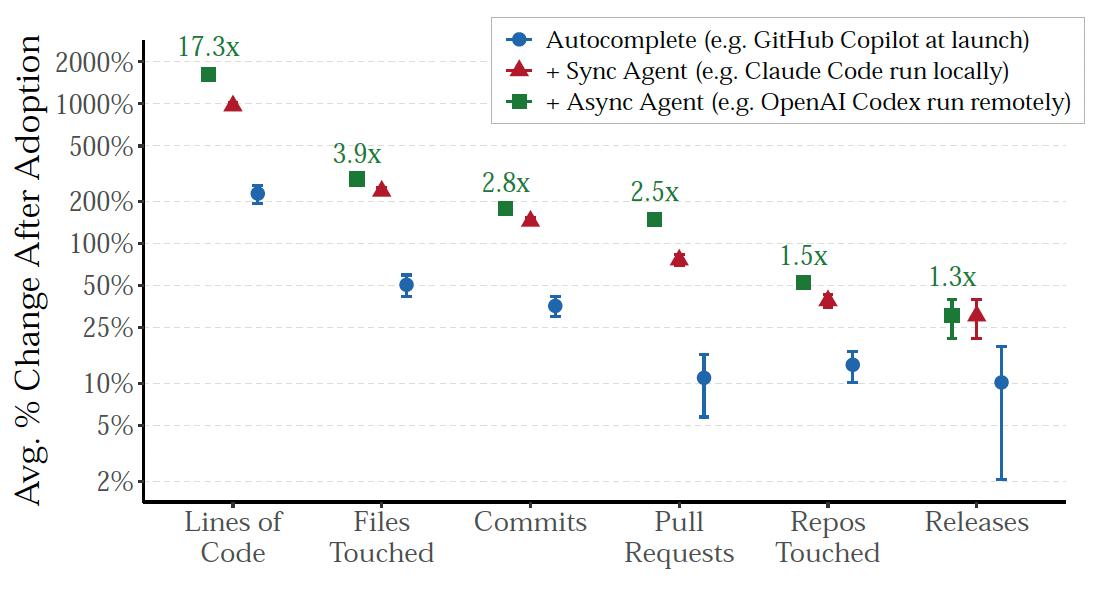
Sync agents, for example, generated a staggering 741% increase in raw lines of code and a 65% increase in pull requests. Yet, this explosion in output translated to a mere 20% increase in actual software releases.
Async agents provide an even clearer reality check. They offer the highest coding output amplification, boosting pull request creation by 71.8% autonomously.
However, these agents cannot release a repository directly. A human engineer must always step in to review and merge the code, establishing the human as the absolute bottleneck.
This dynamic also bleeds into product success, creating an app marketplace paradox. AI has successfully loosened upstream constraints, sparking a visible spike in new app releases across platforms like iOS and Android.
Despite this flood of new software, total user consumption, measured by downloads and ratings, remains flat within the first three months of launch.
Lowering the cost of writing code does not solve the downstream challenge of discovering product-market fit and distribution.
This matches the memes often shared on social media where developers are saying that they are creating tons of applications with zero users.
Balancing generation with the software lifecycle
The main takeaway from the findings is that AI amplifies existing pipeline fragility. According to a 2025 DORA report on the state of AI-assisted coding, AI acts as a strict multiplier of an organization's existing capabilities.
If testing, continuous integration, and code review processes are already slow, flooding the pipeline with AI-generated code exacerbates the problem. For teams lacking solid fundamentals, higher throughput strongly correlates with deployment instability.
This creates a trust paradox. While 90% of tech professionals use AI tools, 30% still lack trust in the generated code. Developers must embrace "trust but verify" strategies to manage this massive new code volume safely.
To adapt, the industry is transitioning from a traditional software development lifecycle (SDLC) to an Agentic Development Lifecycle (ADLC).
In this model, developers shift from being hands-on keyboard creators to high-level orchestrators. They spend their time validating architecture, defining tests, determining risk tolerance, and setting strict guardrails for autonomous tools.
Security and quality assurance must shift left. Autonomous agents write code at machine speed, meaning traditional post-commit vulnerability scans are no longer sufficient.
High-performing teams now deploy internal testing agents. These agents validate outputs and generate edge cases in rapid-fire loops before the code ever reaches a human reviewer.
You still need to review code. The key is determining which code requires your eyes and which should be discarded higher up the pipeline. With the costs of writing code declining, knowing which code to not write and discard is becoming a highly valuable skill.