|
Hey,
Your daily briefing is ready. You can finally take a break from the AI firehose.
Our algos spent the night splitting signal from noise and pulled the top news, models, papers, and repos.
Here’s the must-read:
|
|
Together with:
|

|
|

|
Today's Author
Lior Alexander. Founder of AlphaSignal and former ML Engineer.
Previously built ML systems at Iguazio, Guesty, Enphase, Mila.
|
|
Top News
|
|
|
|
Anthropic reports that DeepSeek, Moonshot AI, and MiniMax created 24,000+ fraudulent accounts and ran 16M+ exchanges with Claude
|
|
47,274 Likes
|

|
Distillation is a common AI training trick: feed a weaker model the outputs of a stronger one, and it gets smarter, fast, cheap, and without building anything from scratch. Legitimate labs do it all the time. These three didn't ask permission.
Anthropic claims it caught DeepSeek, Moonshot AI, and MiniMax running coordinated data-theft operations against Claude through 24,000 fake accounts:
- MiniMax: 13M exchanges, targeted agentic coding and tool use
- Moonshot: 3.4M exchanges, went after reasoning traces and computer vision
- DeepSeek: 150K exchanges, prompted Claude to reconstruct its own chain-of-thought step-by-step to generate training data
The labs routed traffic through proxy networks of 20,000+ fake accounts to dodge detection. When Anthropic released a new Claude model mid-campaign, MiniMax redirected 50% of their traffic to it within 24 hours.
Anthropic detected MiniMax's operation before their stolen-capability model even launched.
How Anthropic responds
-
Traffic classifiers and behavioral fingerprinting
-
Cross-account coordination detection
-
Stronger account verification controls
-
Intelligence sharing with industry partners
|
|
|
|
Presented by AgentField
|
|
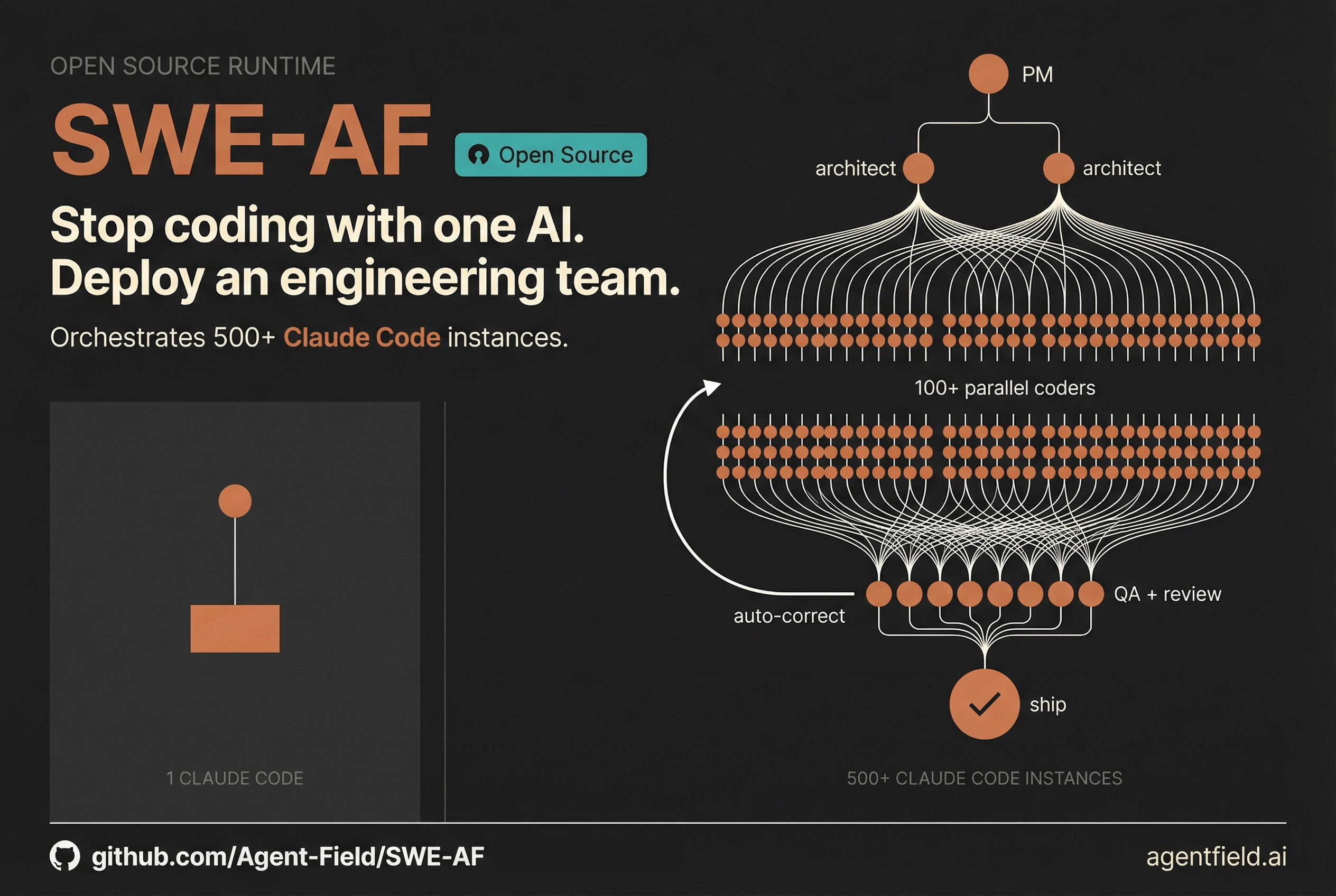
Turn 500+ Coding Agents Into an Autonomous Engineering Team
|
|
Vibe coding is still one agent, one issue. You’re still doing arch, security, sprint planning.
SWE-AF fixes that. Open-source runtime. Spins up hundreds of agents, Claude Code or open models, as a full autonomous engineering team.
Point it at a goal and a repo. It handles:
-
Parallel execution, shared memory
-
Adversarial code review
-
Auto-recovery when things break
-
Auto-decomposition of hard problems
Execution plan rewrites itself at runtime. Ships a production-ready PR.
|
|
|
|
partner with us
|
|
Top News
|
|
|
|
OpenAI recommends SWE-bench Pro for reporting frontier software engineering performance
|
|
5,622 Likes
|
|
OpenAI is changing how it reports frontier coding results. It no longer reports SWE-bench Verified, a benchmark widely used to measure autonomous software engineering, because the test now suffers from flawed evaluation logic and training data contamination.
Instead, OpenAI recommends reporting SWE-bench Pro, which currently provides a cleaner signal of real coding capability.
SWE-bench evaluates whether a model can fix real GitHub issues by generating a code patch that passes hidden tests. The model sees the issue description and the pre-fix repository state, then produces a fix. It succeeds only if all tests pass.
Key findings from the audit:
-
59.4% of sampled failed tasks contain material test design flaws
-
35.5% use narrow tests that reject valid implementations
-
18.8% require behavior not specified in the problem statement
-
Frontier models reproduce exact gold patches from public repos
OpenAI now reports SWE-bench Pro results and builds private benchmarks like GDPVal, where experts author tasks and reviewers grade outputs to reduce contamination risk.
|
|
|
|
Top Paper
|
|
|
|
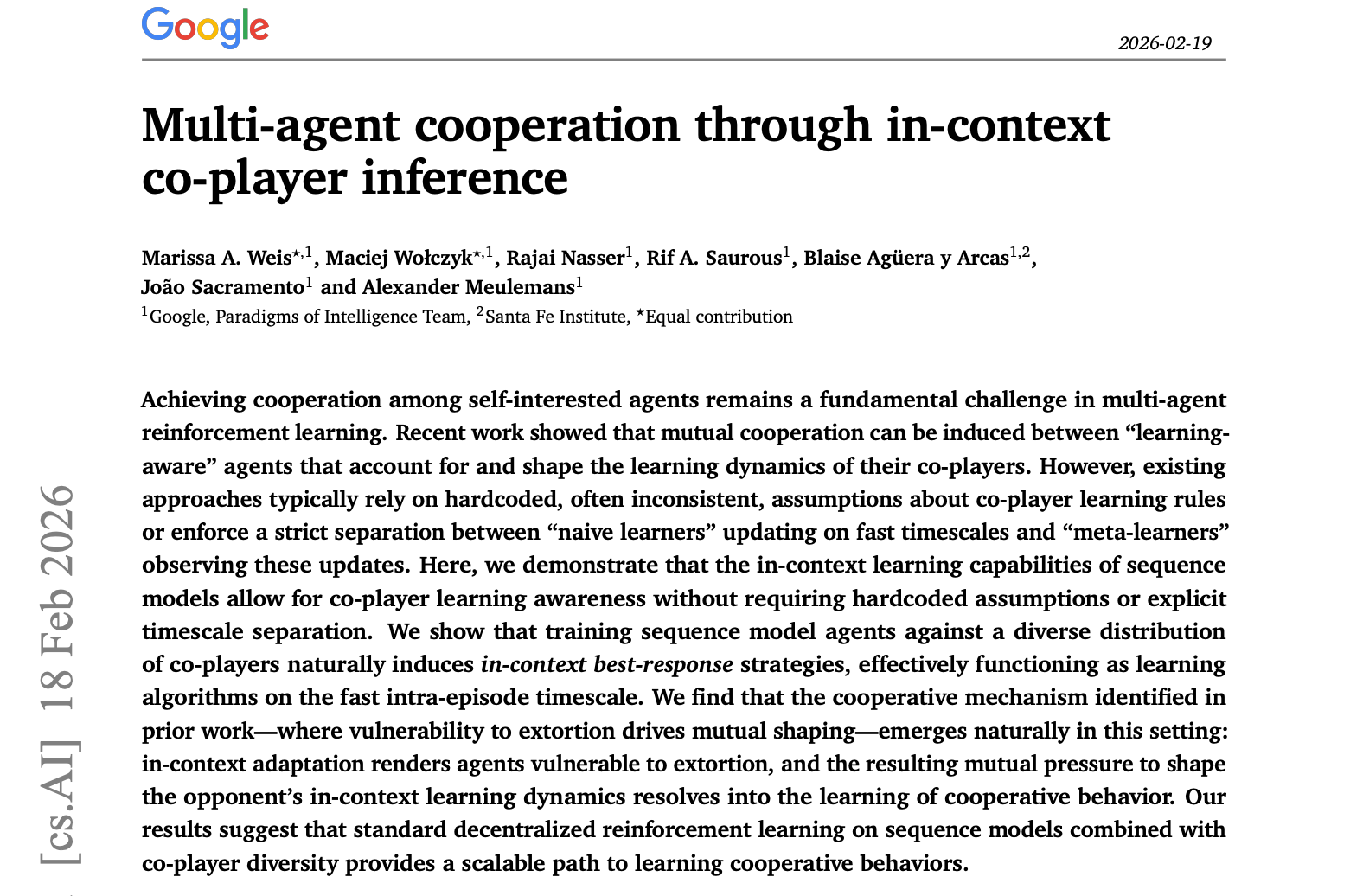
Google shows sequence models can perform strategic reasoning about other agents using only in-context learning
|
|
1,863 Likes
|
|
Google introduces a practical framework for adaptive multi-agent cooperation in the new paper.
It shows that a sequence model can infer who it interacts with by reading behavioral history in its context window and then adjust its strategy during the same episode. It removes the need for retraining, explicit opponent classifiers, or separate belief models.
In multi-agent systems, performance depends on partner behavior, not just the task. Most systems assume fixed roles or average opponents. This work instead uses in-context learning, the model reads prior interaction steps and updates its response policy immediately.
Key Features
-
Infers co-player strategy from interaction history inside the prompt
-
Adapts policy at inference time without architectural changes
-
Trains against diverse partner distributions using decentralized RL
-
Requires no explicit modeling of opponent learning rules
Results
-
Adjusts cooperation level based on observed partner behavior
-
Avoids blind cooperation and blind defection failures
-
Exhibits in-context best-response dynamics
|
|
|
At Alpha Signal, our mission is to build a sharp, engaged community focused on AI, machine learning, and cutting-edge language models, helping over 200,000 developers stay informed and ahead. We’re passionate about curating the best in AI, from top research and trending technical blogs to expert insights and tailored job opportunities. We keep you connected to the breakthroughs and discussions that matter, so you can stay in the loop without endless searching. We also work closely with partners who value the future of AI, including employers and advertisers who want to reach an audience as passionate about AI as we are.
Our partnerships are based on shared values of ethics, responsibility, and a commitment to building a better world through technology.Privacy is a priority at Alpha Signal. Our Privacy Policy clearly explains how we collect, store, and use your personal and non-personal information. By using our website, you accept these terms, which you can review on our website. This policy applies across all Alpha Signal pages, outlining your rights and how to contact us if you want to adjust the use of your information. We’re based in the United States. By using our site, you agree to be governed by U.S. laws.
|
|
|
Looking to promote your company, product, service, or event to 250,000+ AI developers?
|
|
|
|
|
