Hey, | Welcome to this week's edition of AlphaSignal.
Whether you are a researcher, engineer, developer, or data scientist, our summaries ensure you're always up-to-date with the latest breakthroughs in AI.
Let's get into it!
Lior |
|
|
|
IN TODAY'S EMAIL | Mistral Large Latest Announcements Google's Model Drama
Read Time: 4min 49 sec |
|
|
|
NEWS #1 | Mistral Large: A LLM That Outperforms Every Model Apart From GPT-4 | 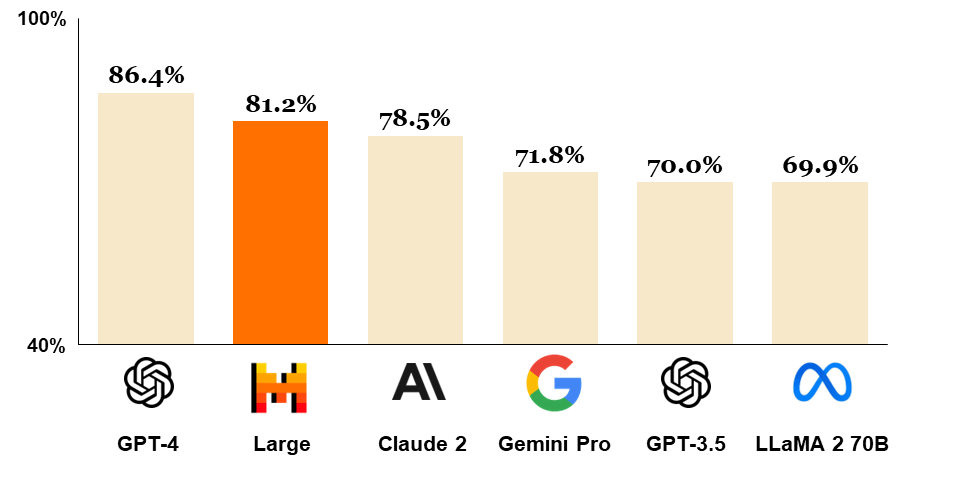 | What's New? | After several weeks of speculations about a new model, Mistral AI has officially released Large - its latest and most performant model- along with Le Chat, a beta of their chat UI.
Large is the world’s second best language model available through an API after GPT-4.
Mistral Large boasts a performance of 81.2% on MMLU (measuring massive multitask language understanding), beating Claude 2, Gemini Pro and Llama-2-70B. Large is particularly good at common sense and reasoning, with a 94.2% accuracy on the Arc Challenge (5 shot).
Mistral Small was also updated on the API to a faster and more performant model than Mixtral 8x7B.
Some of Mistral’s features include: Training on English, French, Spanish and Italian datasets for native multilingual capabilities.
32k token context window - way below Gemini’s 1M token or Claude’s 200k token ones.
Precise instruction-following that were used to moderate the Chat interface.
Native function calling capabilities for agentic capabilities similar to ChatGPT Plus.
The JSON format mode forces the language model output to be valid JSON. This functionality enables the extraction of information in a structured format that can be easily used by developers.
Given the above features, it wouldn’t be surprising that this model is also a Mixture of Expert, similarly to its open-source counterpart Mixtral 8x7B. However, the number of parameters and details of the training of this model have not been disclosed.
Mistral offers a concise and unopinionated model, with fully modular moderation control. This echoes the recent Gemini controversy: Google’s model produced outputs unaligned with the user’s expectations because of its trust and safety finetuning.
This release comes with the announcement of a collaboration with Microsoft, OpenAI’s main partner and investor, to provide the models through Azure. The models are also available through La Plateforme, Mistral’s API platform.
Try it here (login needed) | | Try mistral large |
|
|
|
 | On-Demand GPU Instances with Special Pricing at Latitude.sh | Start today and accelerate your training and inference workloads with the power of NVIDIA’s H100 Tensor Core, deploy your instances in seconds with Latitude.sh!
High-performance networking and enterprise-grade hardware designed for Machine Learning engineers. Our super intuitive dashboard and pre-installed AI software gets you from zero to training with just a few clicks.
Multiple clusters with 8 x H100s available today, use the code G3OFF10 and get 10% off during your first 3 months.
| | Get started | partner with us |
|
|
|
TOP OF GITHUB | --------------------- Stability AI released Stable Diffusion 3, its most capable text-to-image model. The new suite of models ranges from 800M to 8B params and is based on the diffusion transformer architecture and flow matching, similarly to other models like Sora. This new version is way more performant at writing text in images, it also understands negations and relative placement of objects way better. | | --------------------- Phind 70B not only beats GPT-4 at coding, but it also runs 4x faster. The Phind team, which released the model yesterday, claims that it offers the best user experience thanks to its speed (80 token per second), performance (82.3% on HumanEval) and response style (less “lazy” than GPT-4, with detailed code examples).
The 4x increase in speed is achieved by running NVIDIA's TensorRT-LLM library on H100 GPUs. The model is available for trial and will soon release its weights. | | --------------------- Google presented Genie, Generative Interactive Environments, an 11B parameter model capable of generating action-controllable virtual worlds described through text, synthetic images, photographs, and even sketches. Genie was trained in an unsupervised manner from unlabelled Internet gaming videos, without any action or text annotations.
Yet, it still infers an interactive world from an unseen image, where users can act in a logical way, on a frame-by-frame basis. Ot is Google’s first foundational world model, as it understands the world through its autoregressive dynamics model and spatiotemporal video tokenizer. | |
| |
|
|
Get Instant High Accuracy Speech Recognition with Speechmatics | With transcription and translation in real-time, you no longer have to wait for your audio to finish. You can start unlocking value, building workflows, and enhancing your product features instantly. ️
Get started for free today ↗️ |
|
|
|
TUTORIAL | ‘Embarrassing and Wrong’: Google Admits It Lost Control of Image-Generating AI | 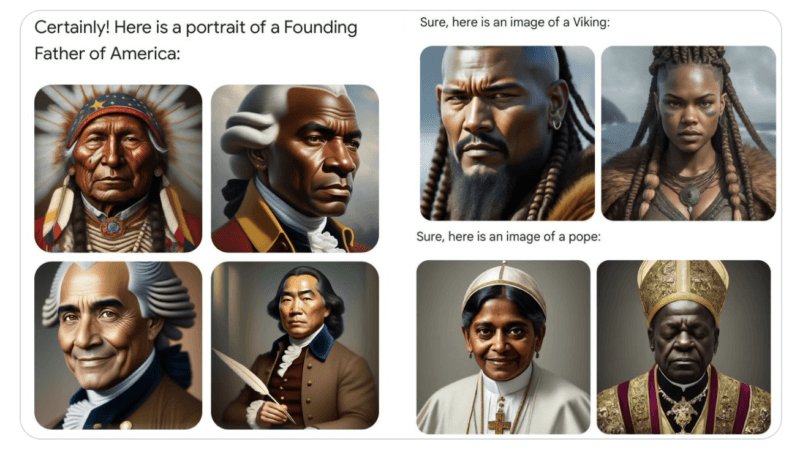 | What's New? | Google has temporarily disabled the people-image generation feature of its Gemini AI due to historical inaccuracies. Gemini, built on the Imagen 2 model, incorrectly depicted historical figures, leading to a broad discussion on diversity and historical context within AI outputs. These inaccuracies, such as misrepresenting the U.S. Founding Fathers with diverse racial backgrounds, have raised concerns over the AI's handling of historical accuracy versus diversity initiatives.
The backlash underlines the challenges faced in balancing the representation within AI-generated content while addressing biases in training datasets, which typically skew towards certain demographics due to overrepresentation in source imagery. Google's initiative to diversify AI outputs aims to counteract these biases but has led to contextually inappropriate content due to lack of historical sensitivity.
Google has acknowledged the issue, attributing it to the model's oversensitivity and the complex nature of training data biases. The company plans to refine Gemini's algorithm to improve context awareness and ensure a balance between diversity and historical accuracy. This incident highlights the ongoing struggle within AI development to achieve ethical representation and the necessity for continuous improvement and oversight in AI systems. | | Read more |
|
|
|
| | Ghita is an editor at AlphaSignal and AI Engineer at Clear Ventures. Experienced in Computer Vision and Language models, she holds 2 masters in Applied Mathematics. | | Thank You. |
| | Want to promote your company, product, job, or event to 170,000+ AI researchers and engineers? You can reach out here. | |
|
|
|
|
