Hey, | Welcome to this week's edition of AlphaSignal.
Whether you are a researcher, engineer, developer, or data scientist, our summaries ensure you're always up-to-date with the latest breakthroughs in AI.
Let's get into it!
Lior |
|
|
|
IN TODAY'S EMAIL | Large World Model YOLOv9 Yann's Insight Pytorch Tip
Read Time: 4 min 27 sec |
|
|
|
TOP PAPER | Large World Model | 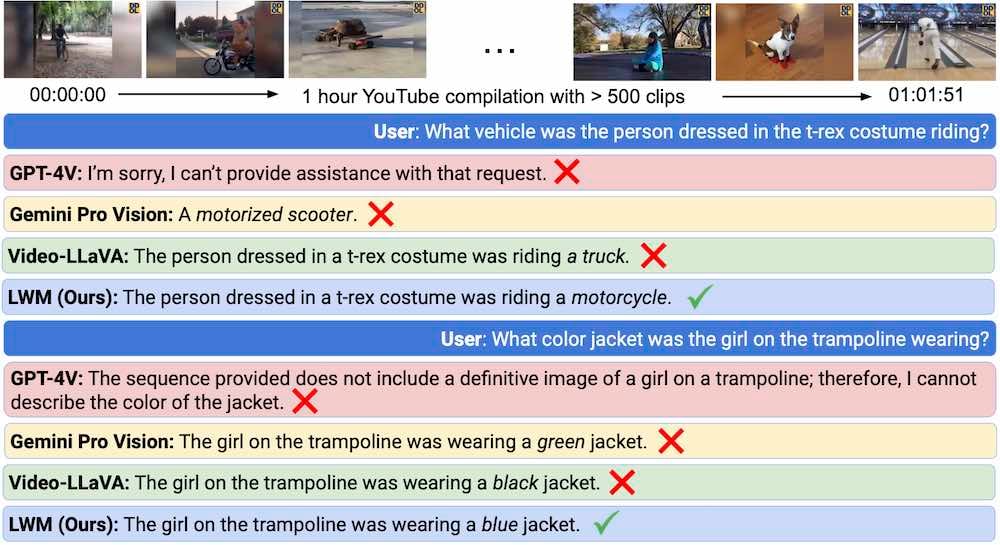 | What's New? | A new open-source bomb dropped when researchers from the Berkeley AI research lab, led by Prof Pieter Abbeel, released Large World Model (LWM), a family of general-purpose large-context multimodal autoregressive models.
These models were trained on several multimodal datasets (text, images, videos). Using next token prediction, they can generate data across all these modalities, over a context of up to 1M tokens.
Problem: Current language models have limitations in understanding our world because they are restricted to short sequences of text, images and clips. That is because learning from long videos represents a challenge due to memory constraints, computational complexity and limited datasets.
Solution: The RingAttention technique was used to gradually and cost-efficiently scale the training context from 4k to 1M tokens. The solution to the challenges associated with training on both video and language was to effectively train on different sequence lengths, with a weighted contribution of language and vision.
RingAttention refers to an advanced attention mechanism that improves how language models handle large context sizes. By distributing the input sequence across multiple devices, the attention matrix can be computed without materializing it entirely.
Performance: LWM beats Gemini Pro on single needle retrieval, and ties with GPT-4. Other tests like multi needle retrieval and long video understanding are also performed.
Similarly to its closed source counterparts, LWM is also capable of generating high quality videos (Sora) and answering questions over a 1 hour video (Gemini 1.5 Pro).
The TPU optimized code, with reproducible tests and models, is available.
| | Lwm code/paper |
|
|
|
 | Lightning AI Studio: Never set up a local environment again | Developed by the creators of PyTorch Lightning, this is where deep learning meets simplicity and speed. Discover a persistent GPU cloud environment that's ready whenever you are.
Prototype, train, serve, and so much more – all from one place. Zero setup.
Key Features
Collaborative Deep Learning: Develop collaboratively in the cloud at any scale.
Massive Data Handling: Up to 12TB per studio and live distributed metrics.
Multi-node Jobs: Scalable and effortless, with no code changes required.
Advanced File Management: Visualize and manage over 100M+ files easily.
Flexible Connectivity: SSH, PyCharm, local VSCode integration, and AWS deployment..
Start today and get 22 free TP4 hours each month.
| | Start today | partner with us |
|
|
|
TOP REPO | YOLOV9 | 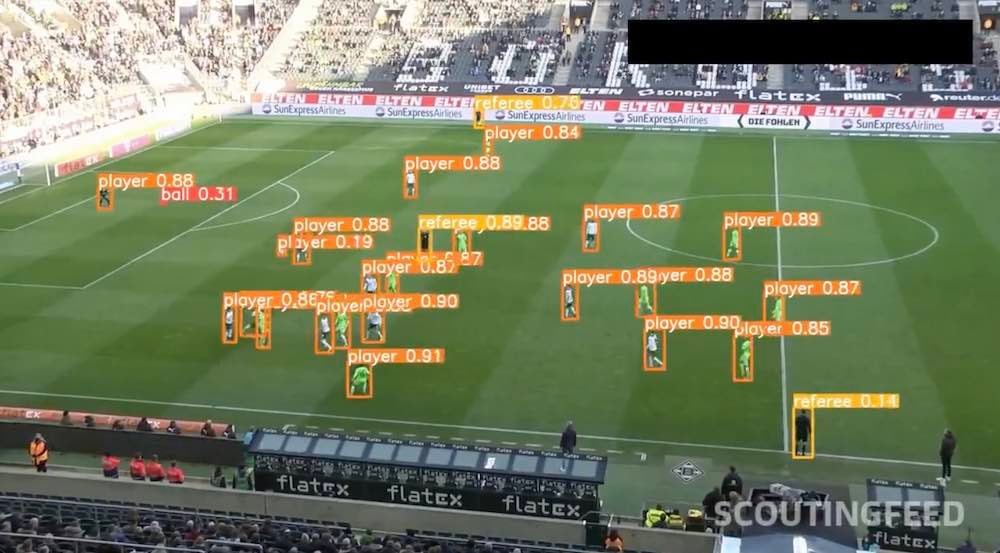 | What's New? | YOLOv9 is out! It's a real-time object detection model that surpasses all convolution and transformer-based models.
Problem: Current deep learning methods lose critical information during data processing, leading to suboptimal model predictions. This issue stems from the information bottleneck and inefficient network architectures that fail to preserve data through layer transformations, impacting accuracy and model efficiency.
Solution: The researchers developed PGI to maintain complete input data information, ensuring accurate gradient updates for weight optimization. They then designed GELAN, a lightweight architecture that utilizes gradient path planning for efficient information flow. Together, these innovations address data loss and optimize network performance.
Performance: YOLOv9, leveraging PGI and GELAN, demonstrated remarkable improvements on the MS COCO dataset, showcasing enhanced parameter utilization and outperforming existing models. Specifically, it achieved better accuracy with lower computational resources, validating the effectiveness of the proposed methods in real-world object detection tasks.
Code here | | Read yolov9 |
|
|
|
TOP TWEET | In a recent tweet, Yann LeCun criticized the approach of using pixel generation for world modeling, calling it inefficient and likely to fail, similar to the outdated "analysis by synthesis" method.
He highlights a historical debate in machine learning between generative and discriminative methods, with notable experts like Vapnik favoring the latter due to simpler training.
LeCun explains that attempts to recognize objects by generating pixels from latent variables have failed because it's slow and ineffective, especially compared to methods that directly classify without generating sensory input.
He concludes that while text generation might work due to its discrete nature, sensory input models struggle with continuous data's complexity.
To get a deeper understanding, it's worth reading the whole tweet from LeCun. |  | Yann LeCun @ylecun |  |
| |
Modeling the world for action by generating pixel is as wasteful and doomed to failure as the largely-abandoned idea of "analysis by synthesis". Decades ago, there was a big debate in ML about the relative advantages of generative methods vs discriminative methods for… | | | Feb 19, 2024 | | | | | | 1.57K Likes 218 Retweets 114 Replies |
|
| | Read tweet |
|
|
|
PYTORCH TIP | DataLoader + pin_memory | In PyTorch, when training neural networks, especially on large datasets, leveraging the DataLoader with pin_memory=True and setting num_workers to a positive number significantly boosts performance. pin_memory=True allows for faster transfer of data to the GPU by keeping it in pinned (page-locked) memory.
Concurrently, num_workers determines the number of subprocesses used for data loading, enabling asynchronous data fetching that doesn't block GPU computation.
This combination minimizes GPU idle time, ensuring more efficient use of hardware resources and faster model training times. |
data_loader = DataLoader(dataset, batch_size=32,
shuffle=True, num_workers=4, pin_memory=True)
|
|
|
|
| | Want to promote your company, product, job, or event to 170,000+ AI researchers and engineers? You can reach out here. | |
|
|
|
|
