| Hey | Welcome to AlphaSignal, the most read source of news by AI engineers and researchers.
Every day, we identify and summarize the top 1% of news, papers, models, and repos, so you’re always up to date.
Here’s today’s roundup: |
|
|
|
Top News
| | Thinking Machines Lab launches Tinker, its first product, enabling LoRA-based fine-tuning of open models
|
| Thinking Machines Lab, the AI startup co-founded by former OpenAI CTO Mira Murati, has released its first product, Tinker, a managed API for training and fine-tuning large language models without the overhead of managing infrastructure.
As Thinking Machines Lab’s first product, Tinker offers a middle ground between black-box fine-tuning services and full infrastructure builds. It gives researchers control over algorithms and data while offloading cluster engineering, making it easier to customize frontier-scale open models.
Key Features Model support: Works with open models from Llama-3.x to Qwen3. API primitives: Offers core functions like forward_backward, optim_step, sample, and save_state. Fine-tunes via lightweight adapters instead of full model weight updates. Infrastructure handled: Manages scheduling, resource allocation, failure recovery, cluster orchestration. Open control: You maintain control over data, algorithms, and custom training loops. Weight access: You can download intermediate and final model weights.
How It Works Exposes four fundamental operations to define training loops. Uses LoRA adapters to reduce cost and share GPU capacity. Supports both supervised fine-tuning and reinforcement learning pipelines. Lets users design custom loops while offloading cluster and infra complexity. Model Compatibility & Scale
Supports a wide range of models: from small Llama-3.2-1B to large MoEs like Qwen3-235B-A22B. Allows switching base models by changing a single string in Python code. Designed to scale experiments from small to large models seamlessly. How to Get Started
Sign up for the Tinker waitlist. Generate an API key in the console and export it as TINKER_API_KEY. Install the client: 'pip install tinker'. Set up the Cookbook: Install tinker-cookbook in a virtual environment (via conda or uv). Run examples with 'pip install -e ..'. Access & Pricing
In private beta, available via waitlist. Free to start; usage-based pricing to follow. Enterprise access available via direct contact. | |
| Try now
|
|
|
|

| Join PyTorch Conference 2025, October 22-23 in San Francisco |
PyTorch Conference is the premier forum for AI innovation. Join 2,500+ AI engineers and researchers for 6 technical tracks, 3 co-located summits, training & certification, a Startup Showcase, poster sessions + MORE.
Whether you’re scaling a startup or advancing the state of AI, PyTorch Conference is your gateway to the people, tools, and insights driving the next era of innovation.
Save 50% off your attendee pass with code ALPHASIGNAL. |
| Register today
| partner with us |
|
|
|
Signals
| |
|
3,147 Likes | |
|
1,534 Likes | |
|
1,132 Likes | |
|
1,133 Likes | |
|
|
1,223 Likes | | |
|
|
|
|
Papers
| |
|
723 Likes | Perplexity Research introduces a system to accelerate RL weight transfers. By combining low-level RDMA, pipelining, and scheduling, they cut update latency to 1.3 seconds, significantly improving trillion-parameter distributed training efficiency.
| |
|
2,243 Likes | Google DeepMind’s Dreamer 4 is an AI agent that learns tasks inside its own world model. It beats OpenAI’s VPT using 100x less data and outperforms Gemma-3 approaches. |
|
|
| 884 Likes |
This paper introduces RLPT, a method to train large language models directly on pre-training data with reinforcement learning. It removes human annotation needs and shows strong gains on MMLU, GPQA, and AIME benchmarks. |
| |
| |
|
|
Top Guide
| |
Unsloth simplifies LLM training through Docker and Jupyter Lab |
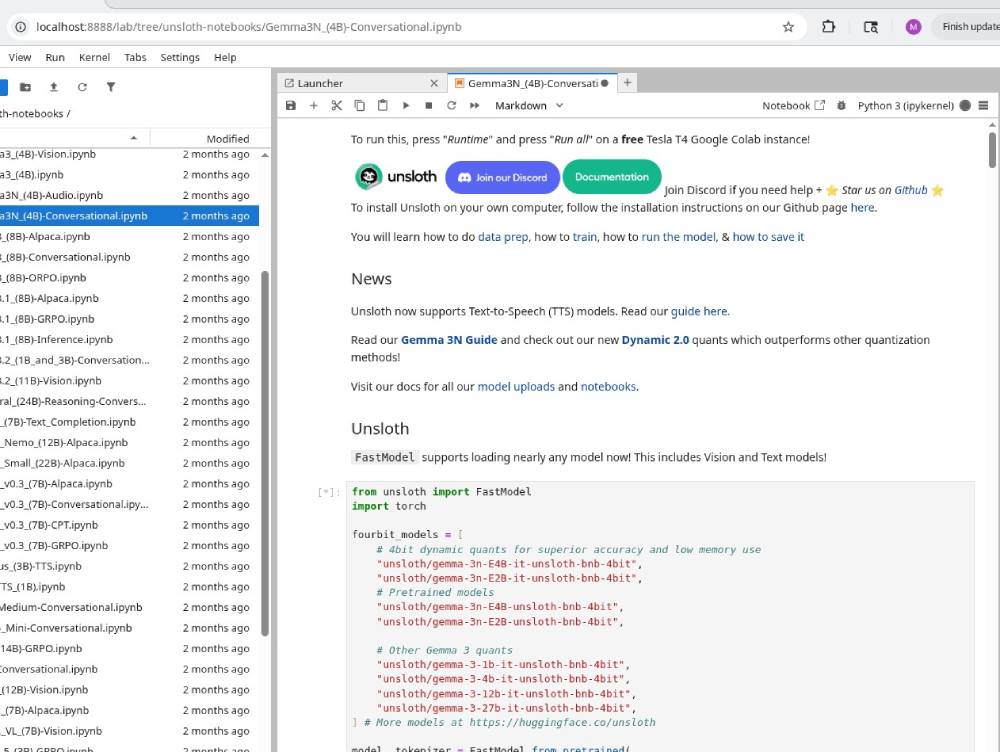
| Unsloth’s guide explains how to use a prebuilt Docker image to train and fine-tune large language models without dependency issues.
It walks through setup, GPU configuration, and secure access so you can run training in a reproducible environment across machines.
What the guide offers:
Prebuilt Docker image with all dependencies for LLM training. Instructions to install Docker and NVIDIA Container Toolkit. Steps to run the container with GPU, ports, volumes, and environment variables. Access to Jupyter Lab inside the container for training. Mounted directories for notebooks, data, and saved work. Options for SSH access, custom ports, and volume persistence. Secure setup with non-root unsloth user and sudo privileges. |
| Try now
|
|
|
|
At Alpha Signal, our mission is to build a sharp, engaged community focused on AI, machine learning, and cutting-edge language models, helping over 200,000 developers stay informed and ahead. We’re passionate about curating the best in AI, from top research and trending technical blogs to expert insights and tailored job opportunities. We keep you connected to the breakthroughs and discussions that matter, so you can stay in the loop without endless searching. We also work closely with partners who value the future of AI, including employers and advertisers who want to reach an audience as passionate about AI as we are.
Our partnerships are based on shared values of ethics, responsibility, and a commitment to building a better world through technology.Privacy is a priority at Alpha Signal. Our Privacy Policy clearly explains how we collect, store, and use your personal and non-personal information. By using our website, you accept these terms, which you can review on our website. This policy applies across all Alpha Signal pages, outlining your rights and how to contact us if you want to adjust the use of your information. We’re based in the United States. By using our site, you agree to be governed by U.S. laws. |
|
|
|
Looking to promote your company, product, service, or event to 250,000+ AI developers?
|
| Work with us
|
|
|
|
|
