| Hey | Welcome to AlphaSignal, the most read source of news by AI engineers and researchers.
Every day, we identify and summarize the top 1% of news, papers, models, and repos, so you’re always up to date.
Here’s today’s roundup: |
|
|
|
Top News
| | Google releases Jules Tools, a command-line interface to manage and customize its coding agent
|
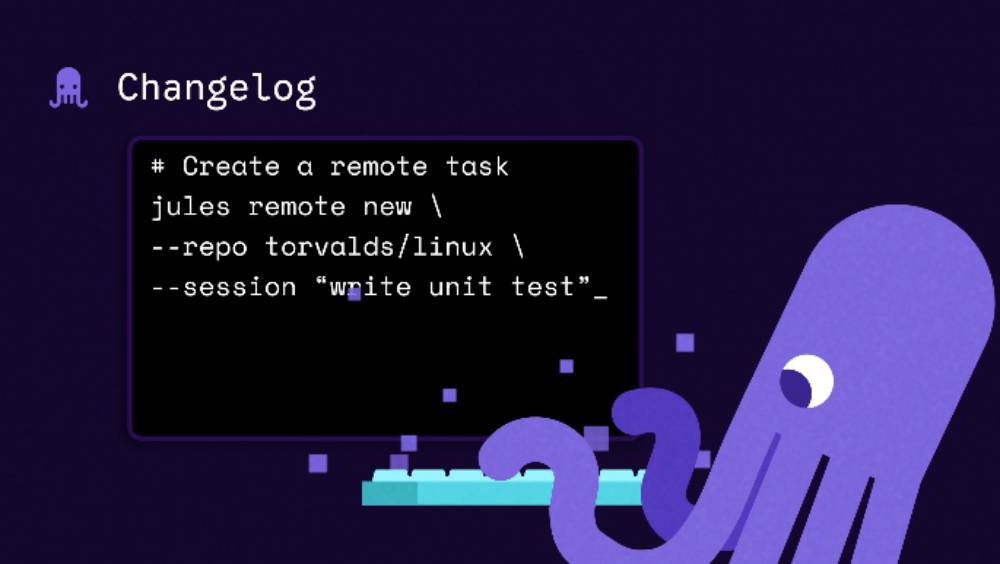
| Google launched Jules Tools, a command-line interface and public API for its asynchronous coding agent. You can now spin up, monitor, and control coding tasks directly from the terminal instead of relying on browser windows.
Key Features
Terminal control: Run, list, and manage tasks through typed commands. Programmable agent: Script it into existing automations with commands. Context awareness: Remembers past corrections and developer preferences. Secure credentials: Manages access when automating tasks in repos or pipelines. Background execution: Runs in remote VMs, syncing results via pull requests. Interactive TUI: Provides dashboard-style task views and guided flows in terminal. How to Get Started
Install Jules Tools globally: 'npm install -g @google/jules' Run a quick test to see connected repos: 'jules remote list --repo'
Create your first task session: 'jules remote new --repo . --session "write unit tests"'
Pipe GitHub issues or TODO files into Jules for automation.
Explore the interactive TUI with commands like /remote or /new. Practical Use Cases
Pipe GitHub issues directly into Jules for automated fixes. Assign multiple tasks from a TODO file in one command. Use Gemini CLI to pre-analyze issues and delegate complex ones. Create and monitor sessions in connected repositories without switching context. Access & Availability
Available today via npm (@google/jules). Works with any repo already linked to Jules. Jules Tools complements the web dashboard and syncs in real time. | |
| Try now
|
|
|
|
Signals
| |
|
4,231 Likes | |
|
2,139 Likes | |
|
5,537 Likes | |
|
3,249 Likes | |
|
|
1,860 Likes | | |
|
|
|
|
|
Build Intelligent AI Agents with Context Engineering at NODES 2025
| AI agents depend on context. Without it, retrieval breaks, answers fail, and systems lose reliability. Developers need better tools to scale beyond surface-level LLMs.
Neo4j’s free 24-hour online conference, NODES 2025, shows how to build with GraphRAG, knowledge graphs, and advanced context engineering. Featured speakers include Andrew Ng and Emil Eifrem. All sessions are live, online, and free to attend. |
Register free today ↗️ |
|
|
|
Lectures
| |
|
5,232 Likes | The lecture argues most “agents” are structured software with LLM loops, JSON outputs, and control flow. Success comes from context engineering, small focused agents, and owning prompts, state, and execution paths. |
|
|
4,127 Likes |
The famous Stanford lectures for deep learning starts with why deep learning succeeds with scale, GPU history, and transformers powering GenAI. It emphasizes CS fundamentals, disciplined project execution, and skills for tuning models, fine-tuning, and building practical AI systems. |
|
|
| 693 Likes |
The lecture shows step-by-step how to build effective evals. It explores trace analysis, coding approaches, human judgment alignment, pitfalls of automation, and why evals act as living product requirements documents for monitoring and improving AI systems in production. |
| |
| |
|
|
Deep Dive
| |
Richard Sutton says LLMs imitate text, not true RL; Karpathy defends pretraining as foundation |

| Richard Sutton, father of RL, argues LLMs are not “bitter-lesson pilled.” He emphasizes continual, on-the-job reinforcement learning with explicit goals, rewards, and online weight updates. In his view, LLMs imitate human text, lack task-grounded objectives, and fail to adapt from real-world surprise.
He defines four core components: policy, value via temporal-difference learning, perception/state representation, and a transition world model that predicts consequences. Training and deployment collapse into a single continual learning loop instead of separate stages.
Andrej Karpathy adds that pretraining provides a practical “evolution-style” prior before reinforcement learning.
|
| Learn more
|
|
|
|
At Alpha Signal, our mission is to build a sharp, engaged community focused on AI, machine learning, and cutting-edge language models, helping over 200,000 developers stay informed and ahead. We’re passionate about curating the best in AI, from top research and trending technical blogs to expert insights and tailored job opportunities. We keep you connected to the breakthroughs and discussions that matter, so you can stay in the loop without endless searching. We also work closely with partners who value the future of AI, including employers and advertisers who want to reach an audience as passionate about AI as we are.
Our partnerships are based on shared values of ethics, responsibility, and a commitment to building a better world through technology.Privacy is a priority at Alpha Signal. Our Privacy Policy clearly explains how we collect, store, and use your personal and non-personal information. By using our website, you accept these terms, which you can review on our website. This policy applies across all Alpha Signal pages, outlining your rights and how to contact us if you want to adjust the use of your information. We’re based in the United States. By using our site, you agree to be governed by U.S. laws. |
|
|
|
Looking to promote your company, product, service, or event to 250,000+ AI developers?
|
| Work with us
|
|
|
|
|
