Hey | Welcome back to AlphaSignal, where we bring you the latest developments in the world of AI.
In the past few days 1,500+ AI papers have been released, and among them, our model has picked the six.
Lets now dive straight into the papers!
Lior |
|
|
|
IN TODAY'S SUMMARY | Reading time: 4 min 40 sec |
|
|
|
TOP PUBLICATION | AnyTool: Self-Reflective, Hierarchical Agents for Large-Scale API Calls | Yu Du, Fangyun Wei, Hongyang Zhang | 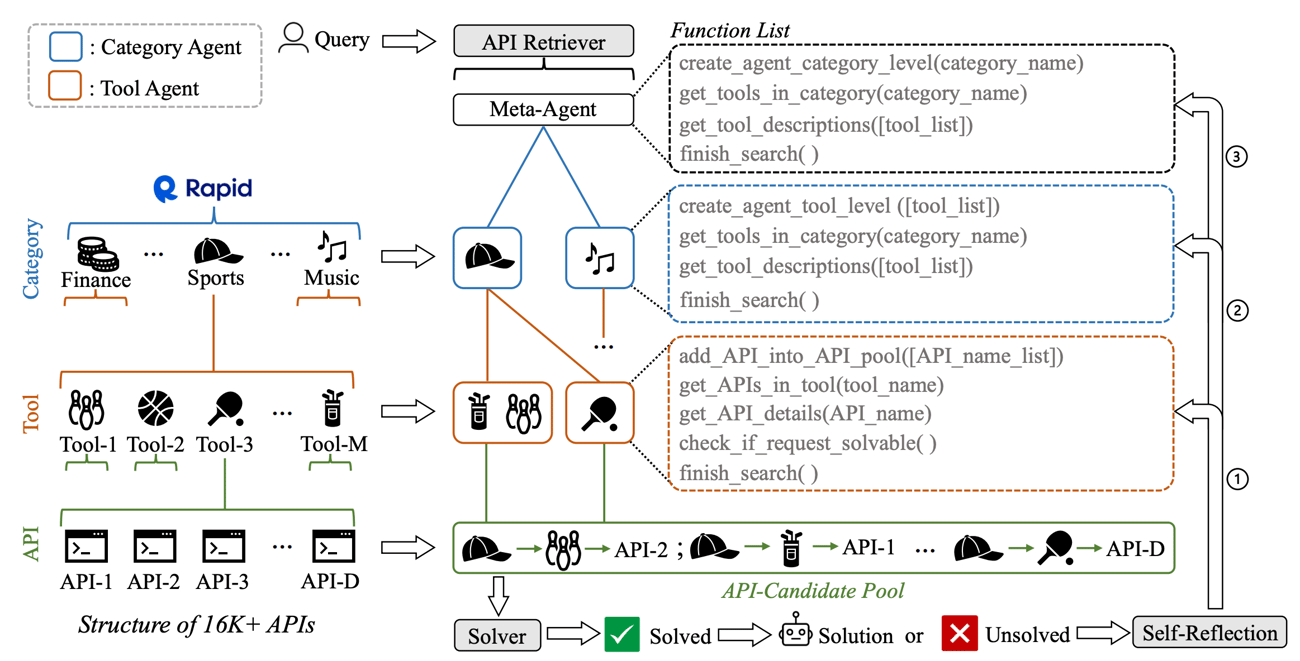 | What's New | AnyTool introduces a method to utilize over 16,000 APIs from Rapid API for solving user queries efficiently. It significantly outperforms other models, achieving a 73.8% pass rate on AnyToolBench, a notable improvement over existing solutions. | Problem | The challenge addressed is the limitation of current language models in handling large-scale API calls due to context length constraints. This issue makes it difficult to integrate and use thousands of APIs effectively in solving complex user queries. | Solution | AnyTool's solution is threefold: First, a hierarchical API retriever narrows down relevant APIs, reducing search scope. Second, a solver uses these APIs to address queries. Third, a self-reflection mechanism re-engages AnyTool if initial solutions fail. This approach avoids the need for external module training, leveraging GPT-4's function calling. | Results | AnyTool showcases superior performance by outperforming ToolLLM and GPT-4 variants with a 73.8% success rate on AnyToolBench, a 35.4% increase over ToolLLM. This demonstrates AnyTool's efficiency in managing and utilizing a vast API pool, offering a scalable solution for real-world application scenarios. | | Read the paper |
|
|
|
 | Train Heavy Models in Seconds: Readers Get 10% OFF GPU Instances | Start today and accelerate your training and inference workloads with the power of NVIDIA’s H100 Tensor Core, deploy your instances in seconds with Latitude.sh!
High-performance networking and enterprise-grade hardware designed for Machine Learning engineers. Our super intuitive dashboard and pre-installed AI software gets you from zero to training with just a few clicks.
Multiple clusters with 8 x H100s available today.
AlphaSignal readers get 10% off during your first 3 months: Use code G3OFF10 | | Get your gpus |
|
|
|
TOP PUBLICATION | More Agents Is All You Need | Junyou Li, Qin Zhang, Yangbin Yu, Qiang Fu, Deheng Ye | | Code | 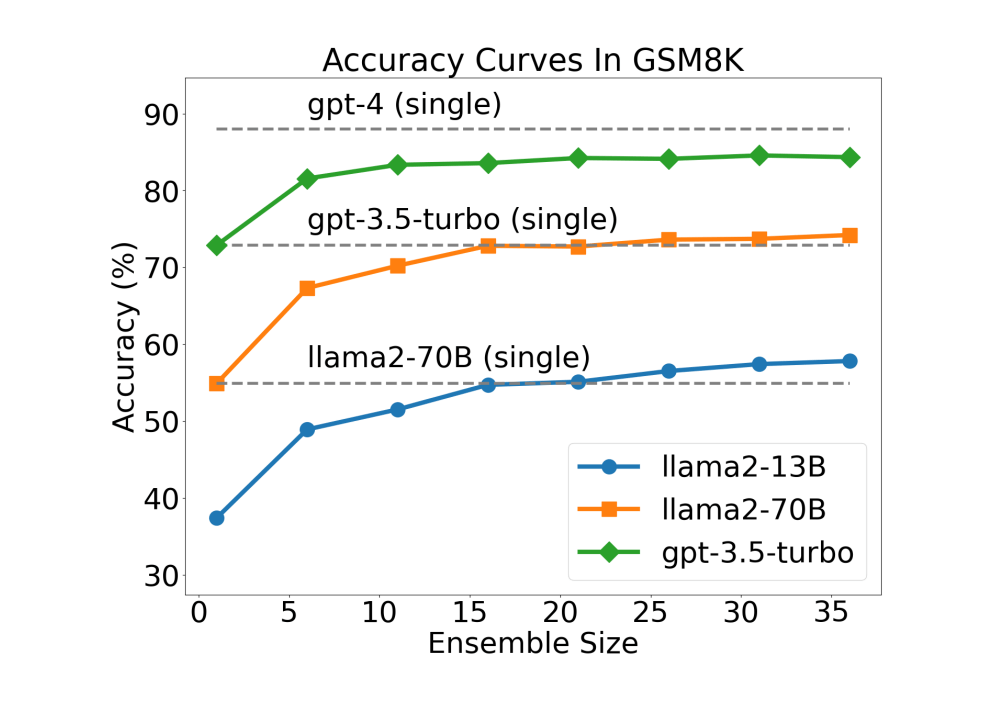 | What's New | This paper introduces a method that significantly enhances Large Language Model (LLM) performance by scaling up the number of agents using a sampling-and-voting approach. It shows a direct correlation between agent count and task performance improvement, making LLMs more efficient in complex problem-solving without needing complex frameworks. | Problem | LLMs face challenges in processing complex tasks due to limitations in existing enhancement methods like Chain of Thought (CoT) pipelines and multi-agent collaboration frameworks. These methods are intricate and not always effective across different tasks, leading to inaccuracies and inefficiencies in model outputs. | Solution | The researchers tackled this issue by implementing a straightforward method of adding more instantiated agents and applying a sampling-and-voting technique. This approach is complementary to existing methods, allowing for combined use for further performance gains. The study also explores task difficulty dimensions to optimize agent scaling effectively. | Results | The findings reveal that increasing the ensemble of agents consistently improves LLM performance, especially in tasks with varying difficulty levels. The performance gains are more pronounced with higher task complexity and longer reasoning steps, indicating a scalable and cost-effective way to boost LLM capabilities without the need for complex enhancements. | | Read the paper |
|
|
|
TOP PUBLICATION | Diffusion World Model | Zihan Ding, Amy Zhang, Yuandong Tian, Qinqing Zheng | 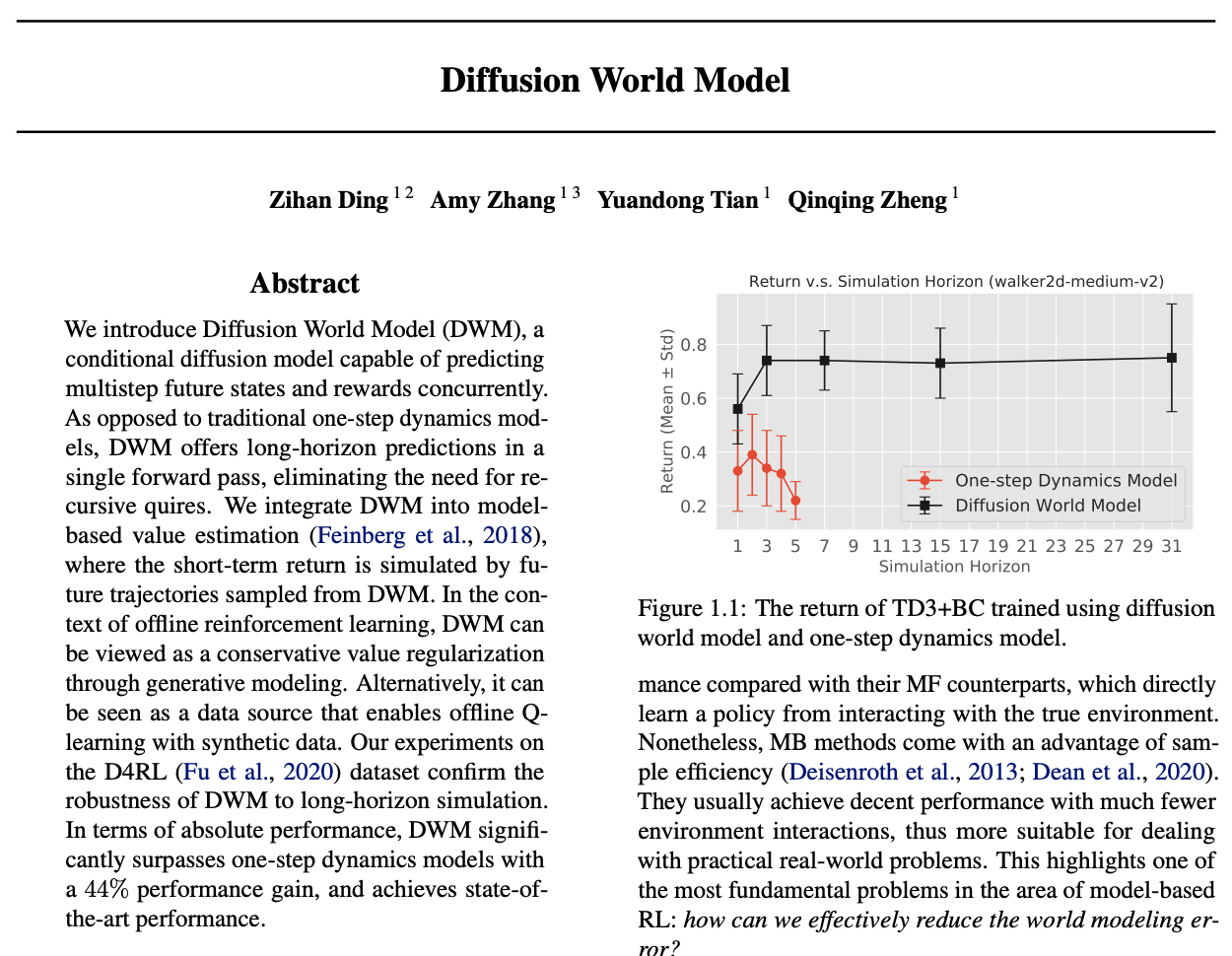 | What’s New | Meta's Diffusion World Model (DWM) introduces a groundbreaking approach to predict multistep future states and rewards concurrently, outperforming traditional one-step dynamics models by a substantial 44%. This enhancement facilitates long-horizon predictions efficiently in a single forward pass. | Problem | Traditional reinforcement learning models face challenges with compounding errors during multistep predictions, limiting their effectiveness for long-term planning. This issue hampers the accuracy and reliability of predictions, particularly in complex environments requiring foresight beyond immediate next steps. | Solution | The researchers developed DWM by integrating conditional diffusion models with offline reinforcement learning to generate future trajectories. This model bypasses the need for recursive queries, using generative modeling for value estimation and enabling synthetic data use in offline Q-learning. The approach combines robust long-horizon simulation capabilities with state-of-the-art performance achievements. | Results | In experiments on the D4RL dataset, DWM showcased significant advantages, including a 44% performance improvement over traditional models and achieving state-of-the-art results. It demonstrated notable robustness in long-horizon simulations, maintaining high performance even with extended prediction horizons, confirming its efficacy in complex predictive tasks. | | Read the paper |
|
|
|
| StabilityAI developed a text-to-speech model guiding speech synthesis via natural language, achieving higher fidelity and naturalness than Audiobox, with metrics showing a MOS of 3.92 and relevance of 3.88. Utilizing synthetic annotations on a 45k hour dataset, it surpasses ground truth in matching descriptions despite minimal clean data. |
| |
|
|
| Introduces the Decision Transformer with Game Instruction (DTGI), which significantly improves multitasking and generalization in RL by using multimodal game instructions. DTGI combines textual and visual cues, outperforming text or trajectory guidance alone. The method leverages a large, diverse offline dataset and a novel SHyperGenerator for knowledge sharing across games. It showcases superior performance in adapting to new tasks, with extensive tests across about 50 Atari games. |
| |
|
|
| This survey categorizes continual learning in LLMs into pretraining, instruction tuning, and alignment for updating models with new knowledge and skills. It contrasts LLM updates with smaller model adaptations, highlighting challenges in multi-stage learning processes and cross-stage forgetting. |
| |
|
|
| | | Want to promote your company, product, job, or event to 170,000+ AI researchers and engineers? You can reach out here. | |
|
|
|
|
