Hey, | Welcome to AlphaSignal, your weekly guide to the latest and most promising developments in the world of AI.
In this edition, we've meticulously scoured GitHub, HuggingFace, and every relevant code repository to identify the most trending and groundbreaking projects.
Let's get into it!
Lior |
|
|
|
IN TODAY'S EMAIL | Repo Highlight:Dify Trending Repos: Fabric, Lepton.. Trending Models/Spaces Pytorch Tip: ModuleDict/ModuleList Python Tip: itertools.chain
| Reading time: 4 min 27 sec |
|
|
|
HIGHLIGHT REPO | Dify (☆ 15.1k) |  | What's New | Dify is an LLM application development platform that has helped built over 100,000 applications. It integrates BaaS and LLMOps, covering the essential tech stack for building generative AI-native applications, including a built-in RAG engine.
Dify allows you to deploy your own version of Assistants API and GPTs, based on any LLMs
LLM Support: Integration with OpenAI's GPT family of models, or the open-source Llama2 family models. In fact, Dify supports mainstream commercial models and open-source models (locally deployed or based on MaaS).
Prompt IDE: Visual orchestration of applications and services based on LLMs with your team.
RAG Engine: Includes various RAG capabilities based on full-text indexing or vector database embeddings, allowing direct upload of PDFs, TXTs, and other text formats.
AI Agent: Based on Function Calling and ReAct, the Agent inference framework allows users to customize tools, what you see is what you get. Dify provides more than a dozen built-in tool calling capabilities, such as Google Search, DELL·E, Stable Diffusion, WolframAlpha, etc.
Continuous Operations: Monitor and analyze application logs and performance, continuously improving Prompts, datasets, or models using production data. | | View the repo |
|
|
|
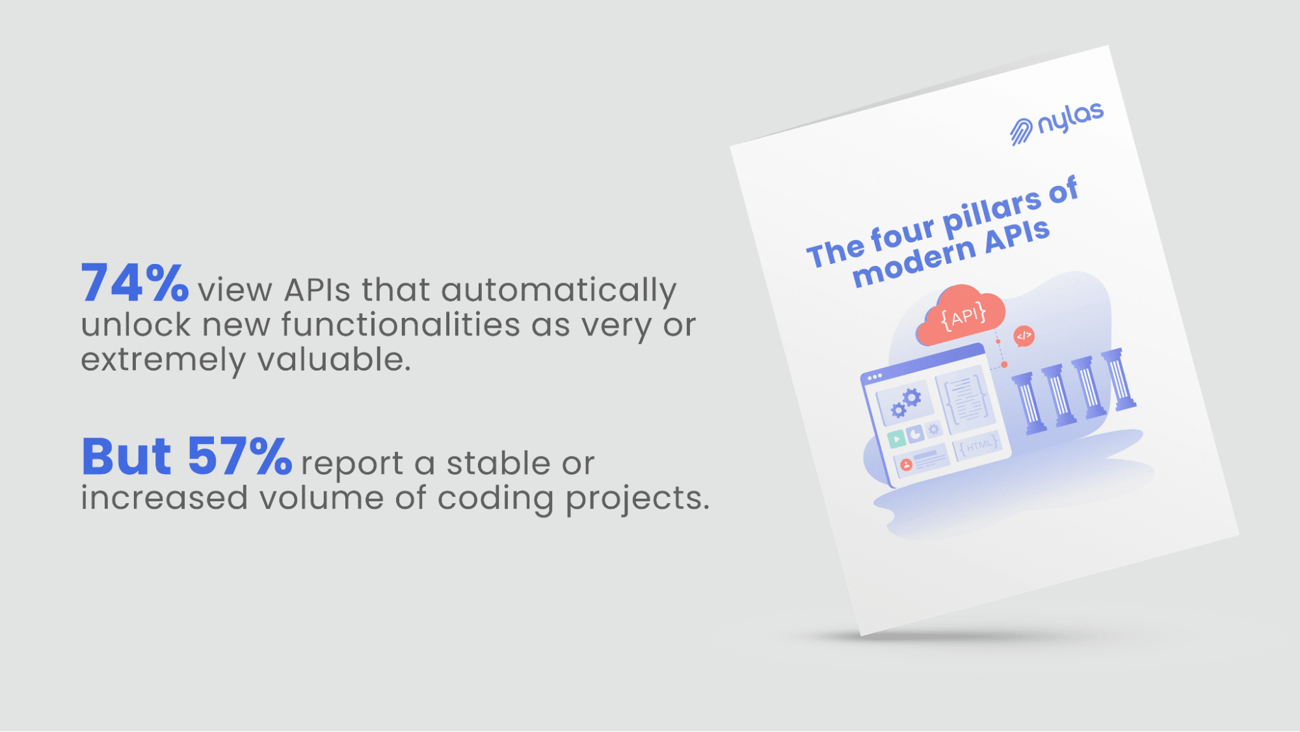 | Report: How 64% of Developers Are Automating API-related Tasks?
Nylas surveyed more than 1,200 developers, engineering leaders, and tech executives in the US to understand how trends like intelligence will influence API usage and creation.
Gen AI-powered capabilities like data parsing and predictive analytics are perceived as a critical component of creating modern APIs but are not always harnessed properly.
Download the full report and learn how the performance, security, developer experience, and intelligence of modern APIs work together. | | Download report | partner with us | |
| |
|
|
TOP OF GITHUB | ---------------------
Fabric helps you integrate AI into daily tasks by providing a framework for managing and applying AI prompts, called Patterns. It simplifies creating, sharing, and using AI prompts in Markdown for tasks like summarizing content or generating code explanations. | | --------------------- Lepton AI helps you transform Python code into AI services with minimal effort, leveraging the Photon abstraction for quick deployment of models like HuggingFace's GPT-2. It includes autobatching, background jobs, and a Pythonic client for native function calls, streamlining cloud deployment. | | --------------------- TaskingAI brings Firebase's simplicity to AI-native app development. The platform enables the creation of GPTs-like multi-tenant applications using a wide range of LLMs from various providers. It features distinct, modular functions such as Inference, Retrieval, Assistant, and Tool, seamlessly integrated to enhance the development process. | | ---------------------
LangGraph, a library built on LangChain, helps you create stateful, multi-actor applications with LLMs by adding cycles for agent-like behaviors. It integrates with tools like Tavily for enhanced functionality and supports streaming output for real-time monitoring of node responses. | | ---------------------
WhisperFusion enables real-time AI conversations by combining WhisperLive's speech-to-text with the Mistral Large Language Model, optimized via TensorRT for efficiency. It requires a GPU with at least 24GB RAM, ideally an RTX 4090 for best performance. This setup allows for low-latency, high-performance processing, utilizing torch.compile for faster PyTorch code execution. | |
| |
|
|
PYTORCH TIP | ModuleDict/ModuleList | torch.nn.ModuleDict and torch.nn.ModuleList let you organize layers in PyTorch models efficiently.
ModuleList is a list of layers you can loop through or access by index, useful when the order matters.
ModuleDict is like a dictionary for layers, where you can use names as keys to add or find layers. This is handy when you need to change parts of your model on the fly without restructuring the whole thing.
Benefits: Simplifies adding/removing layers in neural networks.
Impact: Accelerates model iteration and development speed.
Use Case: Adapts architectures for different input sizes automatically. |
import torch
import torch.nn as nn

class DynamicNet(nn.Module):
    def __init__(self):
        super(DynamicNet, self).__init__()
        self.layers = nn.ModuleList([
            nn.Linear(10, 20),
            nn.ReLU(),
            nn.Linear(20, 10),
        ])

    def forward(self, x):
        for layer in self.layers:
            x = layer(x)
        return x
|
import torch
import torch.nn as nn

class DynamicDictNet(nn.Module):
  def __init__(self):
    super(DynamicDictNet, self).__init__()
    self.layers = nn.ModuleDict()

  def forward(self, x):
    x = self.layers['linear'](x)
    x = self.layers['activation'](x)
    x = self.layers['output'](x)
    return x
|
|
|
|
TOP MODEL/SPACES | --------------------- MetaVoice-1B is a text-to-speech model with 1.2 billion parameters, trained on 100K hours of speech. It focuses on English, offering emotional expression, low-data voice cloning, zero-shot cloning for specific accents, and long text support. It's open-source under Apache 2.0. | | ------------------ InstructIR is a neural model that improves images based on text instructions. It excels in denoising, deblurring, deraining, dehazing, and enhancing low-light images. | |
| |
|
|
PYTHON TIP | itertools.chain | itertools.chain combines multiple iterables (like lists or tuples) into a single iterable, allowing you to loop through all items as if they were part of one collection. It's useful when you want to iterate over several sequences in a single loop without merging them into one list, saving memory.
Benefits: Saves memory, simplifies code by reducing loops, improves performance.
Impact: Makes code cleaner and more efficient, especially in handling large or multiple data collections.
Use Case: Ideal for data processing tasks requiring iteration over several lists or datasets simultaneously. |
import itertools

# Assume we have three lists of numbers
list_a = [1, 2, 3]
list_b = [4, 5, 6]
list_c = [7, 8, 9]

# Now you can iterate over all elements in a single loop
for number in itertools.chain(list_a, list_b, list_c):
  print(number)
|
|
|
|
Want to promote your company, product, job, or event to 170,000+ AI researchers and engineers? You can reach out here. |
|
|
|
|
