Hey, | Welcome to this week's edition of AlphaSignal.
Whether you are a researcher, engineer, developer, or data scientist, our summaries ensure you're always up-to-date with the latest breakthroughs in AI.
Let's get into it!
Lior |
|
|
|
IN TODAY'S EMAIL | Read Time: 4 min 49 sec |
|
|
|
TOP NEWS | Anthropic Releases Claude 3 Beating GPT-4 on Every Benchmark | 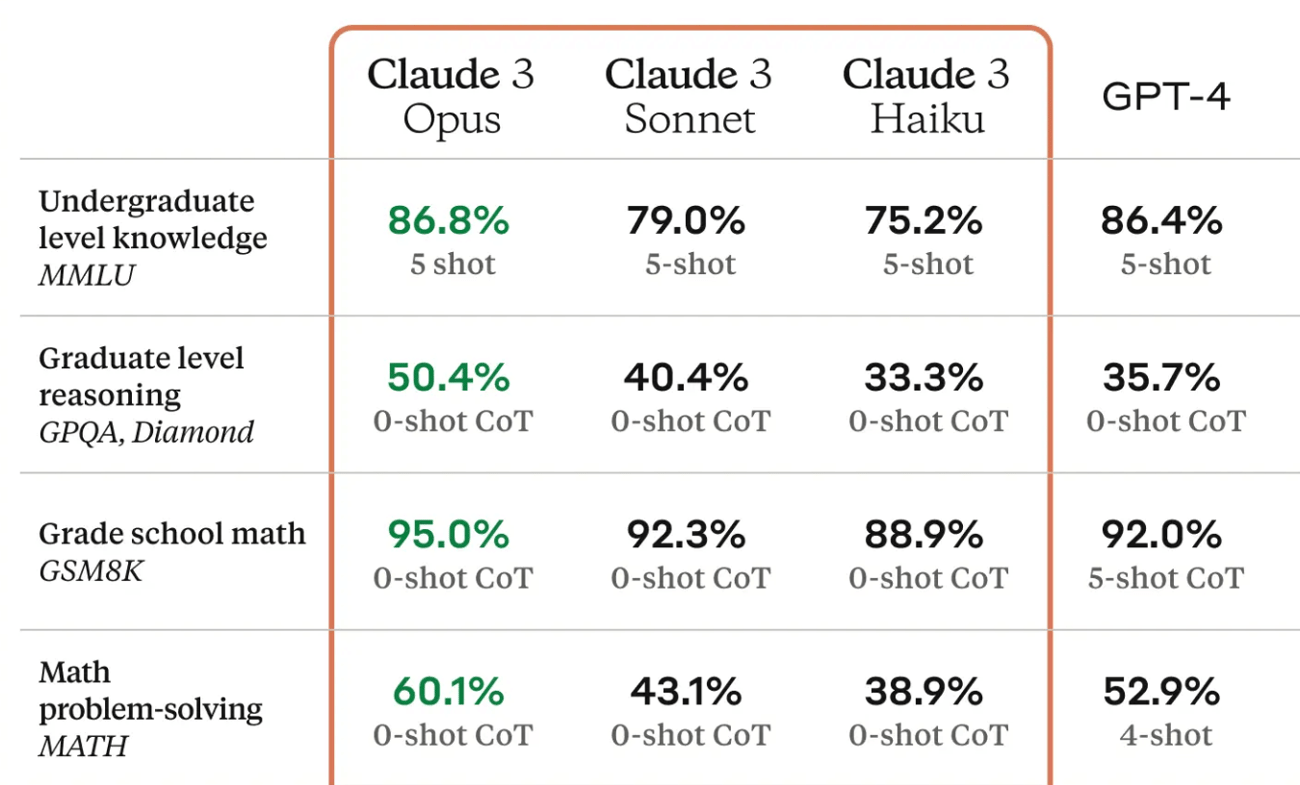 | What's New? | Anthropic recently unveiled its Claude 3 series, a new family of benchmark-crushing models: Opus, Sonnet, and Haiku.
Opus and Sonnet are now available to use in claude.ai and the Claude API which is now generally available in 159 countries. Haiku will be available soon.
Model Specifications: - Opus: Targets advanced intelligence for in-depth processing.
- Sonnet: Balances speed with efficiency for scalable tasks.
- Haiku: Engineered for the fastest response in live interactions.
Performance and Capabilities:
- Benchmark: Opus leads over competitors like GPT-4 and Gemini Ultra in GSM-8k and MMLU benchmarks, indicating superior mathematical reasoning and expert knowledge capabilities.
- Multimodal Functionality: Supports text and image inputs, vital for parsing complex, unstructured data across various formats
Enhanced Context and Recall:
- Extended Context Window: Initially offering a 200K token context window, with capabilities to handle inputs exceeding 1 million tokens.
- Near-Perfect Recall: Demonstrates robust information recall from extensive datasets.
Pricing and capabilities: Opus is priced at $15 per million tokens, a nod to its advanced capabilities over competitors like GPT-4 Turbo, which costs $10.
Multimodal: One of the standout features of the Claude 3 series is its multimodal AI capabilities, enabling the models to process both text and image inputs
Bias Mitigation and Safety: In response to concerns over AI biases, Anthropic has developed the "Constitutional AI" framework, aiming for model neutrality. However, completely eliminating bias remains a challenging task. | | Try claude 3 |
|
|
|
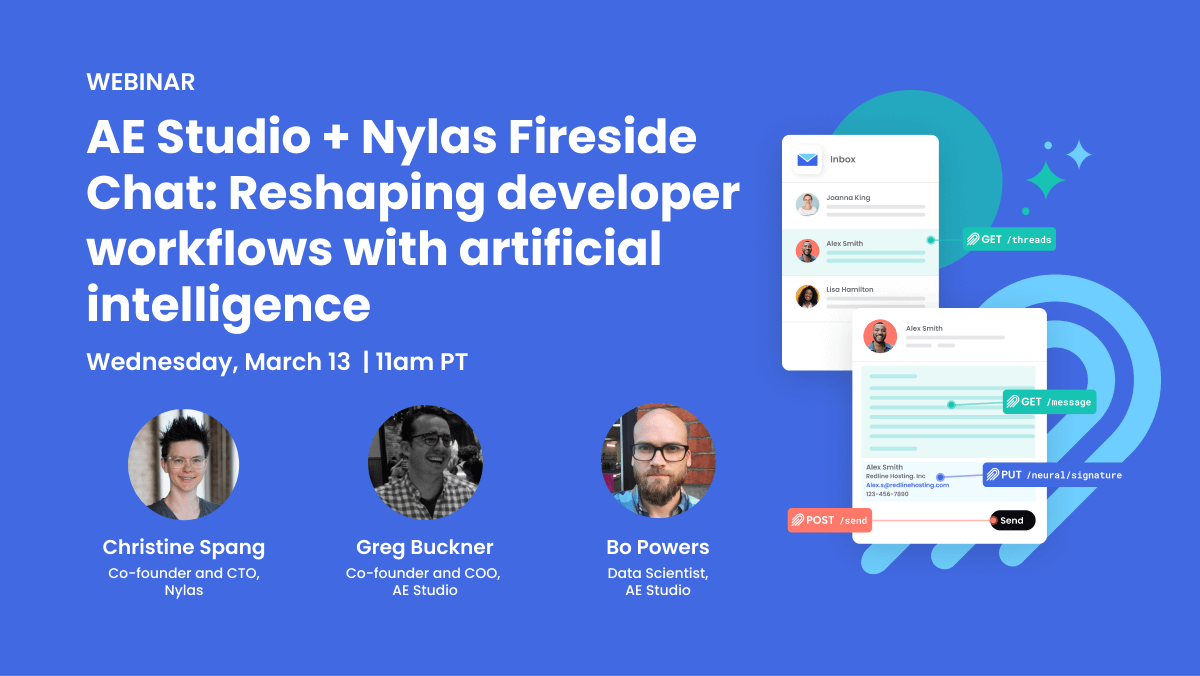 | AI conversation with AE Studio and Nylas | AE Studio’s team of experienced developers and data scientists specializes in launching custom AI solutions. They’ll share the top challenges their clients — like Salesforce, Polygon, and Samsung — face when harnessing AI and how they’re successfully optimizing their developer toolkits and workflows.
Join Greg Buckner (Co-founder and COO, AE Studio), Bo Powers (Data scientist, AE Studio), and Christine Spang (Co-founder and CTO, Nylas) for a quick 45-minute discussion on this topic. | | Join now | partner with us |
|
|
|
TOP OF GITHUB | --------------------- The official PyTorch implementation of Gemma, Google's latest Gemini-inspired open-source models. This suite of text-to-text, decoder-only large language models is lightweight, and available in English only. You can download model checkpoints for various sizes, including 2B and 7B, and run inference on CPU, GPU, and TPU using provided Docker images and scripts. | | --------------------- A no-code application that abstracts away the complexity of data ingestion and allows to ingest data from any source into any destination. You can copy data from your database into any destination ; and perform append, merge and delete/insert operations, using simple command-line flags. It supports many database providers from Postgres to BigQuery and even local csv files. | | --------------------- Implementation of paper - YOLOv9: Learning What You Want to Learn Using Programmable Gradient Information. It's a real-time object detection model that surpasses all convolution and transformer-based models. | |
| |
|
|
TOP REPO | OOTDiffusion: a virtual try-on diffusion model | 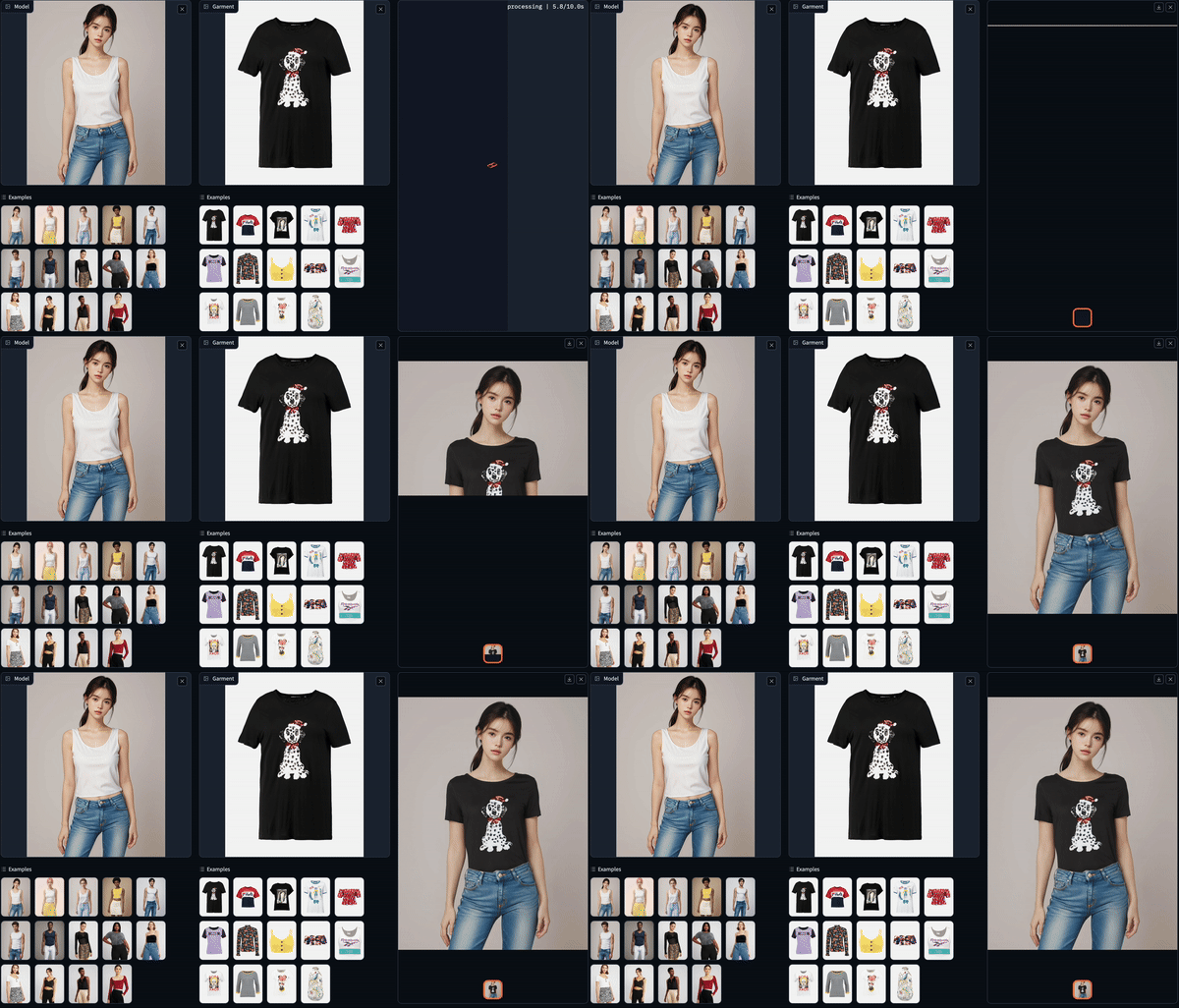 | What's New? | The implementation and model checkpoints of OOTDiffusion, an Outfitting Fusion based Latent Diffusion for Controllable Virtual Try-on, were released this week. This model was previously available for inference through a UI.
What It Allows You To Do: This model merges a person's half-body or full-body image with images of clothing, by simply requiring both the person's image and the clothing images as input. The model checkpoints trained on the VITON-HD dataset were officially released, and the checkpoints trained on the DressCode dataset will be out soon.
How It Works: The model is based on various components that ensure high quality and fidelity, preservation of details and realism of the image generated. - The architecture is based on Variational Auto Encoders (VAE) to encode and decode the images, CLIP models for text encoding, and specialized U-Nets for garment fitting and virtual try-on tasks.
- Similarly to the VITON-HD model, OOTDiffusion uses ALIgnment-Aware Segment (ALIAS) normalization to handle misalignments between clothing and body images, while preserving the texture sharpness and details of clothing at high resolutions.
- ALIAS normalization is targeted feature adjustment process within image synthesis that dynamically aligns and integrates garments onto body segments by correcting feature distributions in areas of misalignment.
Running the pipeline: Try running the inference with the model checkpoints from the repo. | | Check the repo |
|
|
|
TOP NEWS | Elon Musk sues OpenAI for Abandoning Original Mission for Profit |  | What's New? | Elon Musk has filed a lawsuit against OpenAI, accusing the AI research firm, which he co-founded, of deviating from its original non-profit mission to pursue profit-driven goals, particularly in partnership with Microsoft. Filed in San Francisco Superior Court, the lawsuit demands that OpenAI be prohibited from leveraging its AI advancements, including ChatGPT, for financial gain and insists on making their research publicly accessible.
Musk's legal action comes amid escalating tensions with OpenAI, as he claims the company, now aligned with Microsoft, has abandoned its foundational aim of developing AI for the greater good. He argues that this shift not only betrays the initial agreement but also jeopardizes the ethical development of AI technologies.
Furthermore, Musk alleges that OpenAI, under CEO Sam Altman, has strayed from its commitment to open-source AI development, contrasting sharply with Musk’s new venture, xAI, which emphasizes transparency and public benefit. OpenAI, transitioning to a profit-making entity, refutes Musk's claims, asserting ongoing dedication to their mission.
In an internal memo to staff obtained by The Washington Post, OpenAI Chief Strategy Officer Jason Kwon shot back at the lawsuit:
“We categorically disagree and, while we have a long way to go, have already made much more mission progress than many — including Elon — thought possible,” Kwon said in the memo. “We believe the claims in this suit may stem from Elon’s regrets about not being involved with the company today.”
However, this legal challenge raises significant questions about the future direction of AI research and development, particularly around open access versus proprietary technology. | | Read more |
|
|
|
| | Want to promote your company, product, job, or event to 170,000+ AI researchers and engineers? You can reach out here. | |
|
|
|
|
