Hey | Welcome to today’s edition of AlphaSignal.
This week, we've partnered up with Nebius to help us break down the differences between NVIDIA’s top-tier GPUs and identify workloads where each GPU model performs at its best.
Let's get into it,
Lior
|
|
|
|
| IN TODAY'S EMAIL |
H100 and other GPUs — which are relevant for your ML workload? - Transformer Models: Trends and Efficiency
- Numerical Precision in GPUs: Significance and Evolution
- GPU Cores: Differences and Applications
- GPU Specifications and Benchmarks: Analyzing Performance
- Graphics Cards Comparison: Understanding Use Cases
Reading time: 5 min 40 sec |
|
|
|
| Who is Nebius? | Nebius is a cloud platform specifically designed to train AI models. They provide you with the latest and greatest GPUs such as the NVIDIA H100 to manage intensive AI workloads.
Features: Built for large-scale ML workloads: Multihost training with thousands of H100 GPUs, 3.2Tb/s InfiniBand network.
50% cheaper compared to major public cloud providers.
Fully managed Kubernetes: Simplify deployment, scaling, and management of ML frameworks.
ML-focused libraries, applications, frameworks, and tools.
Detailed documentation, resource management in a user-friendly cloud.
There is a special offer from Nebius AI for all our subscribers: sign up and receive a 1000 USD trial for testing the platform. | | Start training |
|
|
|
| Why are transformer models trending? | 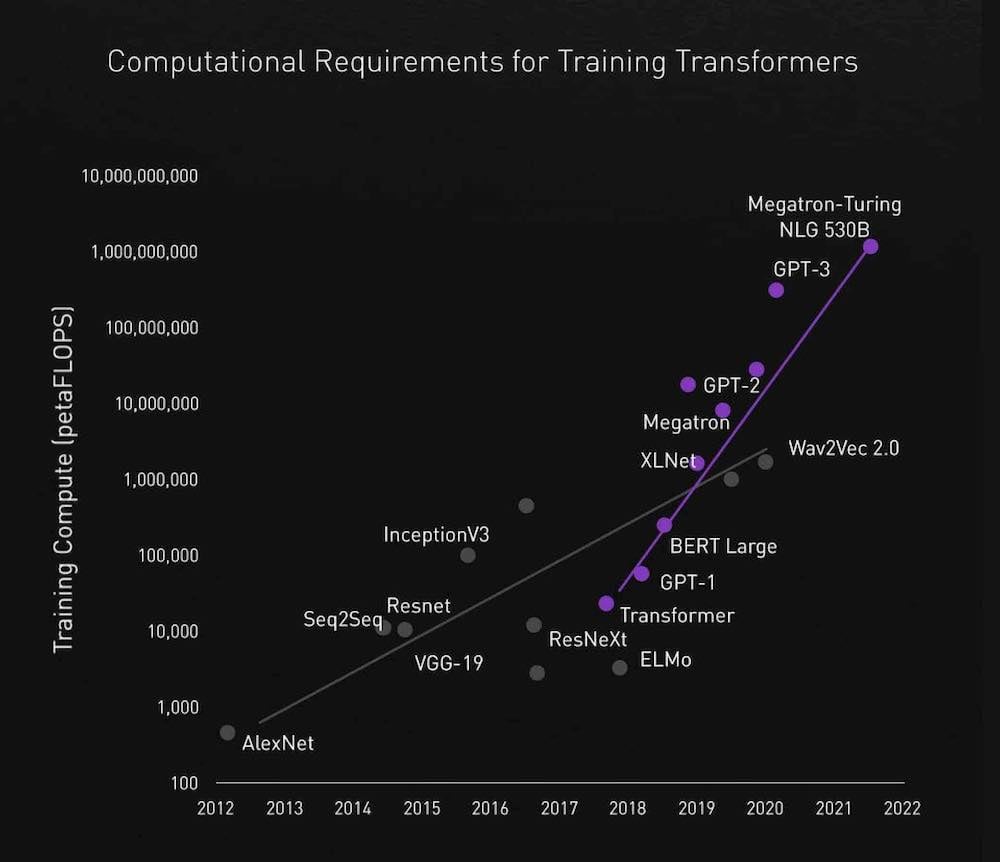 | Transformers consistently outperform their counterparts when pre-trained on large, unlabeled datasets - they excel by leveraging large volumes of data during pre-training and high-quality data during fine-tuning. This method surpasses the need for extensively refined datasets, enabling the use of larger, less processed data pools.
Transformers are characterized by highly parallelizable computations - their architecture allows for efficient distribution across multiple devices, optimizing the use of Tensor cores in modern GPUs. This compatibility ensures high efficiency and performance, particularly in large-scale applications.
Stemming from the previous two points, there’s still tons of untapped potential to scale - by enhancing dataset size and computational capabilities. Despite potential growth limits, innovations like synthetic data generation are being explored to sustain model improvement.
As transformer architecture has become the industry standard, frameworks and GPU hardware are tailored to favor transformers - this adaptation supports the growing trend towards using transformers in various applications, reinforcing their position as a favored solution in AI technology.
| | The role of numerical precision | The recent success of NVIDIA's H100, L4, and L40 GPUs is heavily attributed to their support for FP8 precision, crucial for transformer models.
The importance of FP8 lies in its role in numerical representation. In machine learning, floating point (FP) formats are pivotal as they influence the precision of stored and operational numbers, impacting model output quality.
FP64, or double-precision format, occupies 64 bits but is not typically used in ML, being more relevant in scientific fields. The L40 and L4 GPUs, lacking hardware-level FP64 support, are unsuited for such scientific applications.
Historically, FP32 served as the standard for deep learning, until the shift to FP16, which reduced memory usage and accelerated computations without noticeable quality loss, thus becoming the preferred standard.
TF32 is another format, differing slightly from FP32 but facilitating faster computation by converting FP32 values at the driver level for Tensor cores without code changes.
INT8, an integer format, is utilized post-training through quantization to reduce memory and accelerate inference, although this is less effective for transformers due to their structure and post-training conversion challenges.
FP8 emerges as a solution, particularly for transformer models, enabling conversion of pre-trained models to FP8, thereby reducing hardware requirements without losing performance. This is especially beneficial when transitioning from A100 to H100 GPUs. FP8 also supports mixed-precision training, reducing RAM needs and speeding up the process, eliminating the need for conversion during inference, with parameters already in FP8. | | What types of GPU cores exist | Now it’s time to briefly discuss the differences between the types of GPU cores, which will be crucial to our conclusions. CUDA cores: These are general-purpose cores that can be adapted to a variety of tasks. While they can handle any computation, they aren’t as efficient as specialized cores.
Tensor cores: Designed for matrix multiplication, these cores excel at this particular task. This specialization makes them the standard choice for deep learning.
RT (ray tracing) cores: These cores are optimized for tasks that involve ray tracing, such as rendering images or video. When the goal is to produce photorealistic imagery, a GPU outfitted with RT cores is the way to go.
Almost every GPU model relevant to this article comes equipped with both CUDA and Tensor cores. However, only the L4 and L40 have RT cores. | | Key GPU specs and performance benchmarks for ML, HPC, and graphics | With the numerical formats out of the way, let’s turn our attention to the evolution of GPU specs and their standout features. We’ll focus only on the technical specifications relevant to the context of this article. | 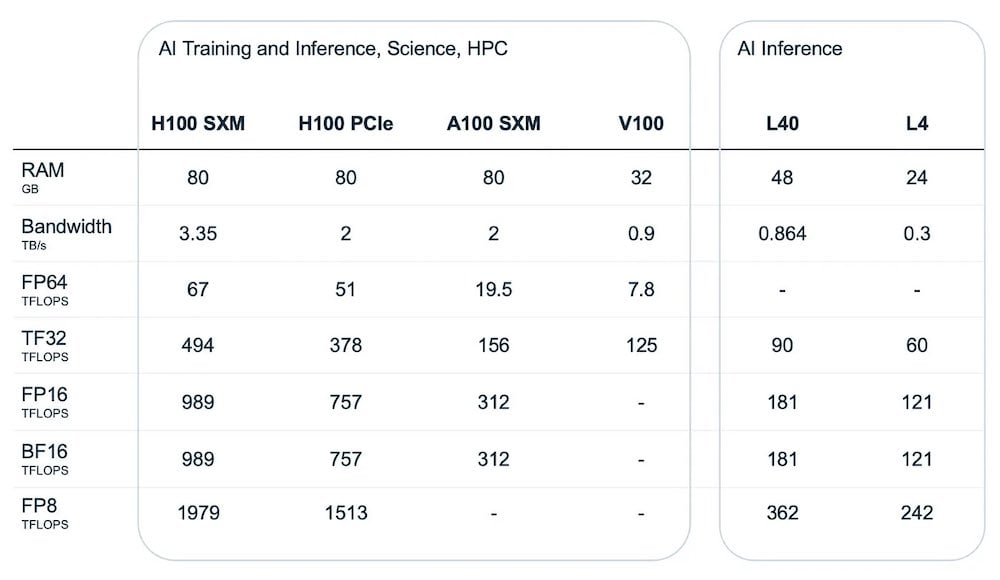 | Pay particular attention to the first two rows: the amount of RAM and its bandwidth. An ML model must fit snugly into the GPU accessible to the runtime environment. Otherwise, you’ll need multiple GPUs for training. During inference, it’s often possible to fit everything on a single chip.
Moving on, let’s examine the performance metrics of various GPUs in training and inference, with the chart based on data from Tim Dettmers’ renowned article:
| 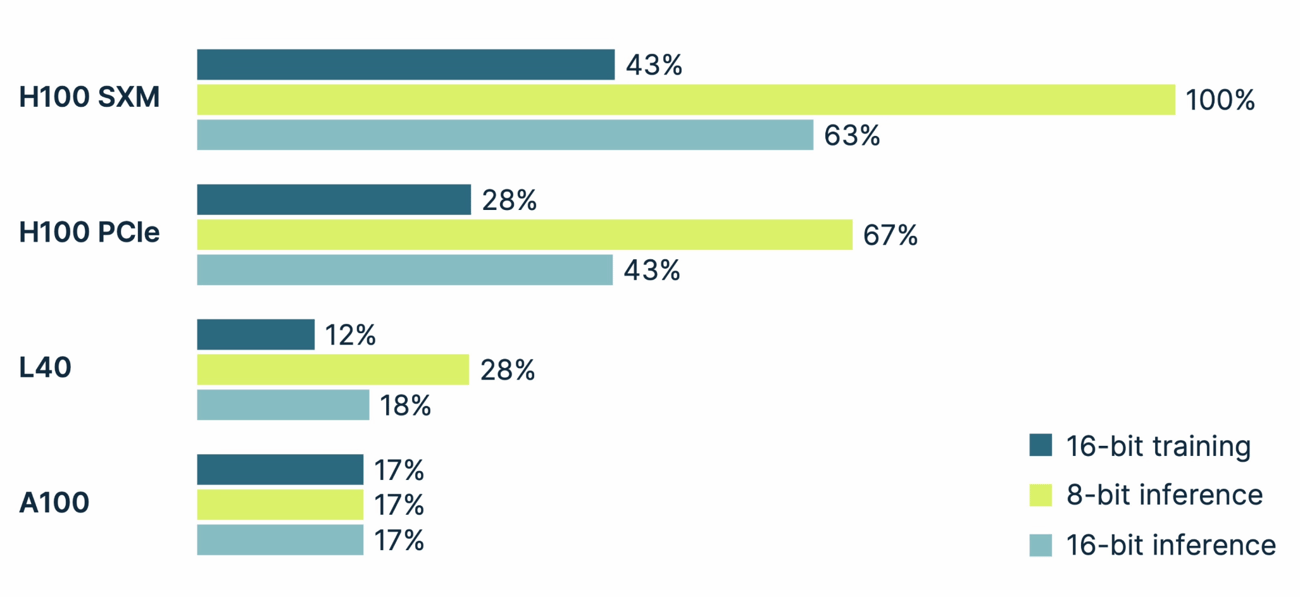 | The H100 SXM metric is used as the 100% benchmark, and all others are normalized relative to it.
The chart reveals, for example, that 8-bit inference on the H100 GPU is 37% faster than 16-bit inference on the same GPU model. This is due to the hardware support for FP8-precision computing. When we say “hardware support, ” we’re talking about the entire low-level pipeline that moves data from the RAM to the Tensor core for computation. | | Final overview | We’ve now arrived at our main comparison table, which showcases the characteristics of different graphics cards based on the purpose for which they were designed: | 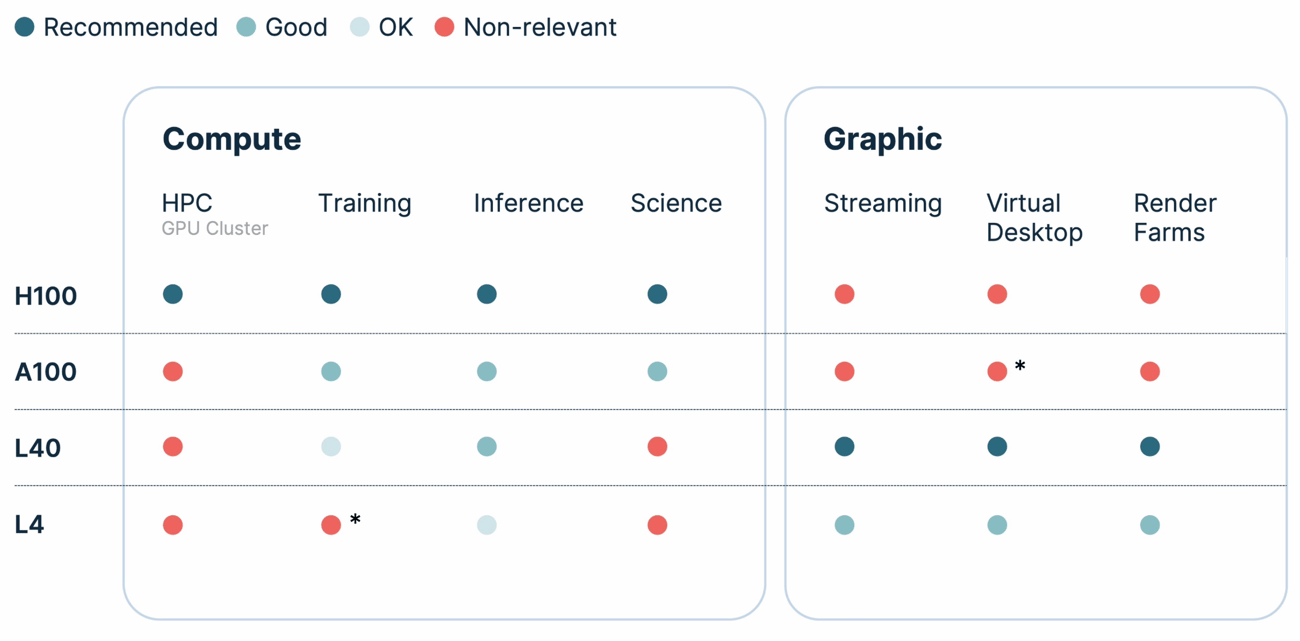 | From this table, we can discern two primary use case categories: tasks that focus purely on computation (labeled “Compute”) and those that incorporate visualization (labeled “Graphic”). To reiterate, the A100 and H100 are entirely unsuitable for graphics, while the L4 and L40 are tailor-made.
At first glance, you might assume that the A100 or L40 would be equally good at inference. However, as we unpacked earlier in our section on the transformer architecture, there are nuances to consider.
The column labeled “HPC” indicates whether multiple hosts can be merged into a single cluster. In inference, clustering is rarely necessary — but that depends on the model’s size.
The key point is ensuring that the model must fit into the memory of all the GPUs on a host. If a model oversteps this boundary, or if the host can’t accommodate enough GPUs for their combined RAM, then a GPU cluster is required. With the L40 and L4, we are limited in scalability by the capabilities of an individual host. The H100 and A100 don’t have that limitation.
So, which NVIDIA GPU should you use in your ML workloads? Let’s look at your options: L4: An affordable, general-purpose GPU suitable for a variety of use cases. It’s an entry-level model serving as the gateway to the world of GPU-accelerated computing.
L40: Optimized for generative AI inference and visual computing workloads.
A100: Offers superior price-to-performance value for single-node training of conventional CNN networks.
H100: The best choice for BigNLP, LLMs, and transformers. It’s also well-equipped for distributed training scenarios, as well as for the inference.
Nebius AI offers GPUs from NVIDIA’s latest lineup — the L4, L40, and H100, along with the last-gen A100. You can use them to train ML models, run inference, and fine-tune through a variety of platform components, including Managed Kubernetes, сloud Marketplace, and more.
There is a special offer for all our subscribers: sign up and receive a 1000 USD trial for testing the platform. | | Start training |
|
|
|
| | | Want to promote your company, product, job, or event to 150,000+ AI researchers and engineers? You can reach out here. | |
|
|
|
|
