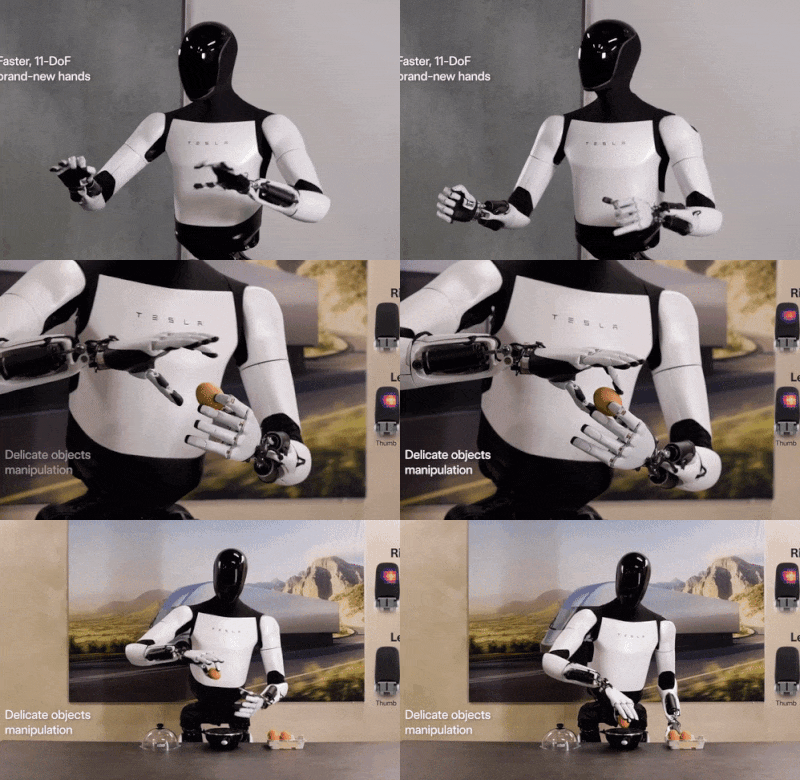
On Tuesday, Tesla released a demonstration video of its latest humanoid robot prototype, Optimus Gen 2, marking a significant advancement from its initial public showing. The previous version, introduced over a year ago, exhibited basic functionalities with noticeable limitations in movement and stability.
In contrast, the new Gen 2 robot demonstrates enhanced hardware and capabilities, as confirmed by Tesla Senior Staff Software Engineer Julian Ibarz: "Everything in this video is real, no CGI. All real time, nothing sped up. Incredible hardware improvements from the team."
The video displays the progression from Tesla's first humanoid prototype 'Bumblebee' to 'Optimus - Gen 1', culminating in the introduction of 'Optimus - Gen 2'. This latest model showcases various tasks, including slow walking, squatting, and the careful manipulation of delicate objects like eggs, indicative of significant improvements in balance, motor control, and tactile sensing.
Key technical specifications of the Optimus Gen 2 include Tesla-designed actuators and sensors, a 2-DoF actuated neck for enhanced head movement, integrated electronics and harnessing within the actuators for streamlined functionality, and a notable 30% increase in walking speed.
The robot's feet feature foot force and torque sensing, articulated toe sections, and are designed to mimic human foot geometry, contributing to a more natural gait. The overall weight of the robot has been reduced by 10 kg, improving its agility and energy efficiency. The hands of the robot are also upgraded, now featuring faster, 11-DoF hands with tactile sensing on all fingers, enabling delicate object manipulation such as holding an egg without causing damage.
While the Optimus Gen 2 shows promising progress, it remains a prototype and is not intended for immediate production or sale. It represents Tesla's ongoing efforts in developing a functional humanoid robot, envisioned by CEO Elon Musk to perform tasks that humans prefer to avoid.
The design aims to replicate human shape and size, intending to seamlessly replace human labor in various applications. However, given the complexities of engineering such advanced robots, the timeline for achieving this goal remains uncertain. |