|
Who took this survey? |
The survey covered 430 participants, representing organizations in size from a few employees to thousands of employees. 51% of respondents came from companies with 600 employees or larger.
The insights from the survey covered dozens of industries; among the most common were: Information Technology Services, Computer Software, Financial Services/Banking, Education, Healthcare, Consumer Goods, Telecommunications, Automotive, Insurance, Media/Entertainment, and Defense.
28% of all respondents are data scientists, 23% engineering/DevOps and 17% in software development roles. |
|
Key Takeaways and Trends |
- 50%+ of respondents found Generative AI to be only moderately, slightly or not important at all to their organizations future AI strategy.
- 10% of organizations launched GenAI solutions to production in 2023.
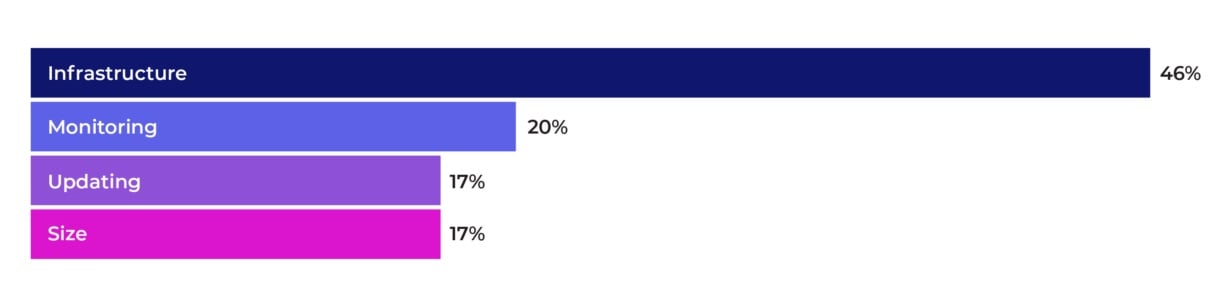
- Nearly half of AI professionals see infrastructure as the largest barrier to productionizing LLMs.
- 8 out of 10 respondents admit their skills need to improve due to the increased interest in LLM adoption.
- Chatbots and translation/text generation AI use cases are on the rise.
- AI integration remains low as this continues to be a difficult area to execute.
- 62% of AI professionals continue to say it is difficult to execute a successful AI project.
|
| Read the report |
|
Despite the hype, more than half of respondents found Generative AI to be only moderately, slightly or not important at all to their organizations future AI strategy
44% of the respondents consider Generative AI to be very, or extremely important. While the majority of respondents found that GenAI is only moderately important to the future of organizations strategies.
|
How important is Generative AI in your organization’s future AI strategy? |
 |
|
10% of organizations launched GenAI solutions to production in 2023 |
Only 10% of respondents said that they had already launched GenAI solutions to production. The majority of organizations are still in the research or testing phase of incorporating generative AI in production. Additionally, when asked, only a quarter of respondents had declared that their organization had deployed any generative AI models to production in the last year. |
What is your current organization’s maturity level in using generative AI? |
 |
|
Nearly half of AI professionals see infrastructure as the largest barrier to productionizing LLMs |
Infrastructure (46%) is the biggest challenge in productionizing LLMs, mentioned twice as much as the 2nd biggest challenge – monitoring (21%). As mentioned earlier, training and deploying LLMs can be quite challenging. Firstly, the immense computational power and specialized hardware required for training are substantial. |
What is your biggest challenge productionizing LLMs? |
 |
|
8 out of 10 respondents admit their skills need to improve due to the increased interest in LLM adoption |
These respondents are split between having what they need to improve these skills and not knowing where to start. LLMs require a distinct set of expertise and skills.
Managing vast amounts of data for effective learning and fine-tuning models for specific tasks demands expertise. Deployment is complex as well, involving considerations like model size, inference speed, and resource constraints. |
Do you believe you need to improve your skills in your role
due to the increasing interest in LLM adoption? |
 |
Chatbots and translation/text generation AI use cases on the rise |
Compared to 2022, the use of chatbots/virtual agents, as well as translation/text generation have seen a spike as a popular AI use case.
That could be due to the rise in Large Language Model technology in 2023 and the advance in generative AI technology. Despite the low adoption of GenAI, it appears there is still a focus on GenAI solutions. |
AI/ML use cases by popularity 2022 vs 2023 |
 |
|
Download the full ML Insider 2023 Report to see the complete results. |
| Read the full report |
