Advanced Machine Intelligence (AMI), the new venture from Turing Award winner Yann LeCun, recently raised $1.03 billion at a $3.5 billion valuation to build "world models." Unlike large language models (LLMs) that process text, AMI's systems learn directly from the continuous reality of the physical world.
The startup has long-term research goals, but it will also target sectors operating complex systems, including automakers aiming to improve the AI stacks of self-driving car companies.
LeCun has long argued that current AI systems fail to produce capable intelligent agents. AMI intends to replace the dominant paradigm of predicting the next word or pixel with systems that natively understand cause-and-effect.
The mathematical limits of next-token prediction
Today's dominant AI systems rely on autoregression, a process where the model predicts the next discrete token based on the sequence of all previous tokens (a token can be a word, a patch of pixels, a stretch of audio, etc.).
This approach works remarkably well for language, which is inherently discrete and follows predictable rules. But the architecture fails when applied to long reasoning tasks or the physical world:
Because the model samples from a probability distribution for every prediction, a single early mistake shifts the context and causes subsequent predictions to diverge exponentially.
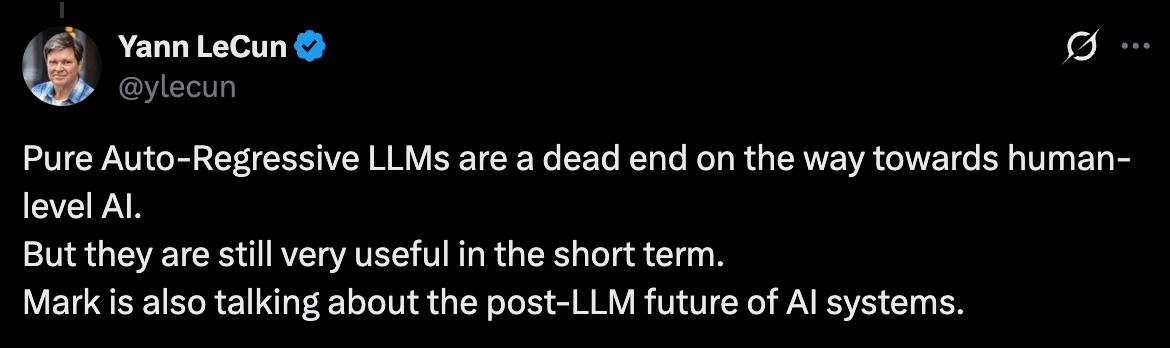
This compounding error rate makes hallucinations a fundamental flaw rather than a fixable bug. On his X account in September 2024, LeCun stated, "Pure Auto-Regressive LLMs are a dead end on the way towards human-level AI. But they are still very useful in the short term."
The physical world introduces continuous, noisy data that language models cannot easily parse. These nuances cannot be captured in a limited set of tokens.
Also, generative models are designed to predict the most granular details of their environment. They waste massive computing capacity attempting to predict irrelevant background noise, like the exact movement of a blowing leaf, instead of capturing underlying physics or causality.
This lack of grounding prevents current AI from operating reliably in open environments. Unfortunately, with so much money to be made from LLMs, there is little appetite for alternative approaches in the tech world right now.
Speaking to The New York Times in January 2026, LeCun warned of the industry's narrow focus: "There is this herd effect where everyone in Silicon Valley has to work on the same thing. It does not leave much room for other approaches that may be much more promising in the long term."
JEPA: Predicting concepts, not pixels
To solve these structural issues, AMI Labs employs the Joint Embedding Predictive Architecture (JEPA), a framework LeCun proposed in 2022. Instead of trying to guess exact pixels or words, JEPA operates in the abstract latent space.
It uses two encoders to map raw observations into simplified mathematical representations, or embeddings. The system then attempts to predict the future embedding based on the current context.
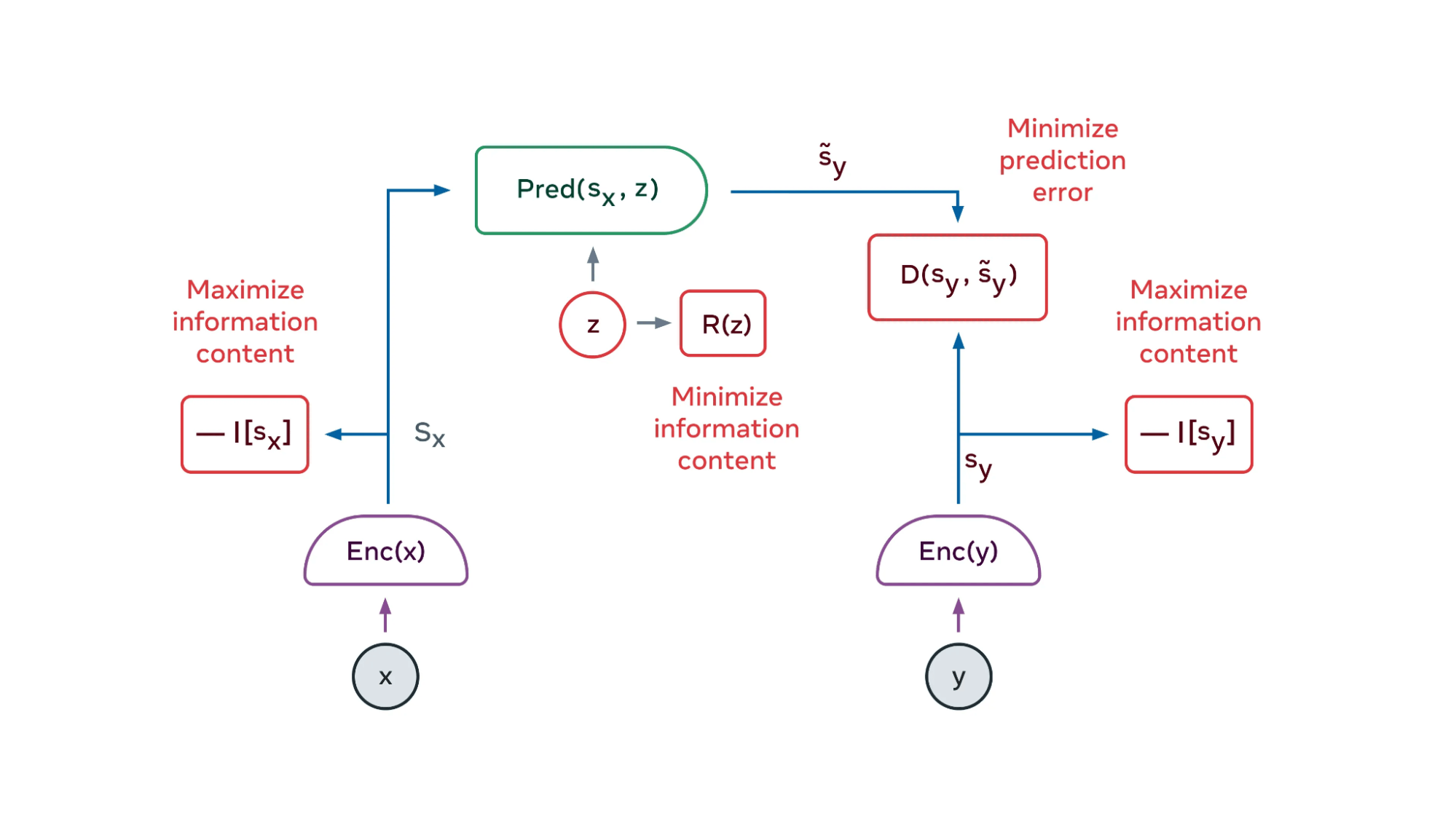
Embeddings are very low-dimensional spaces (hundreds or thousands of features as opposed to millions of pixels), which makes them much more efficient. By working in this compressed representation space, the model learns to ignore irrelevant details (e.g., how the color of an object changes under different lighting).
Instead, it learns the salient rules of physics, spatial reasoning, and cause-and-effect without expending compute on perfectly reconstructing a scene (e.g., what are the different objects in a scene and how they are interacting with each other).
Meta AI previously demonstrated this progression through models like V-JEPA, which learned physical world modeling purely by watching videos. Later iterations, such as V-JEPA 2, enabled zero-shot deployment on physical robots for picking and placing objects using minimal training data.
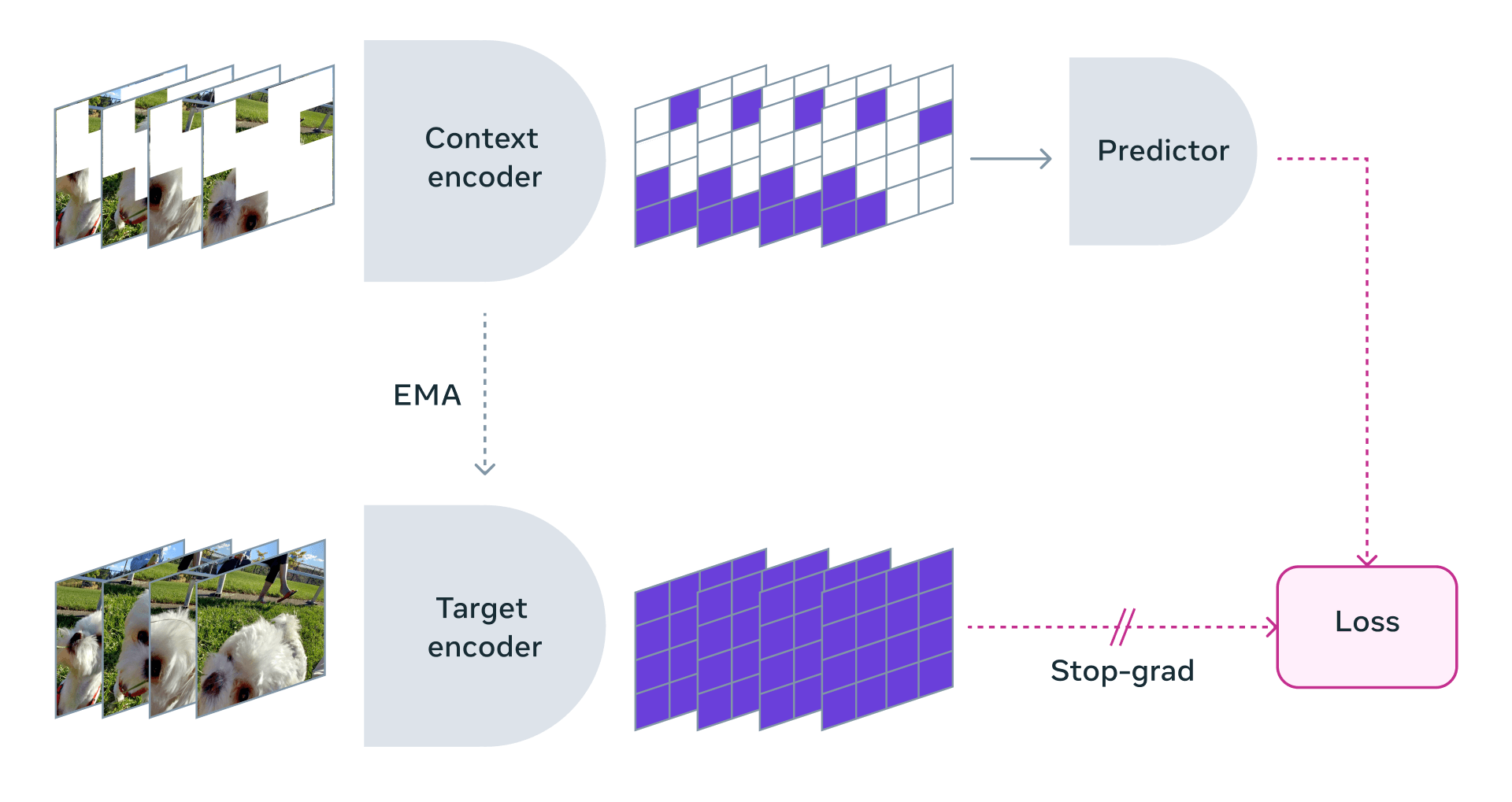
C-JEPA, the most recent architecture in the family, is specifically designed for learning causal relationships between objects.
The world model fork in the road
The push toward world models has split the AI industry into two competing camps: abstraction-first versus pixel-first. While AMI Labs champions abstract embeddings, competitors are scaling explicit generative models to simulate reality.
Google DeepMind's Genie 3 operates as a fully generative autoregressive video model. It creates responsive, real-time 3D environments frame-by-frame based on text prompts and user actions. The model is an end-to-end system that simulates the physics, dynamics, and graphics of the virtual environment.

Another competitor, World Labs, founded by AI pioneer Fei-Fei Li, recently secured $1 billion to build explicit 3D scene representations using a technique called 3D Gaussian Splatting. Marble, World Labs' first product generates photorealistic, editable 3D environments from user prompts. Those environments can then be ported into game engines like Unreal.
These generative approaches offer playable, interactive sandboxes and simulation environments for training AI models for the physical world. Waymo, Google is using Genie 3 to create training environments for its Waymo self-driving cars.
AMI Labs, however, targets the actual intelligence that robots use for making decisions at inference time. The startup contends that predicting pixels remains highly inefficient for real-world robotics and autonomous systems, betting instead that non-generative abstraction provides a safer path to physical intelligence.
Why world models matter for builders
For developers constructing AI applications, the underlying architecture dictates what applications become feasible. Current large language models lack the reasoning capabilities required for operating in physical environments, where the long tail of unpredictable events is very large and training data for edge cases is scarce or unavailable.
An architecture that natively models the world like humans can be more robust against uncertainty and provide built-in safety constraints. Approaches like AMI Labs can also steer the field toward more compute efficient models that can run on edge devices and resource-constrained hardware, which can unlock more applications.
AMI Labs intends to open-source significant portions of its code to foster a surrounding research ecosystem.
The race to achieve human-level AI has expanded beyond text processing. The next major leap in capabilities might emerge from systems that successfully compress the chaotic physical world into reliable, computable abstractions.