|
Hey,
Your daily briefing is ready. You can finally take a break from the AI firehose.
Our algos spent the night splitting signal from noise and pulled the top news, models, papers, and repos.
Here’s the must-read:
|

|
Today's Author
Lior Alexander. Founder of AlphaSignal and former ML Engineer.
Previously built ML systems at Iguazio, Guesty, Enphase, Mila.
|
|
Top News
|
|
|
|
Google enables real-time audio translation on any headphones through upgraded Gemini models
|
|
7,824 Likes
|
|
Google updates Gemini’s audio stack with a clear goal: make real-time voice agents actually work at scale.
Until now, most voice systems stitched together speech recognition, text models, tools, and text-to-speech, which broke conversational flow and made tool use unreliable.
Gemini 2.5 Flash Native Audio removes that glue code by handling audio input, reasoning, tool calls, and audio output in a single model.
The key insight is native audio.The model listens and speaks directly, without converting speech into text first. That design lets it track context across turns, call tools mid-conversation, and respond without breaking flow.
What’s new
-
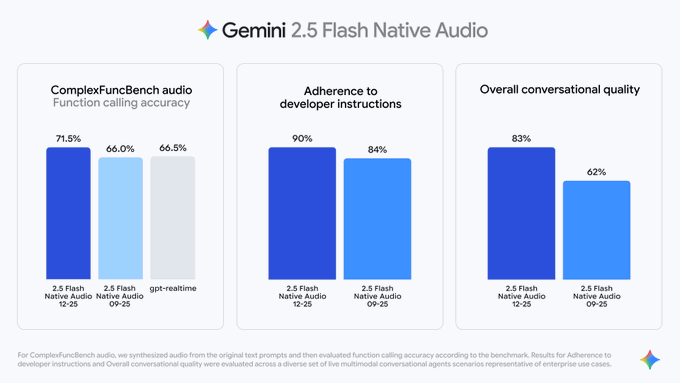
Scores 71.5% on ComplexFuncBench Audio, which tests multi-step function calls under constraints
-
Reaches 90% instruction adherence, up from 84%, in internal evaluations
-
Improves multi-turn context recall during extended spoken sessions
-
Triggers external functions during speech and weaves results into audio replies
Google pairs this with new live speech-to-speech translation. You hear translations in real time, with pitch and pacing preserved, across 70+ languages and 2,000+ language pairs.
How you use it
- Build live voice agents with Gemini 2.5 Flash Native Audio on Vertex AI
- Prototype via the Gemini API preview in Google AI Studio
- Test live translation today through the Google Translate Android beta
|
|
|
|
Top News
|
|
|
|
OpenAI publishes code and weights for its sparsity paper, allowing you to examine learned transformer circuits
|
|
2,359 Likes
|
|
OpenAI published a paper on circuit-level sparsity in November and has now released the code and model weights.
The work changes how language models train by enforcing sparsity from the start instead of pruning dense models later. The most notable result shows that specific behaviors reduce to tiny, readable circuits that still work after extreme pruning.
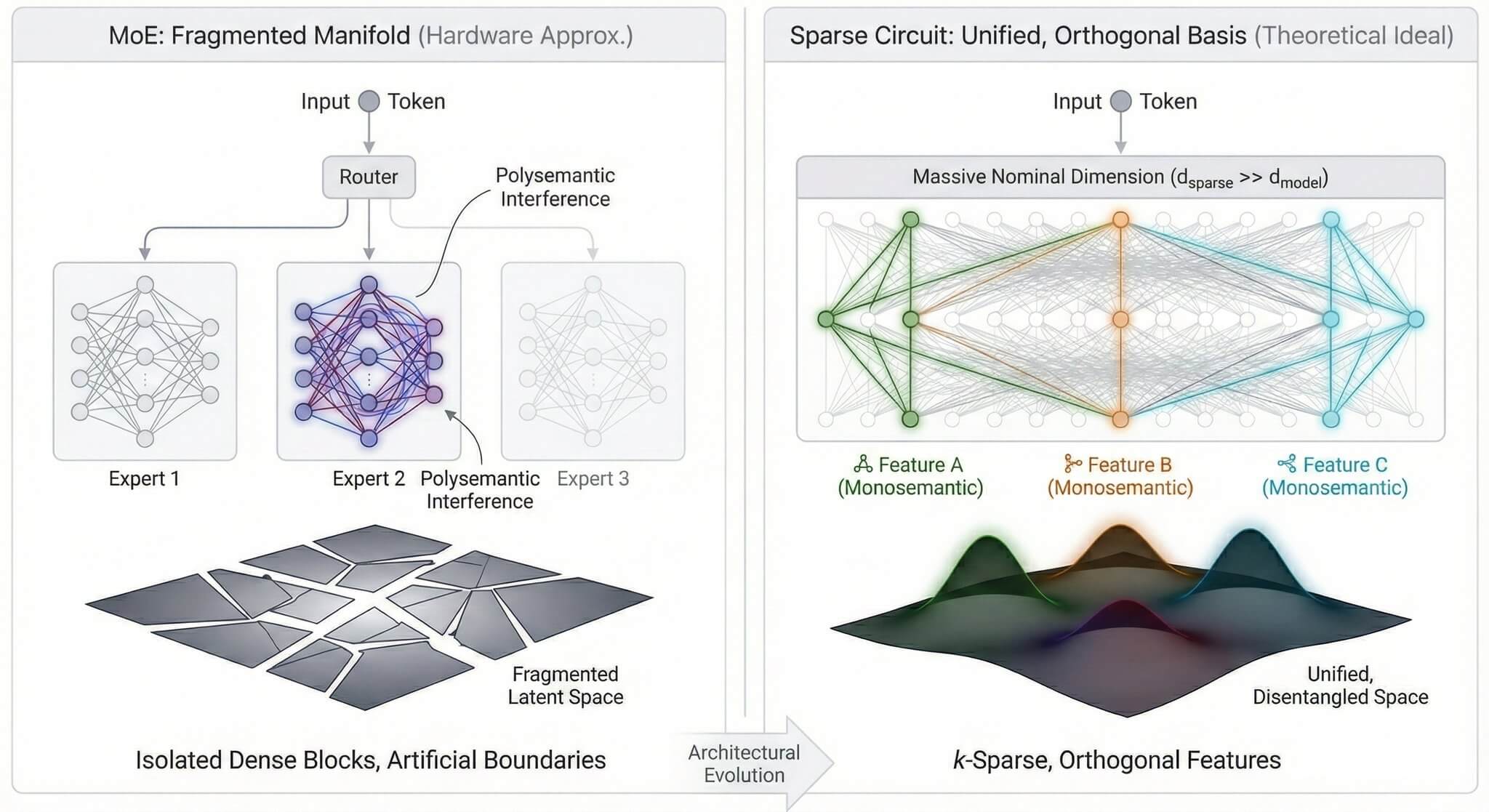
Dense transformers create a problem. Every neuron connects to thousands of others, which causes feature overlap, also called superposition. That overlap makes internal behavior hard to trace.
The insight was to enforce sparsity during training. The model learns with most weights fixed to zero. Each neuron keeps only a small number of connections, which limits interference by design.
What OpenAI built
-
GPT-2–style transformer with weight-level and activation-level sparsity
-
Static sparse connections instead of Mixture-of-Experts routing
-
Large nominal width with few active parameters
How to use it
-
Clone openai/circuit_sparsity
-
Load the csp_yolo2 Hugging Face model
-
Run inference or prune circuits with included tools
|
|
|
|
The annotation metrics every AI leader should track
In just 25 minutes, Encord's ML experts will show you exactly how to measure annotator throughput, identify workflow inefficiencies, and spot quality gaps so you can iterate faster and run a high-performing pipeline.
Learn practical analytics techniques to reduce errors and speed up model iteration.
|
|
|
Top News
|
|
|
|
Allen AI scales reinforcement learning training to 32B without changing model architecture
|
|
1,723 Likes
|
|
Allen AI returns to a familiar question in open-source language models: does reinforcement learning still help after the first gains flatten out?
With Olmo 3.1, the answer stays yes. Instead of new architectures, the team takes the existing Olmo 3 flow and simply runs it longer, then releases everything.
The problem Olmo targets stays clear. Open models often lag on hard reasoning and instruction following because RL runs stop early due to cost.
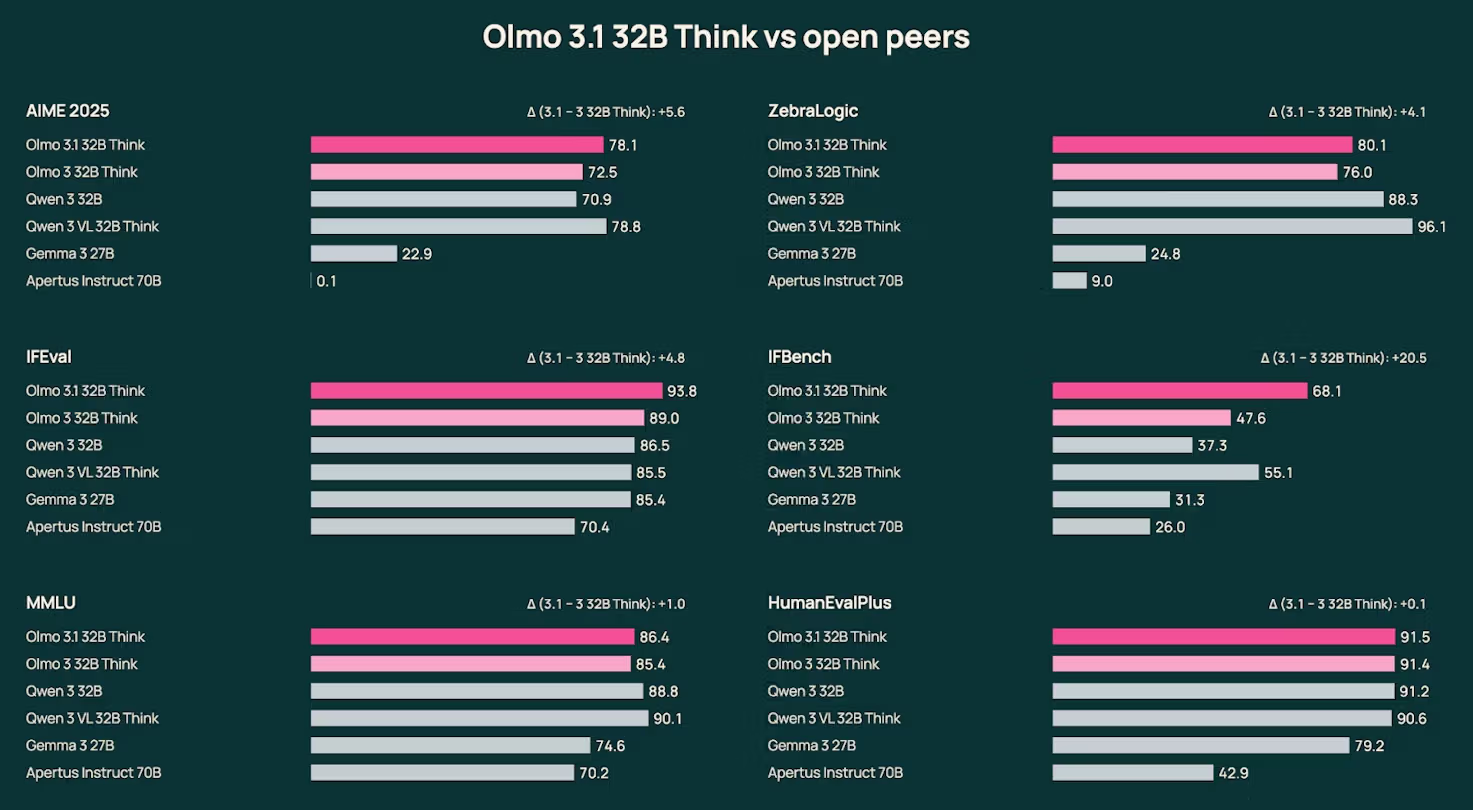
Allen AI extends the same RL job for 21 more days on 224 GPUs, pushing the model to 32B parameters without changing its design. The result shows that scale plus patience still matters.
What was released
-
Olmo 3.1 Think 32B for math, reasoning, and multi-step problem solving
-
Olmo 3.1 Instruct 32B for chat, tools, and multi-turn dialogue
-
RL-Zero 7B Math and Code as refreshed research baselines
What improved
-
+5 AIME, +4 ZebraLogic, +4 IFEval, +20 IFBench over Olmo 3 Think 32B
-
Stronger coding and complex reasoning performance
How you use it
-
Download weights and checkpoints from Hugging Face
-
Test models in the Ai2 Playground
-
Fine-tune or extend RL using released datasets and intermediate checkpoints
|
|
|
At Alpha Signal, our mission is to build a sharp, engaged community focused on AI, machine learning, and cutting-edge language models, helping over 200,000 developers stay informed and ahead. We’re passionate about curating the best in AI, from top research and trending technical blogs to expert insights and tailored job opportunities. We keep you connected to the breakthroughs and discussions that matter, so you can stay in the loop without endless searching. We also work closely with partners who value the future of AI, including employers and advertisers who want to reach an audience as passionate about AI as we are.
Our partnerships are based on shared values of ethics, responsibility, and a commitment to building a better world through technology.Privacy is a priority at Alpha Signal. Our Privacy Policy clearly explains how we collect, store, and use your personal and non-personal information. By using our website, you accept these terms, which you can review on our website. This policy applies across all Alpha Signal pages, outlining your rights and how to contact us if you want to adjust the use of your information. We’re based in the United States. By using our site, you agree to be governed by U.S. laws.
|
|
|
Looking to promote your company, product, service, or event to 250,000+ AI developers?
|
|
|
|
|
