|
Hey,
Your daily briefing is ready. You can finally take a break from the AI firehose.
Our algos spent the night splitting signal from noise and pulled the top news, models, papers, and repos.
Here’s the must-read:
|
|
Together with:
|

|
|

|
Today's Author
Lior Alexander. Founder of AlphaSignal and former ML Engineer.
Previously built ML systems at Iguazio, Guesty, Enphase, Mila.
|
|
Top News
|
|
|
|
Google launches Code Wiki, an automated system that keeps repo documentation continuously up to date
|
|
1,563 Likes
|
|
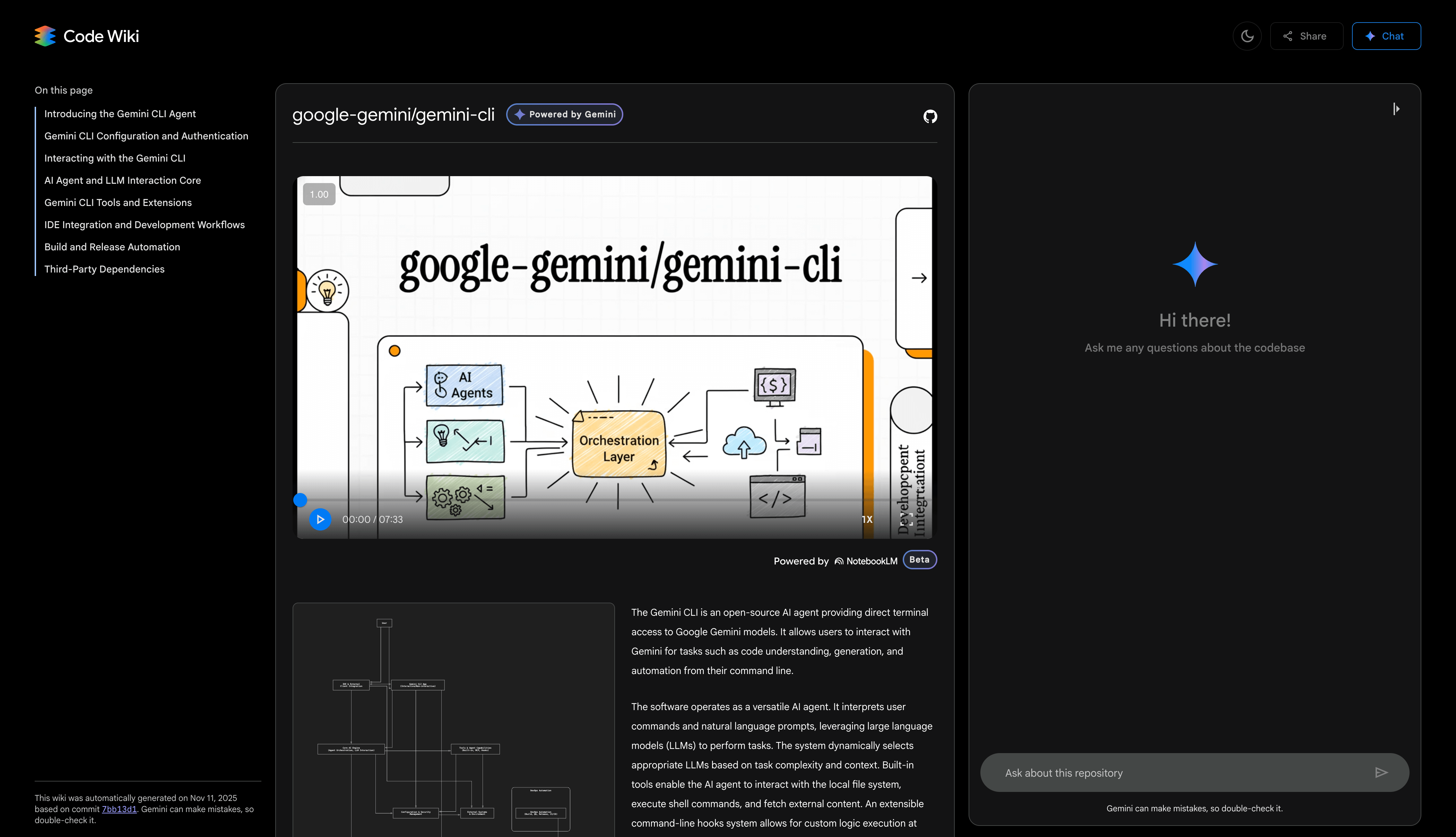
Google introduced Code Wiki to tackle a familiar problem: engineers spend a large share of development time reading existing code instead of writing new code.Large repositories grow faster than their documentation, and static READMEs drift out of sync.
Google’s insight was simple: treat documentation like code and regenerate it after every change.
Code Wiki scans an entire repository and builds a structured wiki that explains how the code works. “Structured” means the system maps concepts, modules, classes, and functions and links them together.
The wiki updates after each code change, so it always matches the current repository state.
You interact with Code Wiki in two ways: navigation and chat.
You browse high-level explanations and jump directly into the exact files and functions they reference. You can also ask questions through a Gemini-powered chat that uses the full wiki as its context, not a generic prompt.
Key features and results
-
Scans full repositories and regenerates documentation after every code change
-
Produces architecture, class, and sequence diagrams directly from source code
-
Links explanations and chat answers to files, classes, and functions
-
Hosts public repositories today through a web interface
-
Plans a Gemini CLI extension to run locally on private repositories
You can use the website now on public code. The CLI version remains on a waitlist.
|
|
|
|
Stop waiting on H100s. Deploy Blackwell architecture today.
|
|
Sponsored
|
|
Model training stalls when hardware sits in allocation queues. Latitude.sh removes that bottleneck by offering immediate access to RTX PRO 6000 Server Edition systems, with no reservations and no markup.
These servers run NVIDIA Blackwell architecture with 768 GB total VRAM and a fully integrated media pipeline. You can run multimodal training and heavy transcoding workloads on the same machine without resource contention.
You get raw Blackwell power paired with Dual AMD 9355s and 100 Gbps networking, starting at just $1.98/GPU/hr.
The infrastructure is live and available now in Ashburn and Chicago. You provision directly without waitlists or advance commitments.
|
|
|
|
partner with us
|
|
Top News
|
|
|
|
NVIDIA releases Nemotron 3, an open model family built for large-scale multi-agent AI systems
|
|
3,583 Likes
|
|
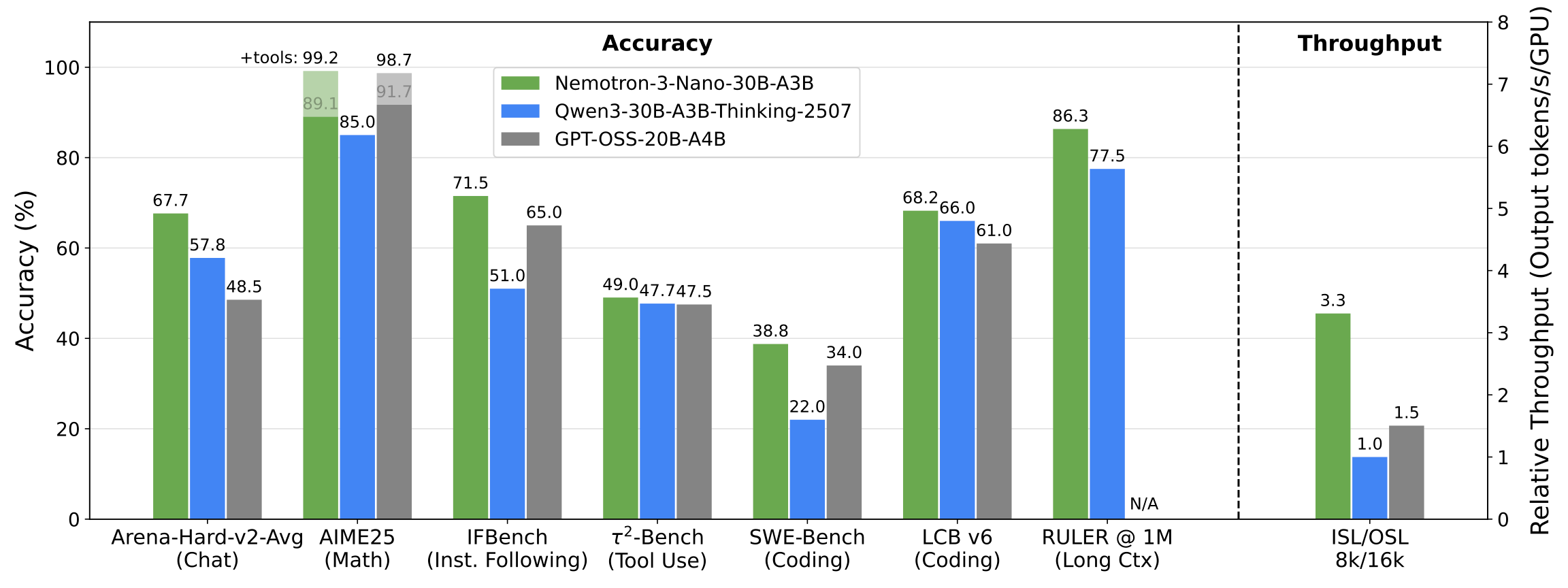
NVIDIA introduces Nemotron 3 as open infrastructure for agent-based AI systems, not another chat model. Teams now push beyond single assistants toward many agents that share context, split work, and route tasks.
The standout change is efficiency. Nemotron 3 Nano reaches 4× higher throughput than Nemotron 2 Nano.
The problem appears once systems add more agents. Cost rises fast, context breaks across steps, and routing adds overhead. Proprietary models solve reasoning but strain budgets. Open models offer control but lag on scale and performance.
Nemotron 3 applies a hybrid mixture-of-experts design, which activates only a small part of the model per token. Each agent uses just what it needs, not the full network.
What NVIDIA releases
-
Nano, Super, Ultra models from 30B to 500B parameters
-
Up to 3B, 10B, 50B active parameters per token
-
1M-token context window on Nano
-
Up to 60% fewer reasoning tokens per task
How you use it
-
Run Nano for retrieval, summaries, debugging, and assistant agents
-
Route complex reasoning to Super or Ultra
-
Fine-tune with NeMo Gym and NeMo RL
-
Deploy via vLLM, SGLang, llama.cpp, or managed inference providers
Nemotron 3 reframes open models as cost-controlled engines inside large agent systems.
|
|
|
|
Top News
|
|
|
|
AI2 debuts Bolmo, an open-source approach that upgrades multilingual and rare-string handling without retraining Olmo
|
|
1,511 Likes
|
|
Ai2 introduces Bolmo, a new family of open byte-level language models built from Olmo 3. Most language models read text as subword tokens, not characters. Bolmo breaks that habit and still keeps Olmo 3’s strength.
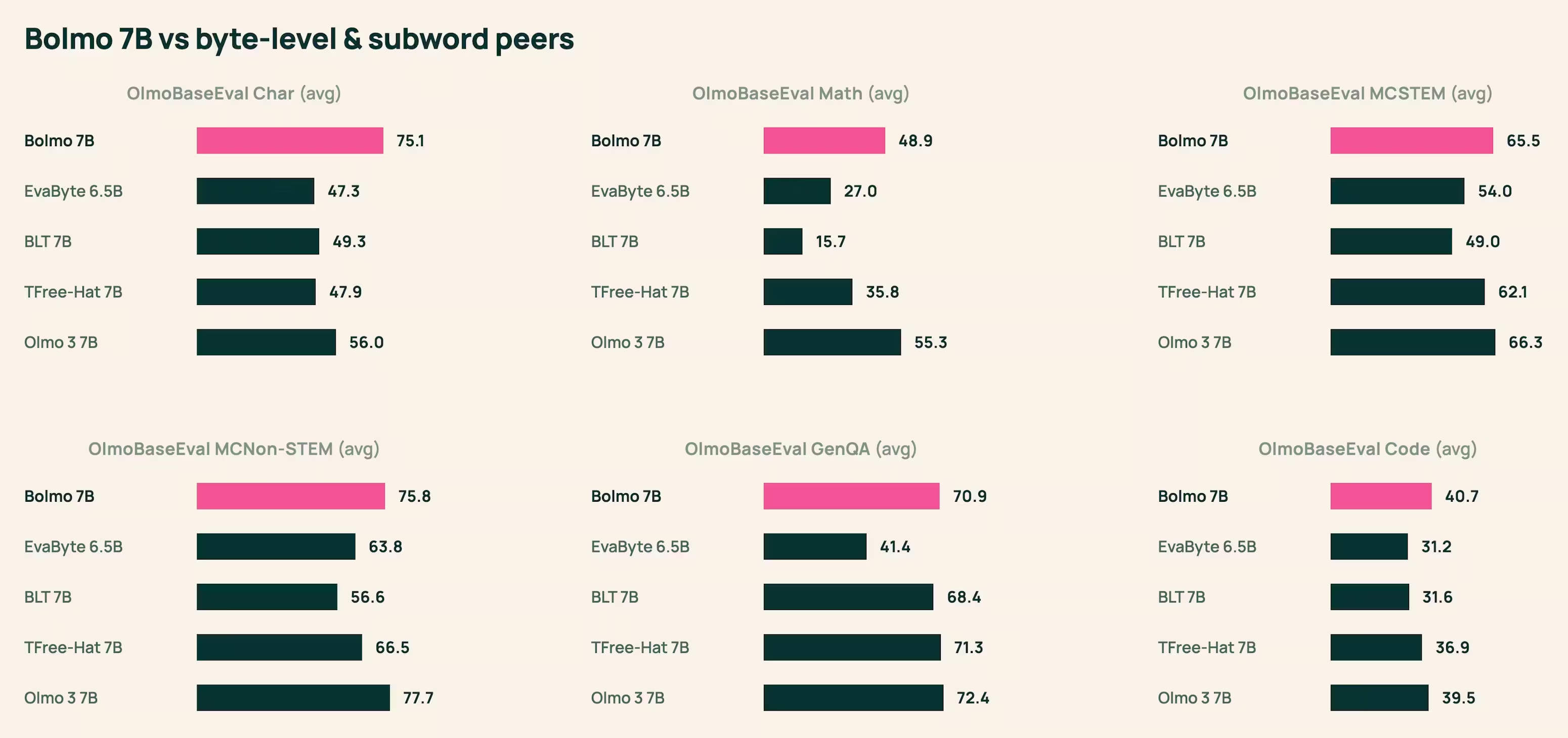
The standout result: Bolmo 7B reaches near parity with Olmo 3 7B and adds almost 20 points on character benchmarks.
Subword tokenizers fail on spelling, whitespace, rare strings, and mixed languages. Byte-level models fix that but usually demand full retraining. Ai2 spots a shortcut. Bolmo “byteifies” an existing Olmo model instead of starting over.
Byteifying means the model reads raw UTF-8 bytes and groups them into dynamic chunks before the transformer step.
Bolmo adds small byte encoders, decoders, and a boundary predictor around the unchanged Olmo 3 transformer. A two-stage training run adapts the model with limited extra compute.
Key features
-
Processes raw UTF-8 bytes without a fixed vocabulary
-
Uses dynamic byte patches with a non-causal boundary predictor
-
Keeps the original Olmo 3 transformer intact
Results
-
Trains with 9.8B frozen tokens plus 39.3B full tokens
-
Improves CUTE and EXECUTE scores by nearly 20 points
-
Decodes at 125 bytes per second
You can use Bolmo by loading the open checkpoints, merging existing Olmo fine-tunes, and running inference without retraining downstream skills.
|
|
|
At Alpha Signal, our mission is to build a sharp, engaged community focused on AI, machine learning, and cutting-edge language models, helping over 200,000 developers stay informed and ahead. We’re passionate about curating the best in AI, from top research and trending technical blogs to expert insights and tailored job opportunities. We keep you connected to the breakthroughs and discussions that matter, so you can stay in the loop without endless searching. We also work closely with partners who value the future of AI, including employers and advertisers who want to reach an audience as passionate about AI as we are.
Our partnerships are based on shared values of ethics, responsibility, and a commitment to building a better world through technology.Privacy is a priority at Alpha Signal. Our Privacy Policy clearly explains how we collect, store, and use your personal and non-personal information. By using our website, you accept these terms, which you can review on our website. This policy applies across all Alpha Signal pages, outlining your rights and how to contact us if you want to adjust the use of your information. We’re based in the United States. By using our site, you agree to be governed by U.S. laws.
|
|
|
Looking to promote your company, product, service, or event to 250,000+ AI developers?
|
|
|
|
|
