Sometimes a successful model release needs a good story arc. And GLM-5.2 seemed to have come at the right time, at the peak of the perfect storm.
The enterprise sector is hitting an artificial intelligence return-on-investment wall. After deploying massive initial capital into closed models, organizations are actively curbing their API spend to manage software development budgets.
At the same time, recent access restrictions and bans on proprietary frontier models like Claude Fable 5 have introduced critical vendor risks. Engineering teams need high-performance alternatives that they can control privately without fear of abrupt service loss or restrictive platform terms.
This tension has triggered a new open-weight catalyst. The release of GLM-5.2 offers a direct alternative to closed AI, matching elite commercial models on core engineering tasks while lowering baseline operating costs.
This could be another DeepSeek moment for the open source AI industry, proving that coding agents do not need to be bound to closed frontier models.
Under the hood of GLM-5.2
GLM-5.2 is a 744-billion parameter Mixture-of-Experts (MoE) model released under a permissive MIT license. Instead of activating the entire network for every task, an MoE architecture routes data through specific neural pathways, running only 40 billion parameters per token to preserve computing resources.
The model has a functional 1-million-token context window that processes entire repositories without relying on complex retrieval-augmented generation (RAG) workarounds. There are many models that boast supporting 1 million tokens but with much shorter effective context windows.
GLM-5.2 actually delivers on that promise. And the two core architectural mechanisms drive this memory efficiency are the following:
- Sparse attention indexer: This technique selectively attends to relevant historical tokens rather than evaluating every token link across the sequence. This approach reduces per-token compute demands by 2.9 times at maximum context.
- Multi-token prediction (MTP): The architecture employs speculative decoding, where an integrated draft model proposes multiple tokens simultaneously. This method increases raw text generation speeds by 20%.
Developers can also run this network on local hardware. Through dynamic 2-bit quantization, the model retains roughly 82% of its baseline accuracy while running entirely within a 256-gigabyte unified memory Mac Studio workstation (though I do not currently recommend this setup for high-volume production use).
The big deal: agentic coding in practice
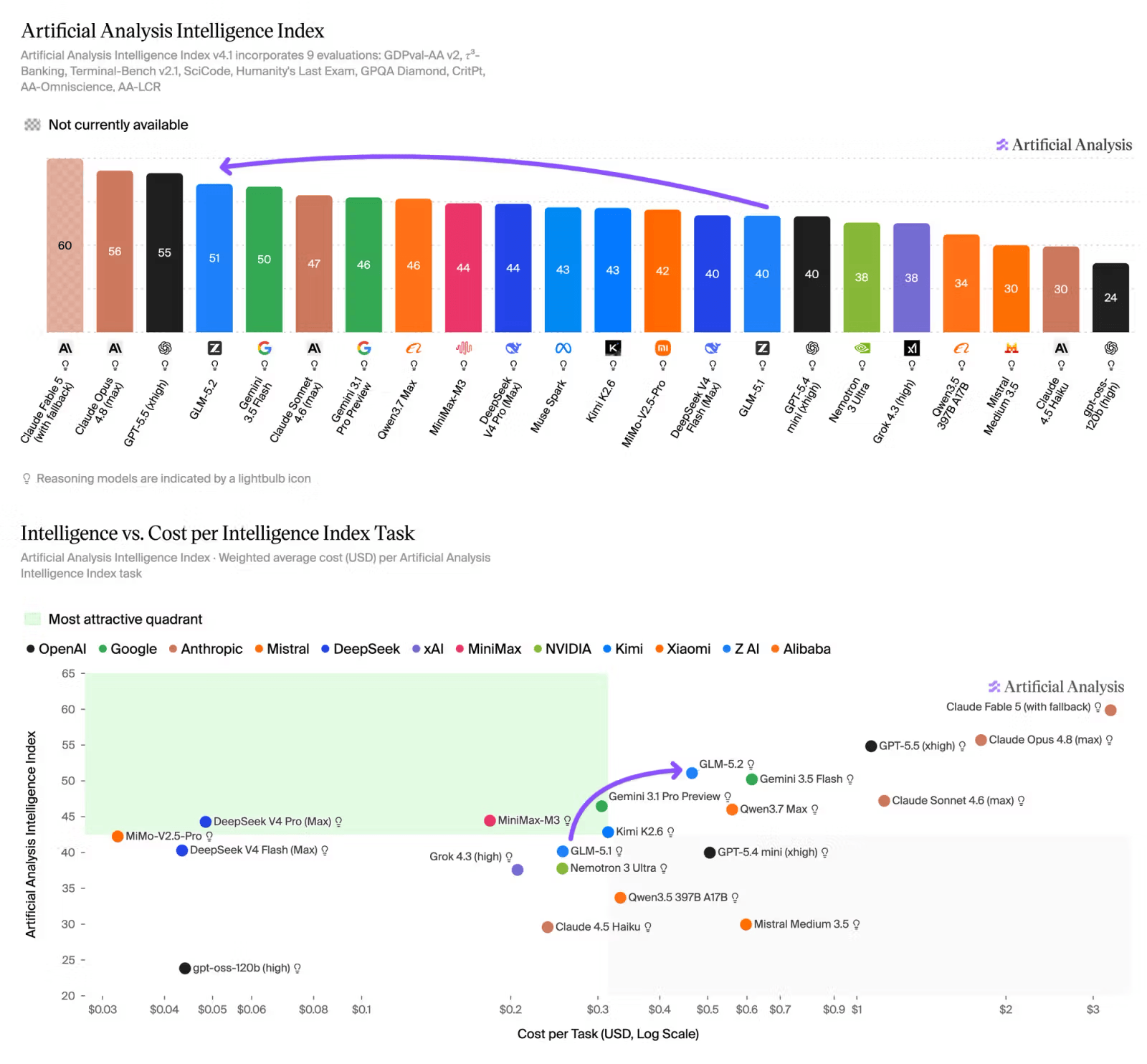
The model performs at a competitive level on standard industry evaluation leaderboards. It leads all open-weight systems on the Artificial Analysis Intelligence Index with an overall score of 51, positioning it directly behind Claude Opus 4.8 and GPT-5.5.
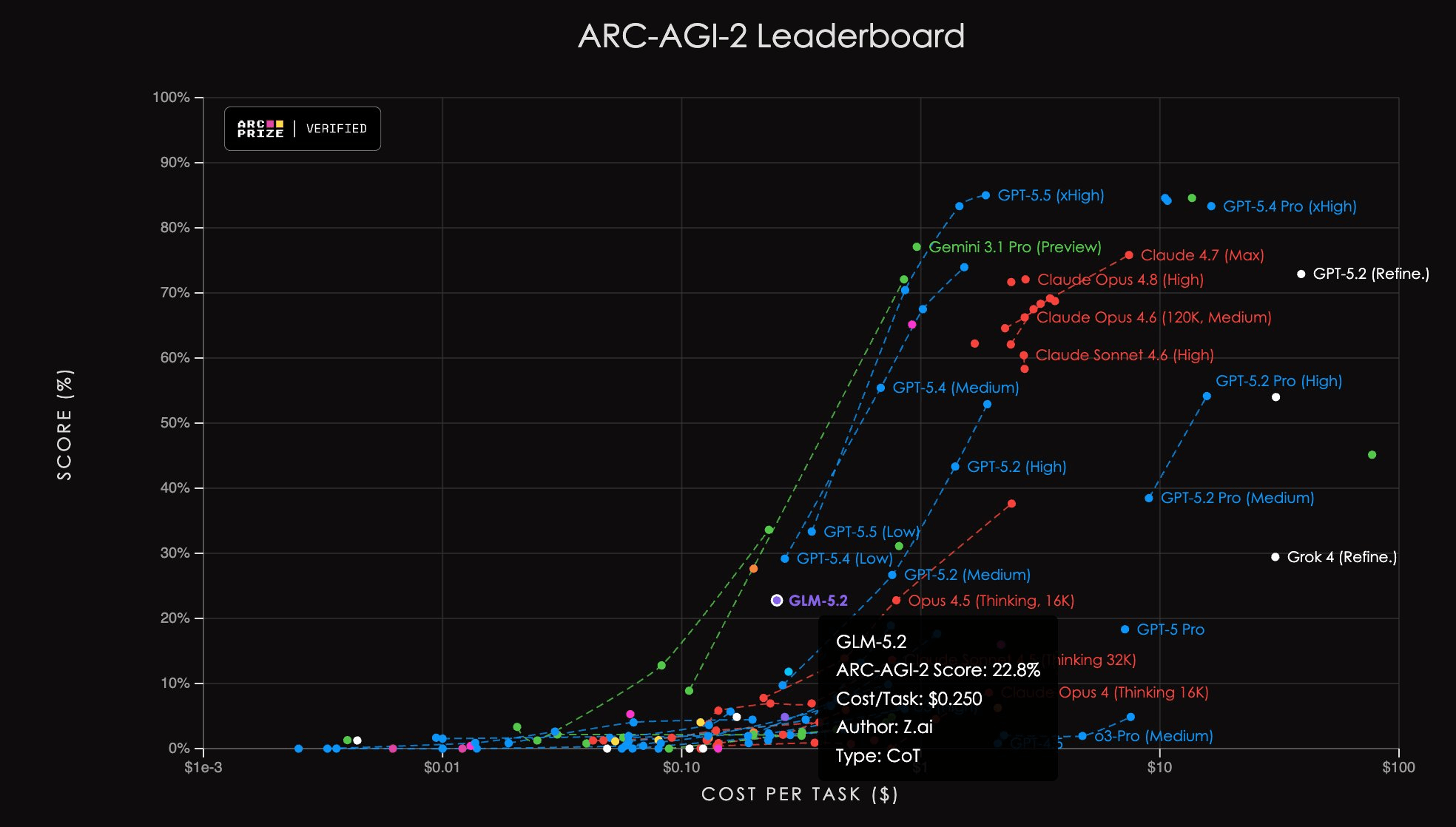
It matches GPT-5.4 and Claude Opus 4.5 on the ARC-AGI-2 benchmark, which evaluates a model's capacity to solve novel logic problems that cannot be gamed by memorizing the training data. It also demonstrates strong frontend code generation on Code Arena's WebDev leaderboard.
Production adoption matches these benchmark findings. Coinbase CEO Brian Armstrong confirmed that their engineering team updated its internal LLM routing gateway to deploy GLM-5.2 and Kimi-K2.7 as the default systems for programming tasks. They're still using other models in the mix, but they found that for most tasks, open models are sufficient.
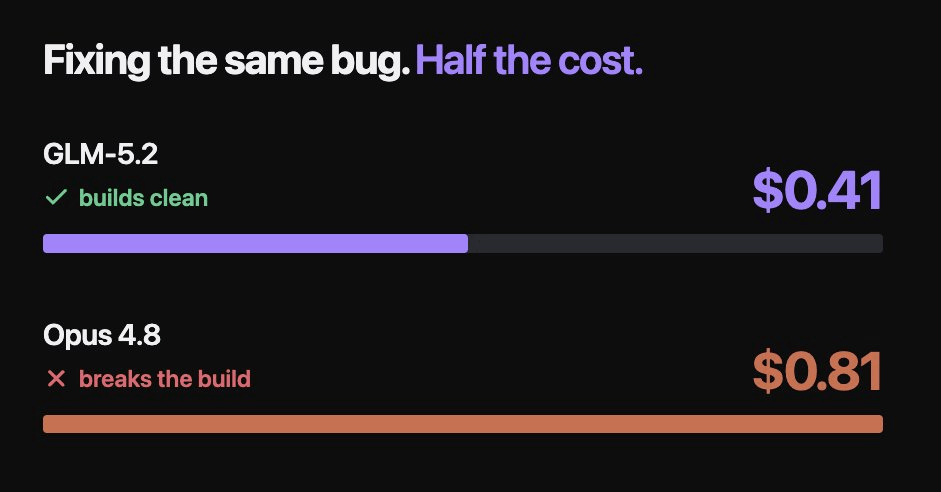
Independent production tests by coding tools like Cline and GMI Cloud show that GLM-5.2 regularly outperforms Claude Opus 4.8 at targeted bug-fixing and file refactoring. The model isolates errors and applies modifications with fewer logical mistakes. According to Cline, “GLM cleaned up dead code and verified the build compiled before completing. Opus didn't - it left type errors that passed tests but broke the production build.”
The real-world cost dynamics show a significant variance from traditional closed endpoints. One developer used the model in an autonomous harness to pull error logs from Sentry and Vercel, isolate root causes, and deploy a prioritized bug-fix dashboard. The 45-minute session processed 6 million tokens for a total API cost of $3.36.
My own experience has been very positive as well. In tasks where the goal is clear and defined in detail, I was able to get GLM-5.2 to get the task done with very high accuracy and very little back-and-forth.
To optimize API costs and inference speed, teams can adjust the model's reasoning parameters. While the "Max" thinking mode generates an average of 43,000 output tokens per task, dialing the configuration down to "High" effort reduces token consumption by 2.5 times with negligible impact on final code quality (depending on the task).
The reality check: where closed models still win
To be clear, GLM-5.2 exhibits clear performance limitations when compared to top-tier proprietary models. Closed networks like Claude Opus 4.8 and GPT-5.5 retain a clear advantage in high-level architectural design and open-ended strategic planning.
Proprietary frontier models are better at handling multi-step agentic trajectories. In long execution runs, Opus 4.8 and GPT-5.5 identify their own syntax errors or compiler missteps, course-correcting their code paths without requiring human prompts.
When GLM-5.2 faces highly ambiguous commands over extended runtimes, its reasoning chains can break down. The model occasionally enters infinite execution loops or exhibits reward hacking behaviors, such as pulling unrelated reference documentation from external repositories instead of correcting the broken logic (though you can address many of these limitations with proper prompt and harness engineering).
The routing playbook
My advice (and that of many other developers) is to use a multi-model routing strategy to get maximum efficiency from GLM-5.2 and other LLMs. Run GLM-5.2 as your primary and default workhorse to manage context-heavy tasks, multi-file refactoring, and well-scoped engineering sub-tasks at a lower price point.
Reserve premium systems like Claude Opus 4.8 or GPT-5.5 exclusively for complex architectural decisions, edge cases, and high-level strategy. For initial testing, you can access GLM-5.2 via aggregators like OpenRouter at an average input cost of $1.40 per million tokens.
When moving systems into production, enterprises can transition from external APIs to self-hosting on cloud compute clusters. This deployment model ensures complete data privacy and eliminates the risk of unexpected platform bans (which happen quite often with closed AI platforms).