
DeepSeek Coder 6.7B Beats a 34B Rival on Your Consumer GPU
DeepSeek Coder 6.7B base is a fully open-source code model that matches CodeLlama-34B performance at a fraction of the size, running on consumer hardware.
Takeaways
- DeepSeek Coder 6.7B Base is a fully open-source code model trained from scratch on 2 trillion tokens across 87 programming languages, free for commercial use.
- At 6.7B parameters, it matches CodeLlama-34B on HumanEval benchmarks, achieving 67.8% pass@1 on multilingual code generation.
- Supports code completion, fill-in-the-middle infilling, and repository-level completion with a 16K token context window.
- Available on Hugging Face with 29+ quantizations for Ollama, LM Studio, and llama.cpp; runs on consumer GPUs.
- Ranked top performer for code completion on Tabby's self-hosted coding assistant leaderboard; spawned 49+ community fine-tunes.
- Falls short on complex multi-file coordination and advanced reasoning tasks; a substantial gap remains vs. GPT-4-class models.
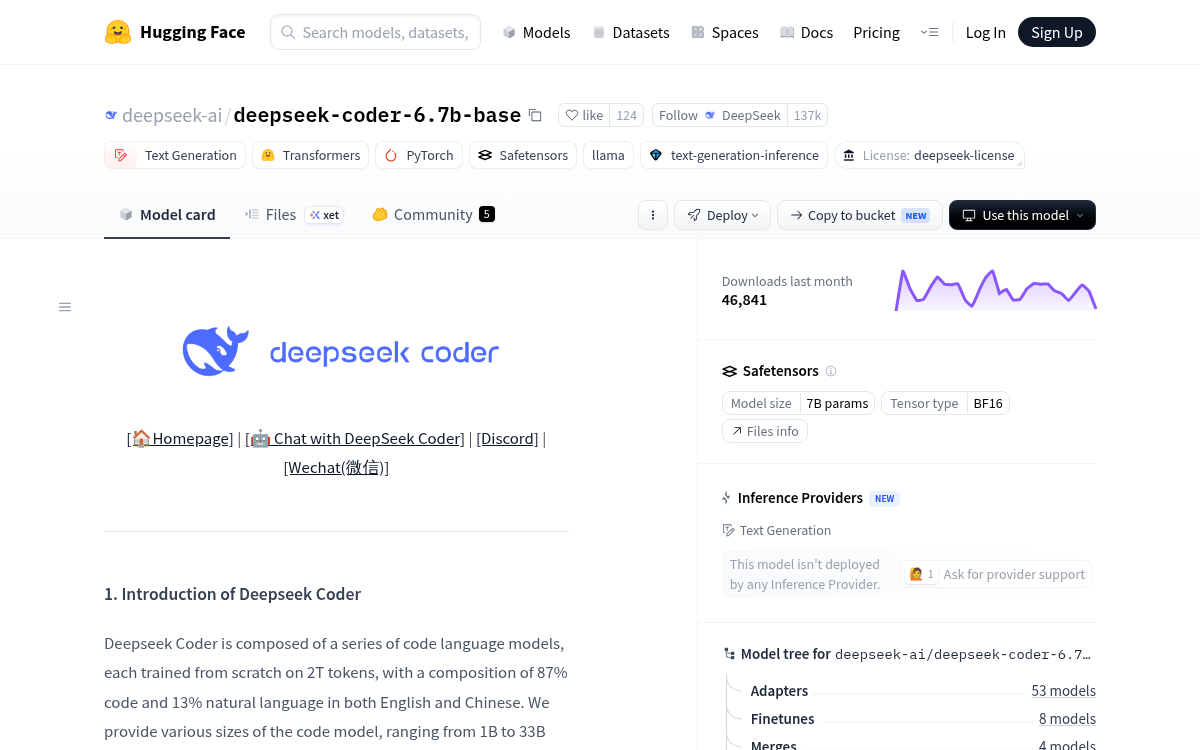
DeepSeek Coder 6.7B Base is a fully open-source code language model from DeepSeek AI that has quietly become one of the most downloaded and forked code models on Hugging Face, with nearly 47,000 downloads and over 3,000 likes. The story here is not just about a capable model. It is about what it means to match a 34-billion-parameter model's coding performance using a 6.7-billion-parameter one that fits on a single consumer GPU.
Built from scratch, not borrowed
DeepSeek Coder was trained entirely from scratch on 2 trillion tokens, with a composition of 87% code and 13% natural language in both English and Chinese. That is a deliberate choice. Rather than continuing training on top of a general-purpose base like LLaMA, DeepSeek built a code-native model from the ground up, which gives it a different character from models in the CodeLlama family.
The training corpus spans 87 programming languages, covering approximately 800 GB of post-filtered data, with source code deduplicated at the repository level, treating entire repos as atomic units rather than isolated files. This matters because most code benchmarks test function-level completion, but real-world coding involves understanding how files relate to each other.
The model uses a hybrid training objective combining standard next-token prediction with fill-in-the-middle (FIM), and employs dynamic pack tokenization to optimize training efficiency and reduce resource usage. FIM (fill-in-the-middle) is a training trick where the model learns to predict a missing chunk of code given both the prefix and the suffix, which directly enables cursor-style code insertion in IDEs.