
DeepSeek Coder 6.7B Matches a 34B Rival on a Single Consumer GPU
DeepSeek Coder 6.7B Instruct is a free, commercially licensed code model that matches CodeLlama-34B at a fraction of the size
Takeaways
- DeepSeek Coder 6.7B Instruct matches CodeLlama-34B on HumanEval at one-fifth the parameter count, with 66.1% pass@1.
- Trained from scratch on 2 trillion tokens across 87 programming languages, with 87% code and 13% natural language data.
- Supports a 16K token context window and fill-in-the-middle (FIM) code completion, enabling project-level infilling tasks.
- Free for commercial use; runs on ~13.5GB VRAM; available via Hugging Face Transformers with a simple chat template API.
- Weak on hard algorithmic problems (9.1% on LeetCode Hard) and general reasoning (39% MMLU); best paired with Chain-of-Thought prompting for complex tasks.
- Over 400 community adapters and 35 quantized variants (including GGUF) available, making it easy to fine-tune or run locally on CPU.
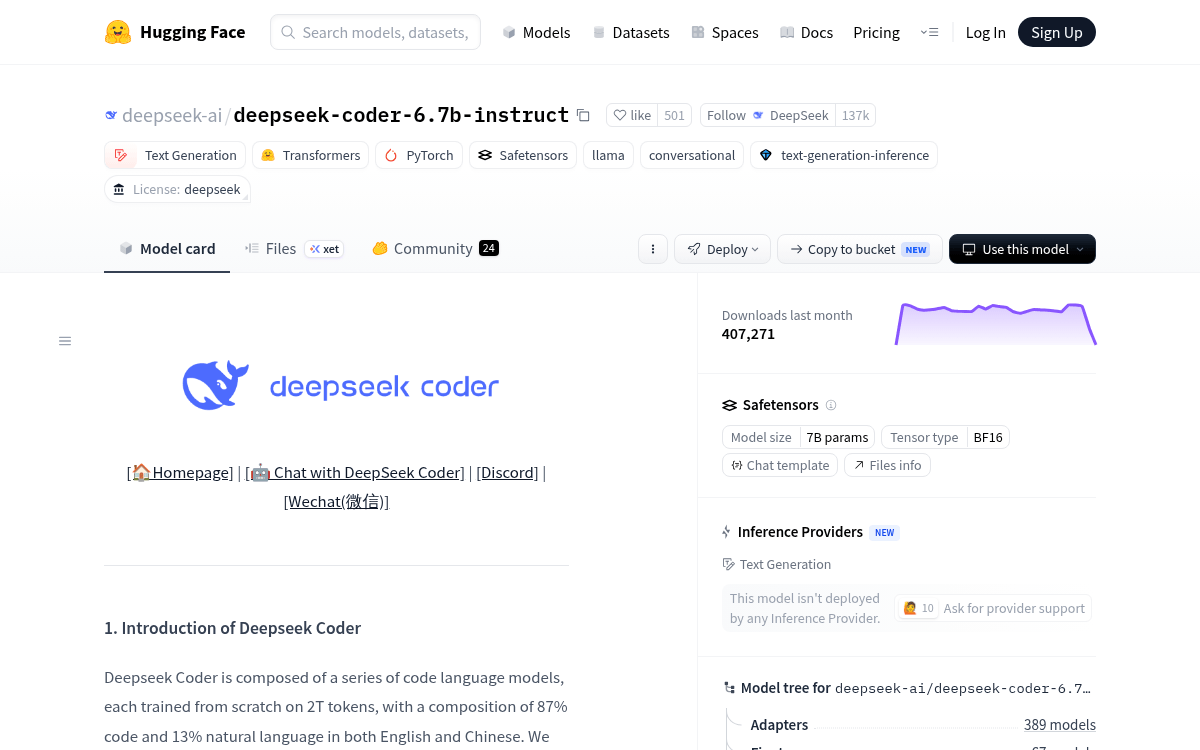
DeepSeek Coder 6.7B Instruct has quietly become one of the most downloaded code models on Hugging Face, sitting at over 407,000 downloads and 3,750 likes. For a model in the 7B weight class, those numbers are striking, and the reason is simple: it punches well above its size in nearly every benchmark that matters for real coding work.
The efficiency paradox at the heart of this model
The headline result is almost counterintuitive. At just 6.7B parameters, it matches CodeLlama-34B on HumanEval with a 66.1% pass@1, a model five times its size. That is not a marginal win on a niche benchmark. HumanEval is the standard Python coding test used to compare virtually every code model in the field. Matching a 34B model at 6.7B means you can run this locally on a single consumer GPU with 16GB of VRAM, at a fraction of the inference cost.
The instruct variant specifically is what most practitioners will use. It is a 6.7B parameter model initialized from deepseek-coder-6.7b-base and fine-tuned on 2B tokens of instruction data. That instruction tuning transforms the raw base model into something you can prompt directly in a chat-style interface, making it practical for code generation, debugging, and explanation tasks out of the box.
Built from scratch, not borrowed
Unlike many open-source code models that fine-tune on top of LLaMA or similar general-purpose backbones, DeepSeek Coder was trained from the ground up. It is composed of a series of code language models, each trained from scratch on 2T tokens, with a composition of 87% code and 13% natural language in both English and Chinese. The training corpus spans more than 80 programming languages.
The data pipeline is where a lot of the secret sauce lives. Rather than treating each file as an independent training example, the team organized code at the repository level. Files within the same project were sorted by their import dependencies using a topological sort, then concatenated in dependency order. This means the model saw code the way a real developer reads it, with context from the files a given module actually depends on, not just isolated snippets.