
DeepSeek-R1 Crashed Nvidia's Stock and Rewrote AI's Cost Rules
DeepSeek-R1 matches OpenAI o1 on math and code benchmarks, ships open-weight under MIT, and costs 27x less via API
Takeaways
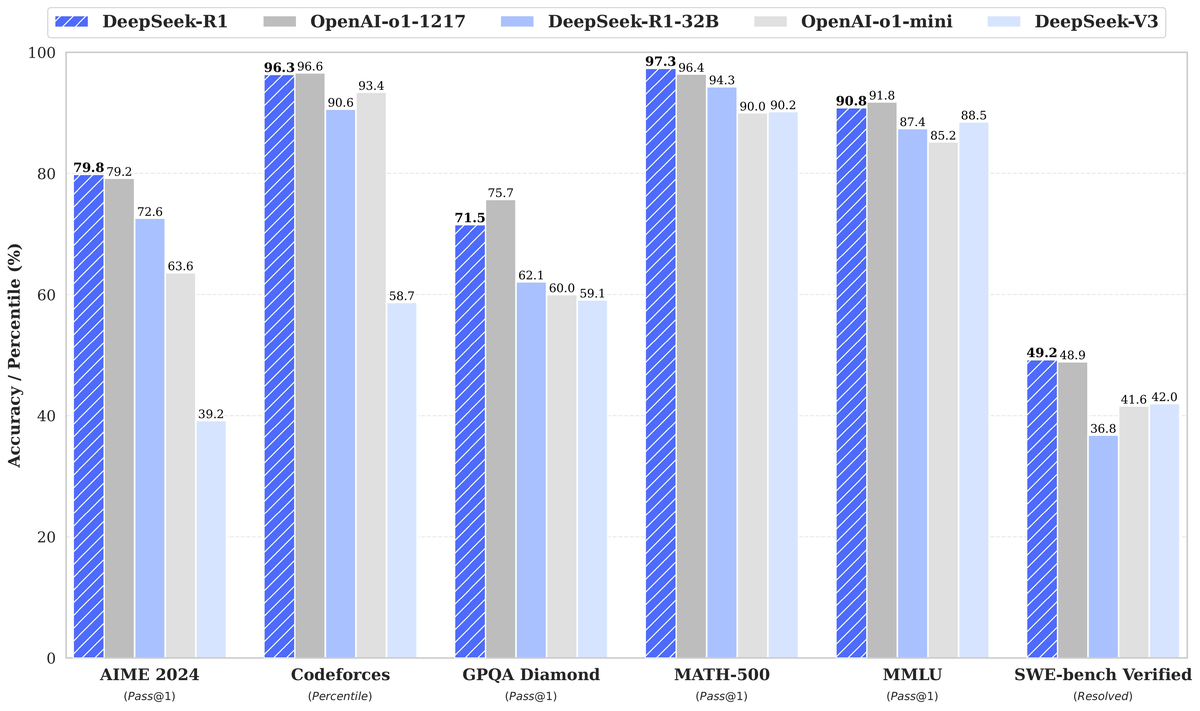
- Benchmark parity with o1: DeepSeek-R1 matches or beats OpenAI o1 on AIME 2024 (79.8%), MATH-500 (97.3%), and Codeforces (96.3rd percentile).
- Open weights, MIT license: Full 671B model and six distilled variants (1.5B–70B) are freely downloadable and commercially usable from Hugging Face.
- 27x cheaper than o1 via API: $0.55/M input tokens vs. OpenAI o1's $15/M; cache hits drop to $0.14/M.
- RL-only training breakthrough: R1-Zero is the first open proof that LLMs can develop chain-of-thought reasoning purely through reinforcement learning, no human-labeled reasoning data needed.
- Distilled models run on consumer hardware: The 14B variant runs on a single RTX 4070 Ti and outperforms many larger open-source alternatives.
- Market shockwave: The release wiped ~$589B from Nvidia's market cap in a single day, triggering an industry-wide reassessment of AI compute economics.
DeepSeek-R1 landed without warning and immediately rewrote the assumptions the AI industry had been operating under. On January 20, 2025, DeepSeek released R1 with no advance notice: a 671-billion-parameter Mixture of Experts (MoE) reasoning model that activates only approximately 37 billion parameters per token. The technical paper and model weights were released simultaneously under the MIT License, and on virtually all mainstream benchmarks, R1 achieved performance on par with, and in some cases surpassing, OpenAI's top reasoning model at the time, o1. The kicker? It did this at a fraction of the cost, and anyone can download the weights.
RL All the Way Down
The real story here is the training methodology. Most frontier models are built on a foundation of massive supervised fine-tuning: humans label examples of good reasoning, and the model learns to imitate them. DeepSeek took a different path. They applied reinforcement learning directly to the base model without any supervised fine-tuning as a preliminary step, allowing the model to explore chain-of-thought reasoning for solving complex problems. DeepSeek-R1-Zero demonstrated capabilities such as self-verification, reflection, and generating long chains of thought, and it is the first open research to validate that reasoning capabilities of LLMs can be incentivized purely through RL, without the need for SFT.
The RL algorithm at the core is called GRPO (Group Relative Policy Optimization). GRPO evaluates policy improvements relative to a group of sampled responses rather than requiring a separate reward model for each comparison. This is cheaper and more stable than the RLHF pipelines most labs use. Neural reward models are deliberately avoided to prevent reward hacking, and during training, sophisticated reasoning behaviors including self-verification, reflection, and dynamic strategy exploration emerged organically without explicit instruction, including a striking "aha moment" where the model spontaneously learned to pause and re-evaluate its reasoning.
The pure-RL version, R1-Zero, had rough edges. It encountered challenges such as endless repetition, poor readability, and language mixing. To address these issues, DeepSeek introduced R1, which incorporates cold-start data before RL. The final pipeline incorporates two RL stages aimed at discovering improved reasoning patterns and aligning with human preferences, as well as two SFT stages that serve as the seed for the model's reasoning and non-reasoning capabilities.
The Architecture Under the Hood
DeepSeek-R1 is built on the DeepSeek-V3 base model and uses a Mixture-of-Experts (MoE) architecture with 671 billion total parameters, but only ~37 billion parameters activate per inference pass. MoE routing selects a subset of specialized expert networks for each token, which means the model delivers performance characteristic of a much larger dense model while keeping compute costs proportional to a ~37B model at inference time.