
DeepSeek Releases DeepSeek-OCR to Process 200K Pages Daily on One GPU
DeepSeek-OCR compresses document pages into as few as 100 vision tokens, hitting 97% OCR precision while processing 200k+ pages per day on a single GPU.
Takeaways
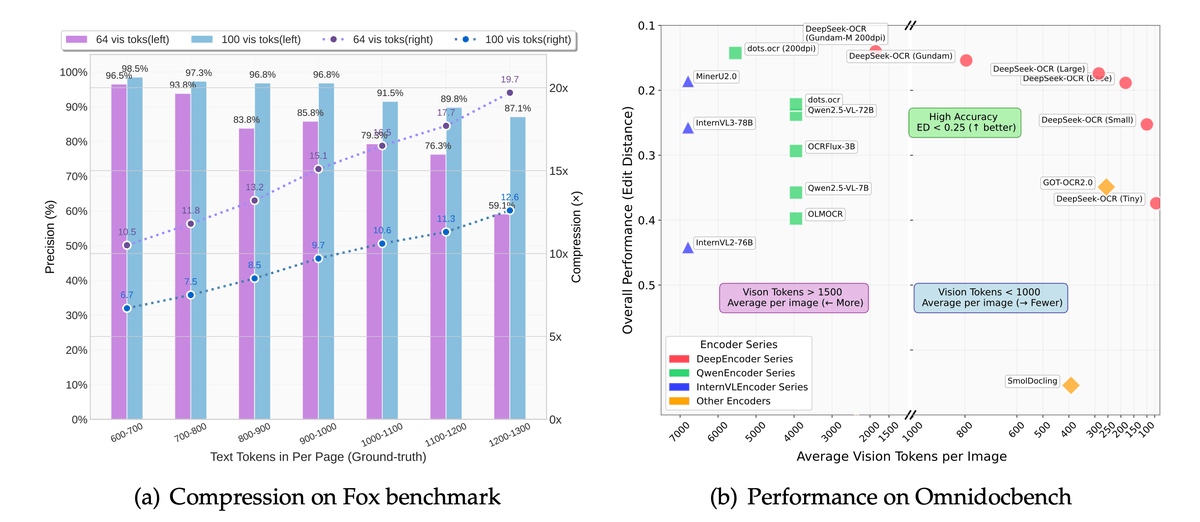
- DeepSeek-OCR is a 3B-parameter vision-language model that compresses document pages into as few as 100 vision tokens, achieving 97% OCR precision at under 10x compression. [Model]
- It outperforms MinerU2.0 (6,000+ tokens/page) using fewer than 800 vision tokens, and can process 200,000+ pages per day on a single A100-40G GPU.
- The model supports document-to-markdown, free OCR, figure parsing, and grounded element recognition via simple prompt switching.
- Weak spots include old scans (33.3% on olmOCR-bench), dense financial documents (15-25% accuracy drop in production), and no native PDF support.
- Released under MIT license; runs via Hugging Face Transformers or vLLM, with 126 community fine-tunes and 9 quantized variants already available.
- A successor, DeepSeek-OCR2, has since launched with a Visual Causal Flow architecture, scoring 91.09% on OmniDocBench v1.5. [GitHub]
DeepSeek-OCR is a 3-billion-parameter vision-language model built around a deceptively simple idea: instead of converting a document image into thousands of text tokens before feeding it to an LLM, what if you compressed the whole page into a handful of visual tokens? That question drives the model's core architecture, and the results are hard to ignore -- over 2.3 million downloads on Hugging Face and nearly 4,500 likes within days of trending.
DeepSeek released DeepSeek-OCR to investigate the role of vision encoders from an LLM-centric viewpoint. The framing matters: this is not a traditional OCR system that extracts text and hands it off. It is a rethink of how documents enter the LLM pipeline in the first place.
The Compression Trick at the Core
Most document-processing pipelines are token-hungry. Tools like MinerU2.0 consume 6,000+ tokens per page on average. DeepSeek-OCR takes the opposite approach. The system consists of two primary components: DeepEncoder and DeepSeek3B-MoE-A570M as the decoder. The DeepEncoder is the key piece -- it is designed to squeeze a high-resolution document image into a very small number of vision tokens (think of vision tokens as the compressed, visual shorthand the model uses to represent what it sees).
Together, they achieve an impressive 97% OCR precision when compressing text at a ratio of less than 10x (meaning 10 text tokens compressed into 1 vision token). The core innovation lies in its ability to compress textual information dramatically while maintaining high accuracy: 96%+ OCR precision at a 9-10x compression ratio, ~90% accuracy at 10-12x, and ~60% accuracy at 20x compression.
The practical implication: on OmniDocBench, it surpasses GOT-OCR2.0 (256 tokens/page) using only 100 vision tokens, and outperforms MinerU2.0 (6,000+ tokens per page on average) while utilizing fewer than 800 vision tokens. That is a 7-60x reduction in token usage, which directly translates to lower inference cost and faster throughput.