
DeepSeek's Tiny 1.3B Coder Beats StarCoder Running Fully on Your Hardware
DeepSeek's 1.3B instruction-tuned code model offers local, commercial-friendly deployment with 16K context and 80+ language support
Takeaways
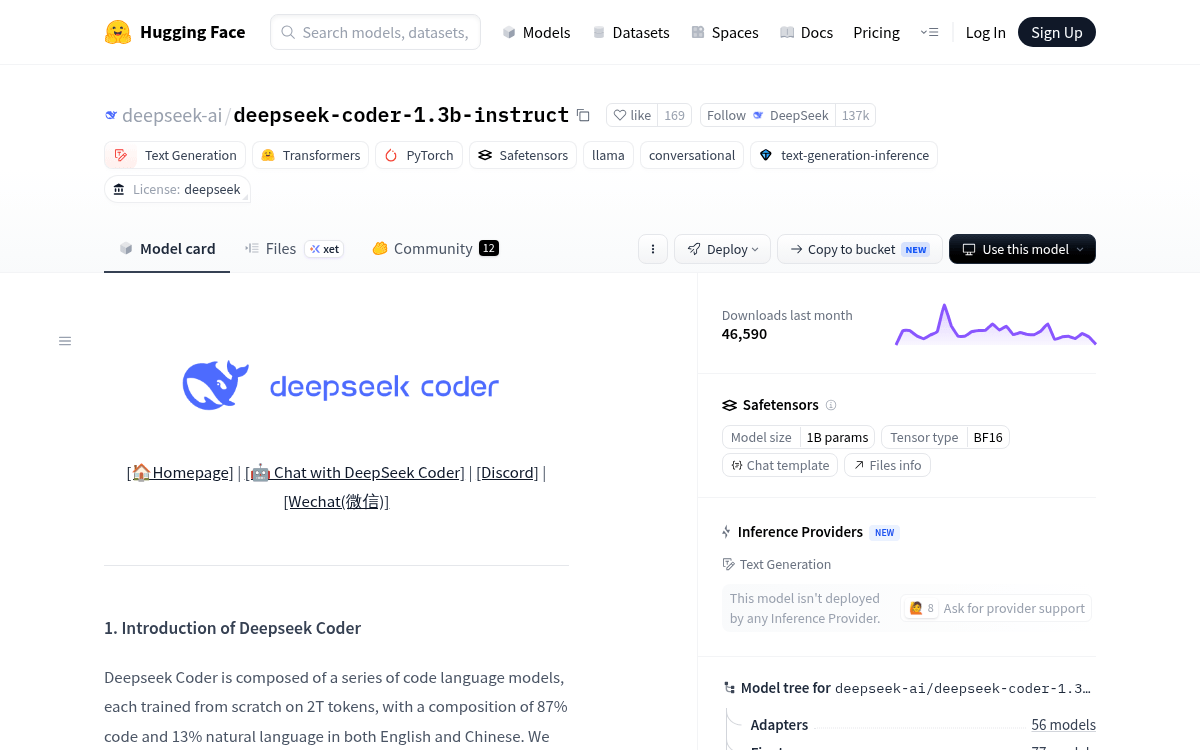
- DeepSeek-Coder-1.3B-Instruct is a compact, commercially licensed coding model available free on Hugging Face with 46K+ downloads.
- Trained from scratch on 2 trillion tokens (87% code), then instruction-tuned on 2B additional tokens for chat-style code generation.
- Scores 65.2% on HumanEval Python in instruct mode, outperforming similarly sized models like StarCoder-1B.
- Supports 80+ programming languages and a 16K token context window for project-level code completion and fill-in-the-middle infilling.
- Best suited for local deployment, IDE plugins, CI/CD pipelines, and fine-tuning on narrow domains like text-to-SQL.
- Lags behind the 6.7B and 33B siblings on complex tasks; aggressive quantization (Q2_K) can degrade output quality.
DeepSeek-Coder-1.3B-Instruct is a compact, instruction-following code model that sits at the smallest end of DeepSeek's coding lineup. With over 46,000 downloads and 3,100+ likes on Hugging Face, it has quietly built a real following among people who want a capable coding assistant they can run locally, fine-tune cheaply, or embed in a product without paying per token.
Tiny model, serious training
The DeepSeek Coder series is composed of code language models trained from scratch on 2 trillion tokens, with a composition of 87% code and 13% natural language in both English and Chinese. That is a massive data budget for any model, let alone a 1.3B parameter one. The instruct variant is initialized from the deepseek-coder-1.3b-base and then fine-tuned on 2 billion tokens of instruction data.
The training dataset is composed of 87% source code, 10% English code-related natural language corpus, and 3% code-unrelated Chinese natural language. The English corpus includes materials from GitHub Markdown and StackExchange, to improve understanding of code-related concepts and handle tasks like library usage and bug fixing. The result is a model that understands not just syntax but the surrounding context of how code is actually written and discussed.
What it can do
The model uses a window size of 16K and a fill-in-the-blank task, supporting project-level code completion and infilling tasks. Fill-in-the-blank (also called Fill-in-the-Middle, or FIM) means the model can insert code into the middle of an existing file, not just append to the end, which is essential for real editor integrations.
- Code completion and generation