
DeepSeek's VL2-Tiny Beats Models Twice Its Size on OCR Benchmarks
DeepSeek-VL2-Tiny packs strong OCR, document understanding, and visual grounding into just 1B active parameters using a sparse MoE architecture
Takeaways
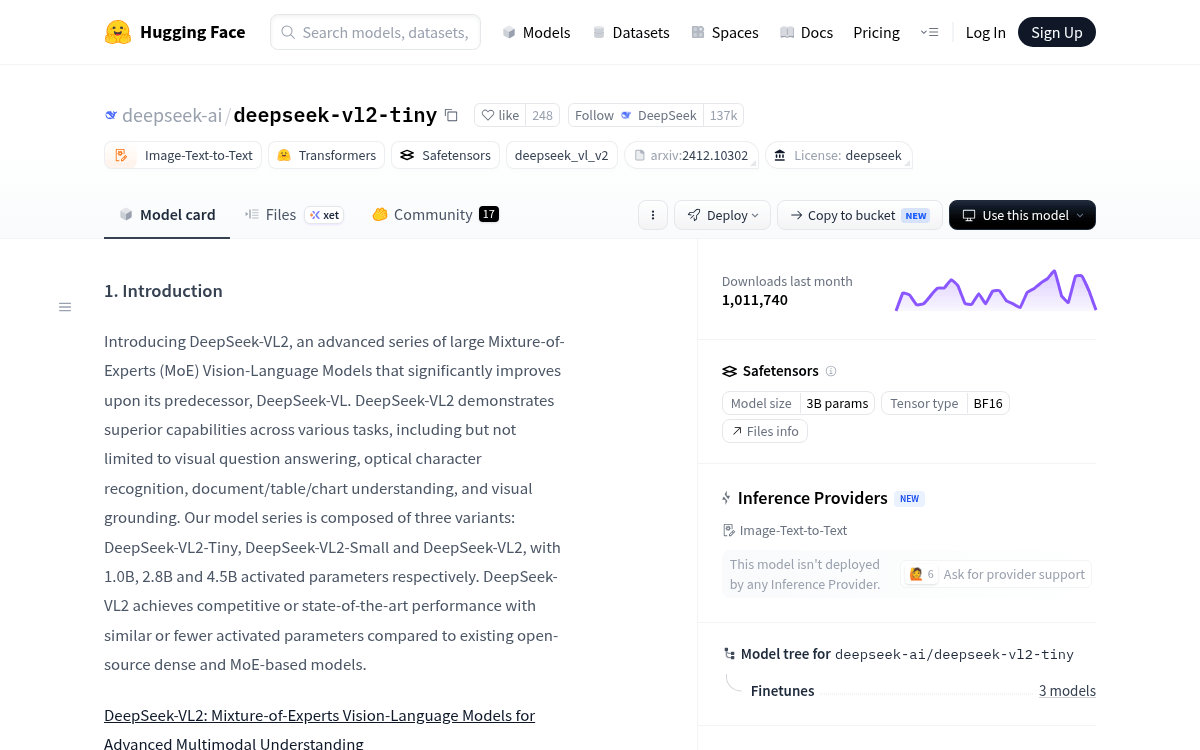
- DeepSeek-VL2-Tiny is a 1B activated-parameter vision-language model using Mixture-of-Experts, free and open-source on Hugging Face.
- It scores 809 on OCRBench, beating GPT-4V (645) and GPT-4o (736) despite being a tiny open-source model.
- Two key innovations: dynamic image tiling for high-res inputs and Multi-head Latent Attention for efficient KV-cache compression.
- Visual grounding is a new capability — the model can output bounding box coordinates for objects described in natural language.
- Runs in ~10GB VRAM; supports commercial use under the DeepSeek Model License with MIT-licensed code.
- Limitations include restricted multi-image context, English/Chinese-only OCR, and weaker reasoning depth vs. larger variants.
DeepSeek-VL2-Tiny is the smallest member of DeepSeek's second-generation vision-language model family, and it punches well above its weight class. With only 1 billion activated parameters, it outperforms several models that activate 2x more compute on key benchmarks, making it one of the most efficient open-source vision-language models available today.
One model, three sizes
The DeepSeek-VL2 series comes in three variants: Tiny, Small, and the full model, with 1.0B, 2.8B, and 4.5B activated parameters respectively. The key word is activated. DeepSeek-VL2-Tiny activates 1.0 billion parameters total, with the base language model activating just 0.57 billion out of a total of 3 billion parameters. This is the magic of Mixture-of-Experts (MoE): a large pool of specialized sub-networks exists, but only a small fraction fires for any given input, keeping inference fast and cheap.
The main difference between DeepSeek-VL2-Tiny, DeepSeek-VL2-Small, and DeepSeek-VL2 is the base LLM , with each variant scaling up the underlying language backbone while sharing the same vision encoder and architectural innovations.
Two key upgrades under the hood
DeepSeek-VL2 significantly improves upon its predecessor through two key upgrades: a dynamic tiling vision encoding strategy designed for processing high-resolution images with different aspect ratios, and a DeepSeekMoE language model with the Multi-head Latent Attention (MLA) mechanism, which compresses the Key-Value cache into latent vectors to enable efficient inference and high throughput.
Let's break those down:
- Dynamic tiling: Instead of squishing every image into a fixed resolution, the model slices high-res images into tiles of 384x384 pixels and processes each tile through a shared vision encoder (SigLIP-SO400M). It supports dynamic tiling for up to 2 images and implements direct padding for 3 or more images at 384x384 resolution. This means tall receipts, wide charts, and square photos all get processed at their natural shape.
- Multi-head Latent Attention (MLA): Standard attention mechanisms store large key-value caches that grow with context length, which is expensive. MLA compresses those caches into compact latent vectors, dramatically cutting memory usage and boosting throughput during inference.