
DeepSeek-V3.1 Doubles Agent Coding Scores and Merges Reasoning Into One Model
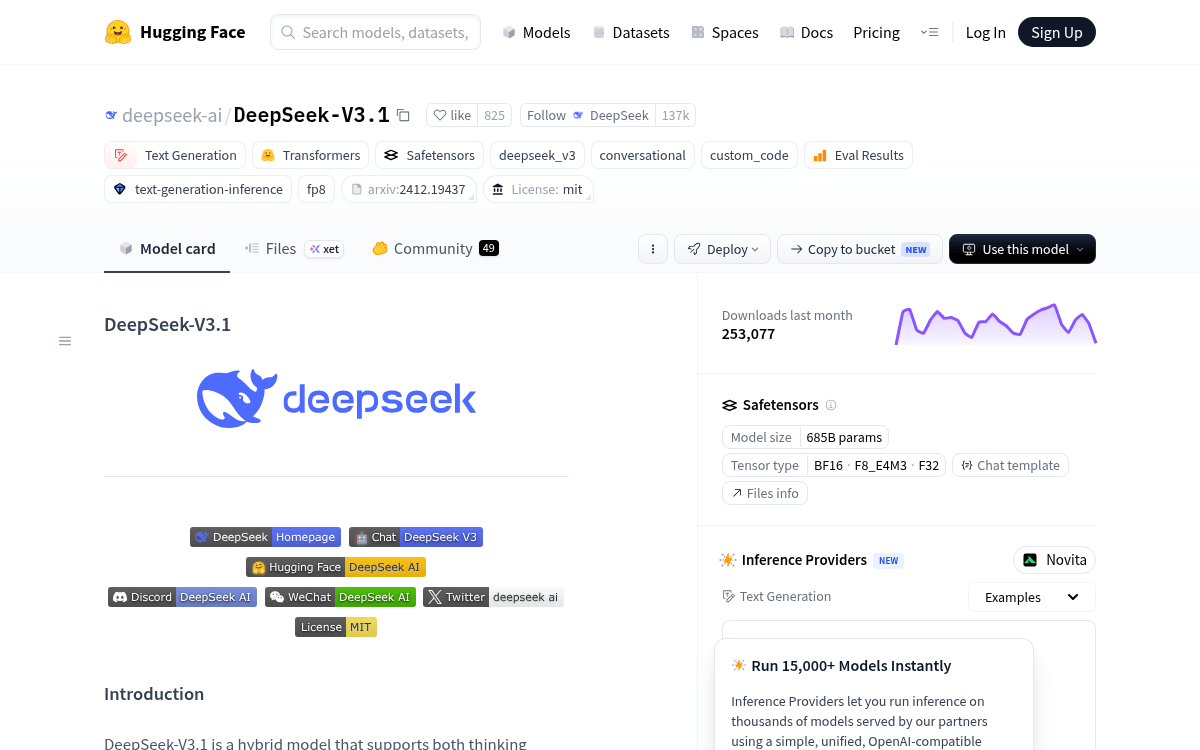
DeepSeek-V3.1 merges thinking and non-thinking modes into one 671B open-weight model, with major agentic coding and search improvements
Takeaways
- Hybrid modes: A single 671B model switches between fast non-thinking and chain-of-thought reasoning via chat template, replacing two separate model families.
- Agentic leap: SWE-bench Verified jumps to 66.0% (from 45.4% in V3-0324), nearly doubling multilingual SWE-bench to 54.5%.
- Faster reasoning: V3.1-Think matches DeepSeek-R1-0528 quality while responding faster, with AIME 2024 at 93.1%.
- Open weights, MIT license: Both base and chat weights are on Hugging Face, compatible with vLLM and SGLang out of the box.
- Long-context training: Two-phase extension to 128K context: 630B tokens at 32K, then 209B tokens at 128K, a 10x increase over V3.
- No multimodal support: V3.1 is text-only; vision and grounded tasks are its weakest category.
DeepSeek-V3.1 is out, and it is a meaningful step up from the V3 line. The headline feature is a single model that can switch between a fast, direct-answer mode and a slower, chain-of-thought reasoning mode, just by changing the chat template. But the deeper story is what happened to its agentic capabilities: tool use, code agents, and search agents all got a substantial post-training overhaul that pushed V3.1 well past its predecessors on real-world software engineering benchmarks.
One model, two brains
Previous DeepSeek releases split reasoning and non-reasoning into separate model families. V3.1 collapses that into a single hybrid architecture that supports both thinking and non-thinking modes, delivering faster responses and stronger tool usage for intelligent agents. The switch is a one-line change to the chat template: prepend <think> to activate reasoning mode, or </think> to skip it entirely.
In thinking mode, V3.1 reaches answers in significantly less time compared to DeepSeek-R1-0528, while post-training optimization gives the model major improvements in tool usage and intelligent agent tasks. That is a notable claim: comparable answer quality to a dedicated reasoning model, but faster. The efficiency gain comes from the model learning to reason more concisely rather than generating sprawling chains of thought.
The architecture under the hood
With 671 billion total parameters but only 37 billion activated per token, V3.1 uses a Mixture-of-Experts (MoE) design to achieve high performance with reduced computational cost. MoE works by routing each token through a small subset of specialized sub-networks ("experts") rather than the entire model, keeping inference costs manageable despite the enormous total parameter count.