
Liquid AI's LFM2-24B Runs a 24B Model on a Consumer Laptop
Liquid AI's largest LFM2 model packs 24B parameters, activates just 2.3B per token, and fits in 32GB of RAM on a laptop.
Takeaways
- LFM2-24B-A2B is a 24B MoE with only 2.3B active parameters per token
- Hybrid architecture: gated short convolutions plus Grouped Query Attention in a 3:1 ratio
- Fits in 32GB RAM, runs at 112 tok/s on AMD CPU and 293 tok/s on H100
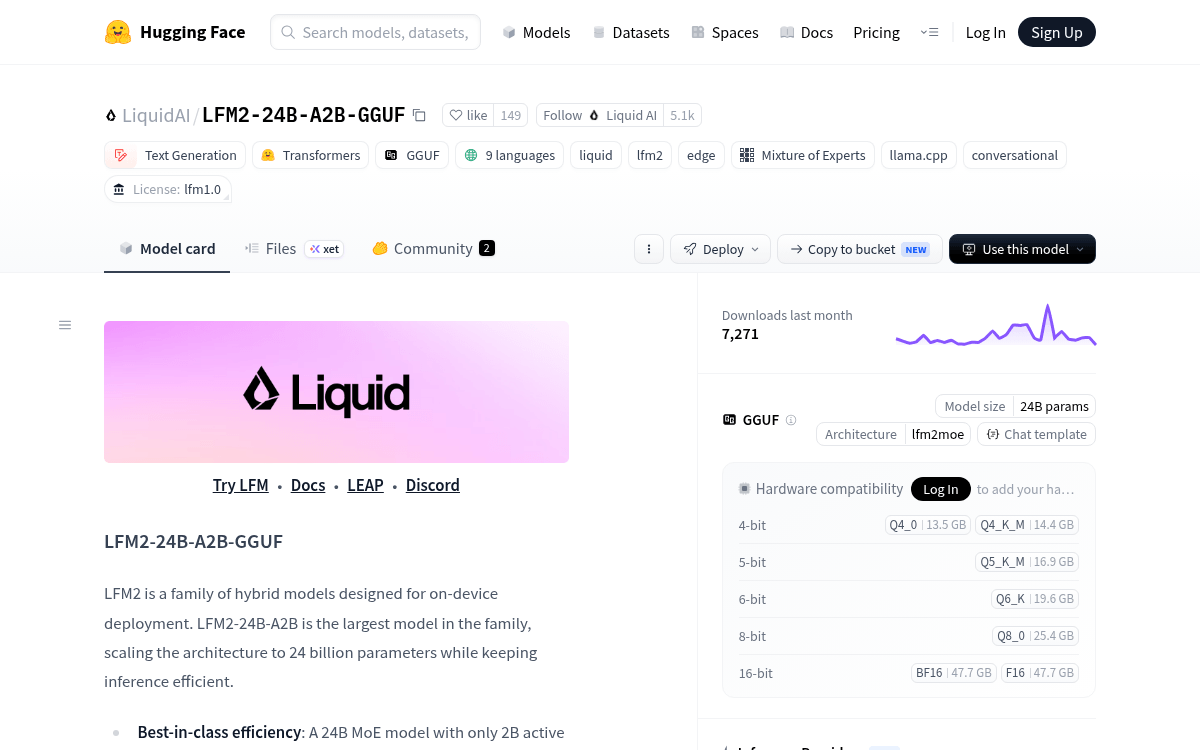
- 128K context, nine languages, GGUF quantizations from 13.5GB to 47.7GB
- Cloud pricing on OpenRouter is $0.03 input and $0.12 output per million tokens
- Day-zero support in llama.cpp, vLLM, SGLang, Ollama, LM Studio, and Nexa AI
Liquid AI just closed out its LFM2 family with the biggest sibling yet: a 24 billion parameter Mixture of Experts model that only fires 2.3 billion parameters per token, small enough to run comfortably on a consumer laptop with 32GB of RAM. LFM2-24B-A2B is open-weight, ships with day-one support for llama.cpp, vLLM, and SGLang, and comes with GGUF quantizations ranging from 13.5GB up to the full 47.7GB BF16 checkpoint.
Rather than chasing frontier scores with dense transformers that need a datacenter, Liquid is betting that a well-designed sparse hybrid can deliver competitive quality on hardware you already own. The model targets 32GB of RAM, making it deployable across cloud and edge environments, including consumer laptops and desktops with integrated GPUs and dedicated NPUs.
Convolutions doing most of the heavy lifting
The interesting part is the architecture. In a traditional Transformer, every layer uses Softmax Attention, which scales quadratically with sequence length, leading to massive KV caches that devour VRAM. LFM2 sidesteps that by mixing two block types in a fixed ratio.
- Base layers are efficient gated short convolution blocks, while the attention layers use Grouped Query Attention.
- The mix is roughly three convolution blocks for every one attention block, so most layers run in linear time.
- By interspersing a small number of GQA blocks with a majority of gated convolution layers, the model retains the high-resolution retrieval and reasoning of a Transformer while keeping the fast prefill and low memory footprint of a linear-complexity model.