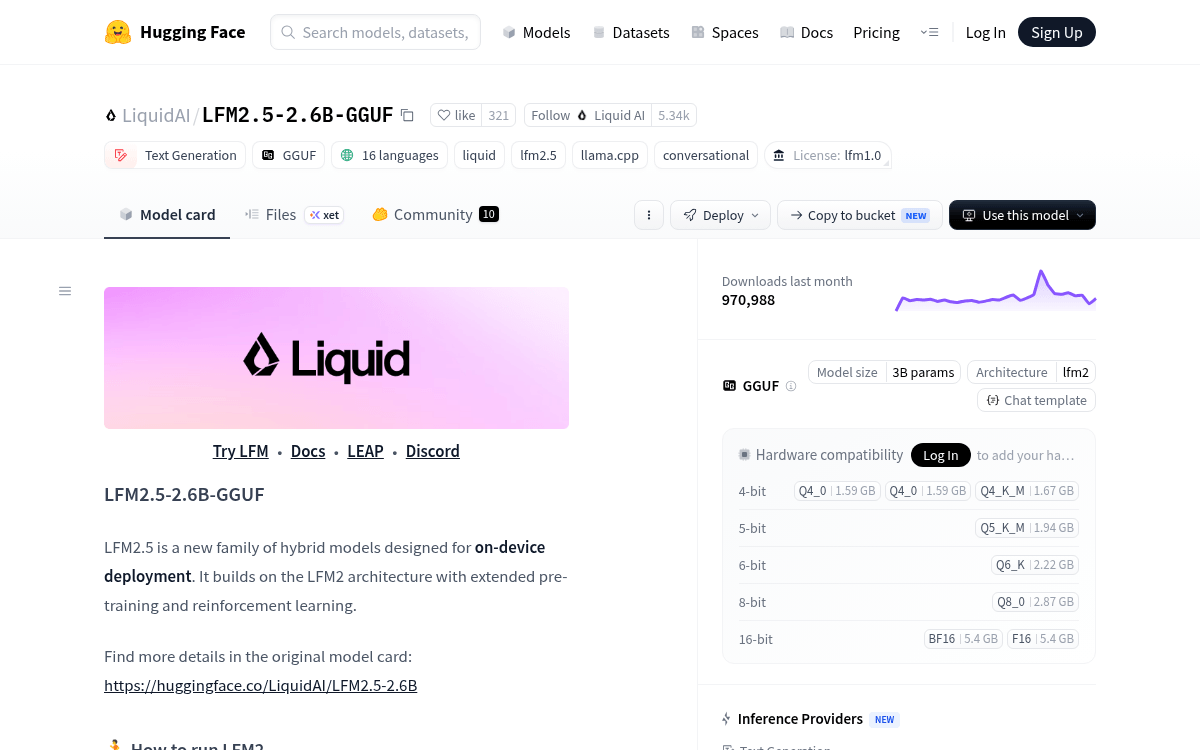
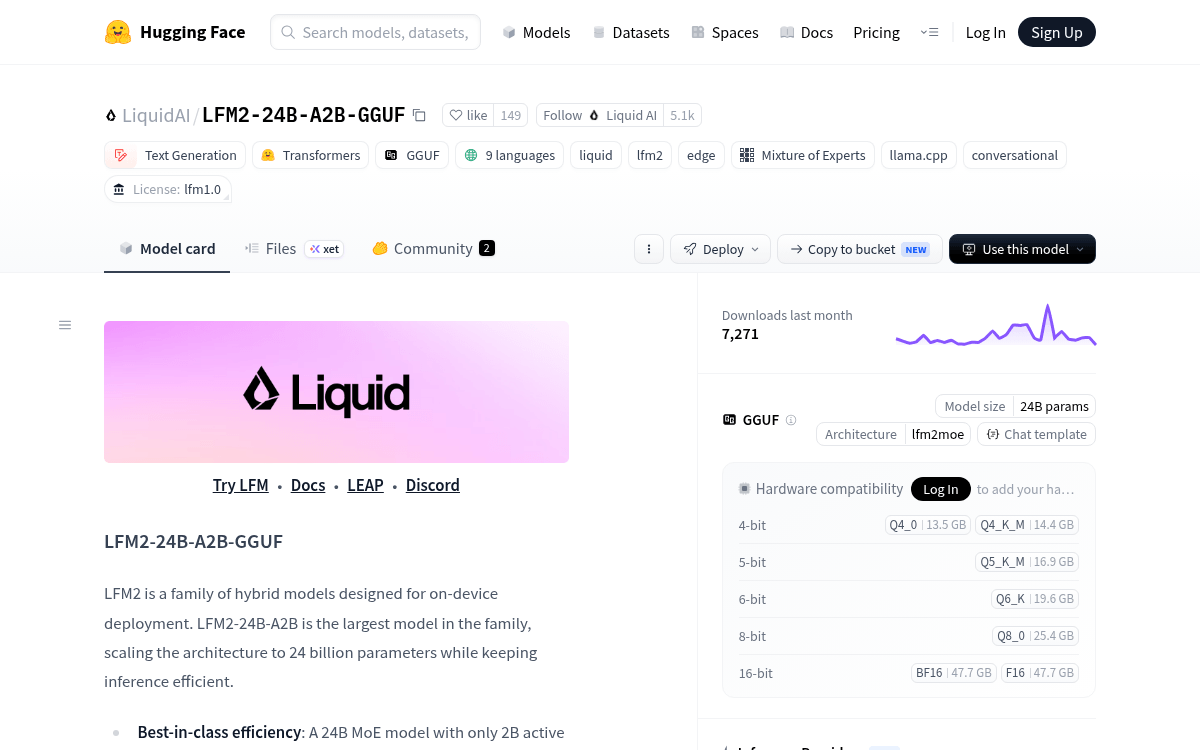
MIT spinout building Liquid Foundation Models (LFMs), a non-transformer architecture combining gated short convolutions and grouped-query attention, unified under a linear input-varying (LIV) operator framework. Architecture search is hardware-in-the-loop via the STAR engine. LFM2 models (350M to 2.6B parameters) target CPU, GPU, and NPU inference on-device, trained on 10T tokens.
Liquid AI's d1.2 and d1.2-ultra top the Artificial Analysis Decision Index with audio input, five new structured output tasks, and near-perfect calibration.
Liquid AI's 74M-parameter streaming audio codec encodes at 361x real time on a single CPU thread, beating Mimi, X-Codec 2, and NanoCodec on speech generation quality.
Liquid AI's new multimodal decision model tops the Artificial Analysis Decision Index, returns calibrated probabilities with zero generated tokens, and costs $0.042 per million input tokens.
Liquid AI's d1-3B skips token generation entirely, returning calibrated classifications and scores in a single forward pass, with multimodal input on edge hardware.
Liquid AI's zero-output-token decision model lands on Vercel's AI Gateway, giving developers a cheap drop-in for classification, routing, and scoring work.
Liquid AI's new d1 model returns typed decisions with calibrated probabilities in one call, generating zero output tokens for classification and routing.
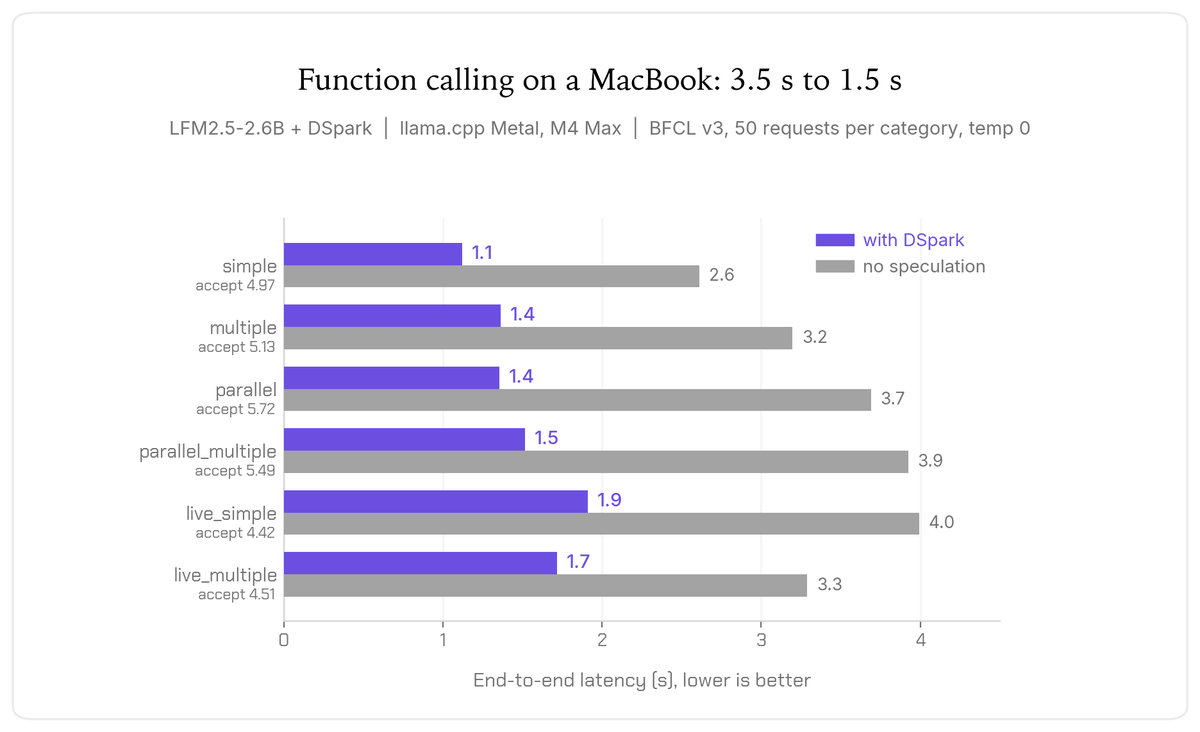
Liquid AI's new DSpark drafter brings speculative decoding to LFM2.5-VL-3B, delivering up to 3.13x faster decoding on Apple Silicon with lossless output.
Liquid AI and Artificial Analysis release an open-source suite that measures model quality, speed, latency, and memory across real phones, laptops, and embedded hardware.
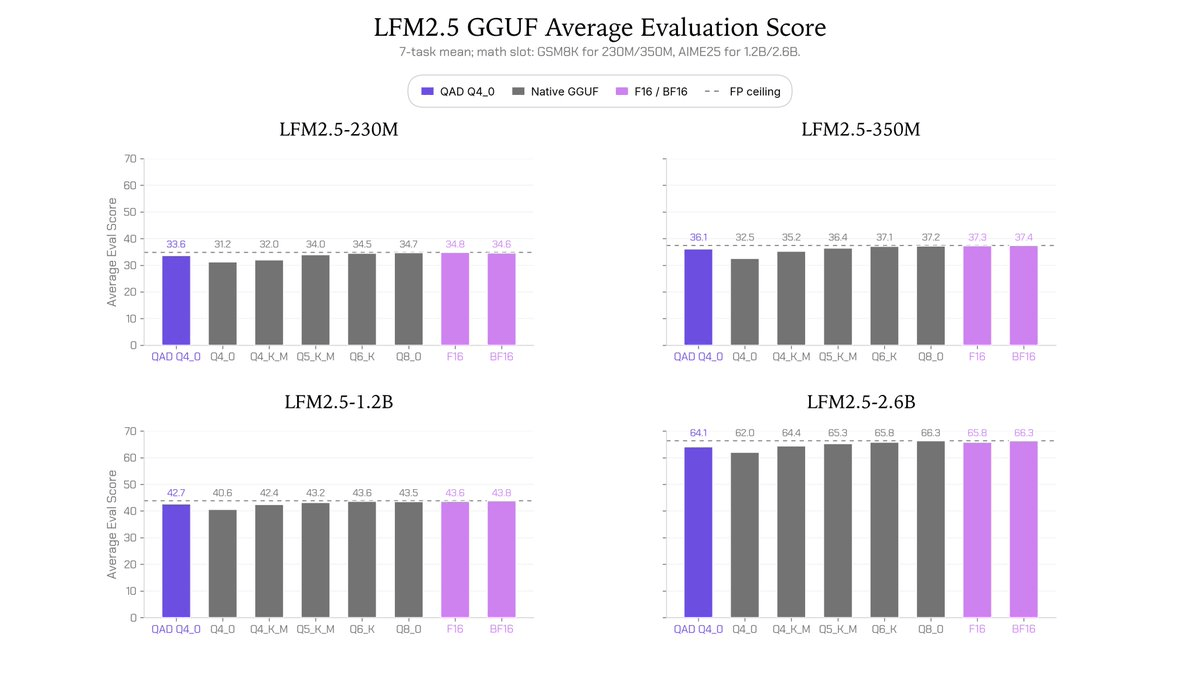
Liquid AI released 4-bit LFM2.5 checkpoints trained with quantization-aware distillation, recovering 97% of full-precision quality with no runtime changes.
Liquid AI open-sourced toktoktok, a production-grade BPE tokenizer trainer written entirely by coding agents inside an iteration loop against real data.
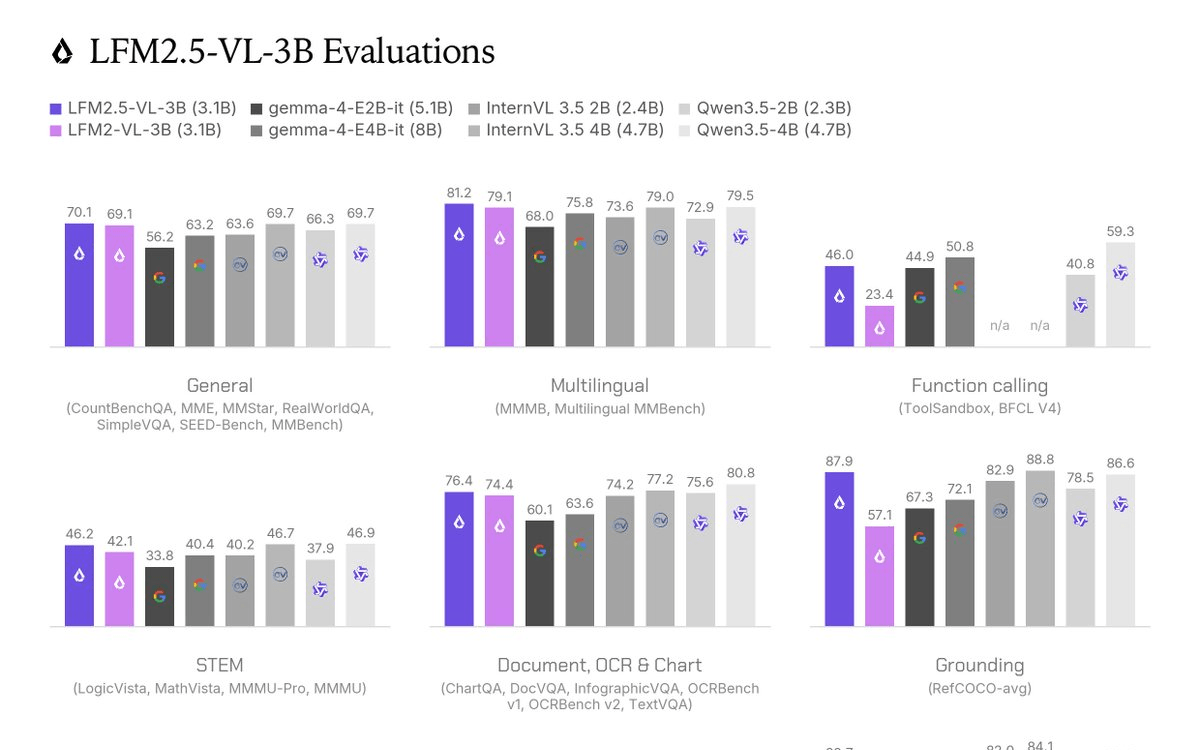
Liquid AI's 3B vision-language model beats models up to 2.6x its size on screen understanding and grounding, running on-device at 20 tokens/s on a phone.
Liquid AI and MacPaw are co-building a full on-device AI stack for Mac, with LFMs, local inference, and persistent memory — opening up to thousands of Setapp developers
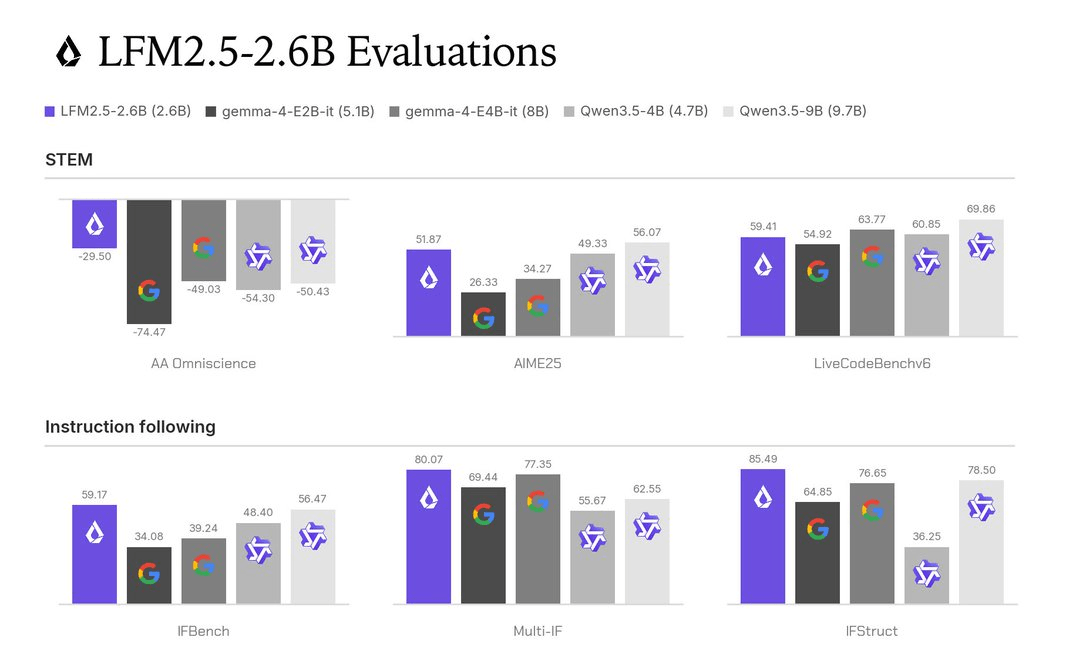
Liquid AI's 2.6B parameter agent model runs entirely on-device at 220 tokens per second, fits in 2.5 GB, and beats models four times its size on tool use.
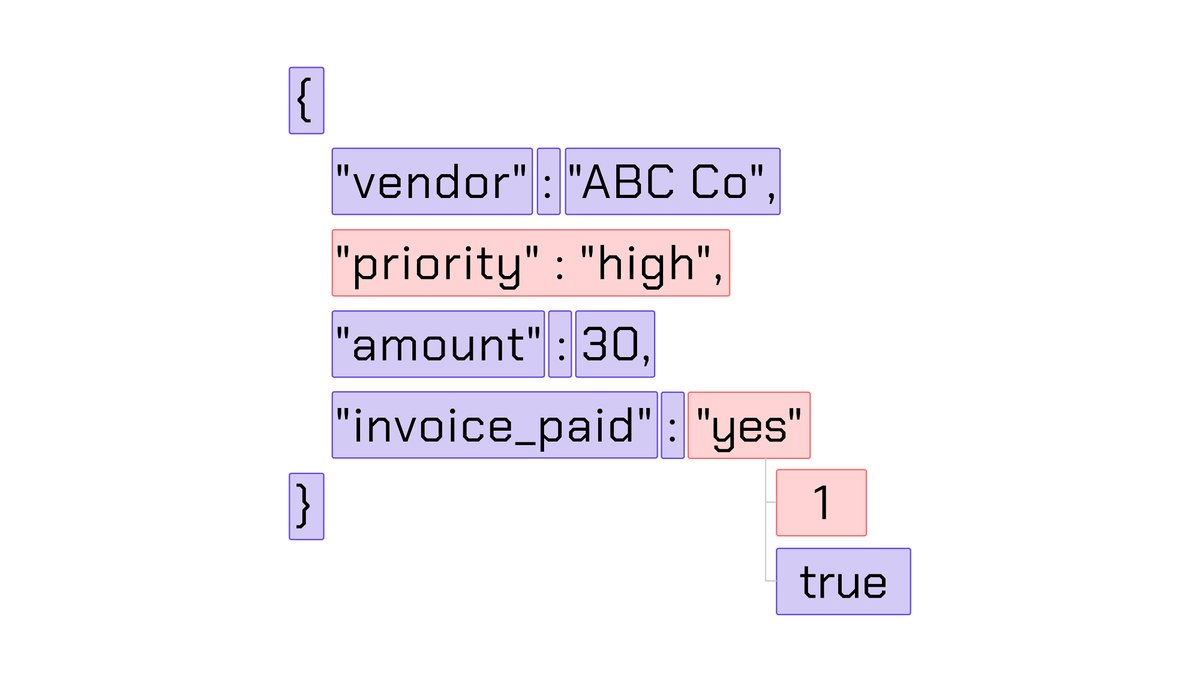
Liquid AI's new open benchmark tests structured output compliance under realistic, messy prompts — and a 350M model trained on it beats models 10x its size
Ion Stoica, the Berkeley professor behind Databricks, Anyscale, and Chatbot Arena, joins Liquid AI's advisory council to help scale its hardware-aware, on-device AI platform.
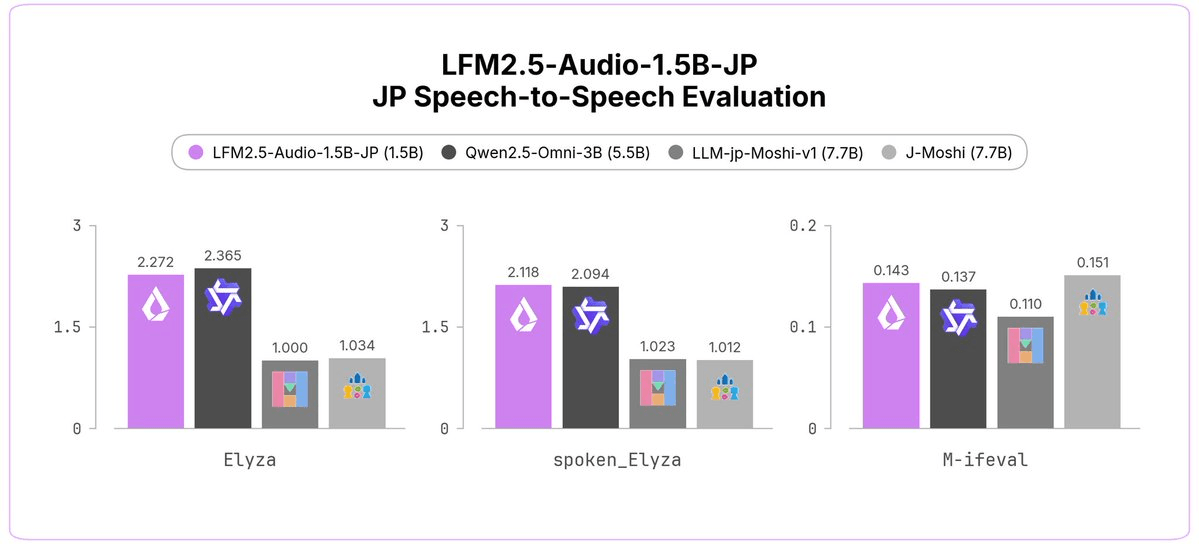
Liquid AI releases two sub-2B Japanese models: a first-of-its-kind end-to-end speech model and an updated language model that tops the sub-2B Japanese benchmark charts.
Liquid AI releases two sub-2B Japanese models: a state-of-the-art text chat model and the first end-to-end Japanese speech-to-speech model at this scale
Liquid AI's LFM2.5-8B-A1B packs a full agentic reasoning loop into 1.5B active parameters, running faster than any rival on consumer CPUs and a single H100.